Ryan Frigillana Reconsiders the American Dream at Silver Eye
Ryan Frigillana's Tears, Blood, Sweat, at Pittsburgh's Silver Eye Center for Photography through November 7, 2026, brings Balikbayan, PATMOS and Manong together for the first time.
Ryan Frigillana's exhibition Tears, Blood, Sweat runs at Pittsburgh's Silver Eye Center for Photography through November 7, 2026. Co-curated by Helen Trompeteler and Leo Hsu, it brings three interconnected bodies of work — Balikbayan, PATMOS and Manong — into conversation for the first time, using displacement, belonging and memory to reconsider the American Dream through intertwined histories of land, labor and citizenship.
Frigillana, born in Iligan City, Philippines and based between Long Island, New York, and Southaven, Mississippi, draws on his experience as a first-generation Filipino American. He weaves personal and family histories into broader sociopolitical narratives, combining photographs with reworked print media, family and public archives, and biblical illustrations from his Adventist upbringing. He approaches photography, he says, "as a form of evidence, allegory, and prayer: as record, symbol, and confession."
How does the family album become the work?
Balikbayan, which opens the exhibition, explores the artist's desire to return to the Philippines through studio still lifes, collage and tableau. In The House They Built, an archival photograph of his grandparents becomes the foundation of a deck of cards, setting family love against stability and precarity.
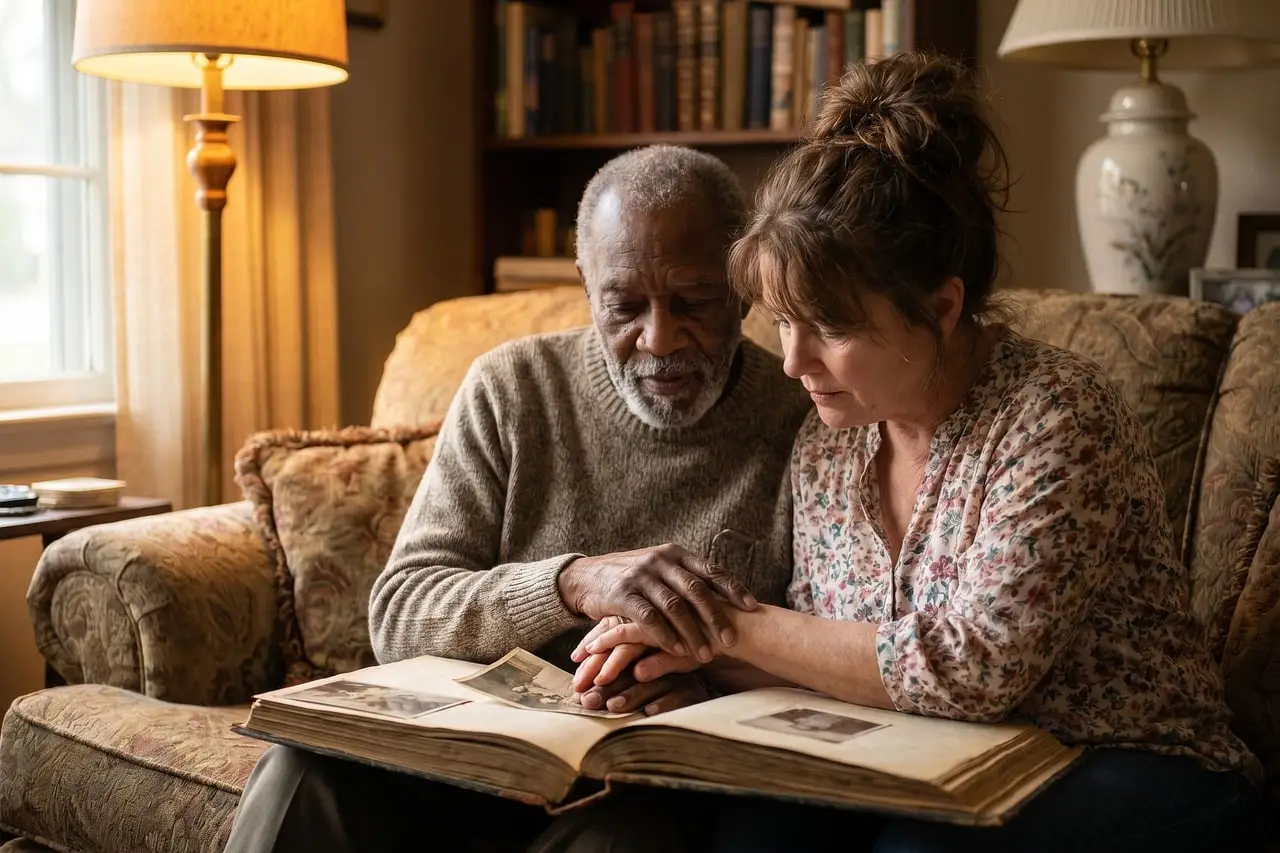
"The family album was my introduction to photography," Frigillana told Trompeteler in an interview published with the exhibition. "Most people engage with the family album in a book-like form, and that's how I came to know of photography's utility from the way my family used it."
The project inverted his usual method. After years working in a traditional documentary mode, making images intuitively in the field with his family, he rarely staged images and "felt that staging or intervening was a big no-no." Balikbayan led with process instead — props, staging, the physicality of tangible family pictures. The House They Built itself was spontaneous: after playing cards with his niece and looking at photographs from the Philippines, he built a small house structure from the pile on the picnic tablecloth. "By having fun, and then allowing yourself to just explore things freely, maybe from there things can escalate into more serious questions," he said.
In Family Tree (after Rockwell), Frigillana layers Norman Rockwell's The Graduate — originally an illustration for The Saturday Evening Post — with family photographs on a lightbox, his hand and loupe visible on the surface. The lightbox does double duty: it shows the physical layering of objects while alluding to scrutiny, "as if you were examining something scientifically on a table." It feeds a two-pronged notion of hypervisibility and invisibility he associates with coming to this country — feeling alienated and unseen, yet hyper-conscious of how you present yourself.
The Rockwell source is autobiographical. The previous owners of his family's Long Island home left behind a trove of 1960s and 1970s books — Rockwell volumes, illustrated encyclopedias for boys and girls — that he "trained my eye on as a young child." Using those images, he said, was "a way for me to impose my own family's presence into this storied culture of what America could or should be."
What does invisibility do across the show?
Trompeteler points to a running tension between presence and absence. In Kung Ano Ang Nagpapakain Sa Iyo (What Feeds You), his mother first appears through gestures of care shown in shadow. In Memories of a Body, only the indentations her body leaves on the couch remain. In PATMOS, the president is never made fully visible.
"I sometimes make things invisible to protect my family," Frigillana said. Omission can amplify presence through imagination, or shield it. With Trump — "this larger-than-life figure. We all know what he looks like" — he focused instead on "how this person's presence makes you feel and on the gutgural reaction to the images."
How does the show handle Filipino labor history?
Manong began with Frigillana repeatedly photographing his father tending his garden — initially without knowing why. "The camera became a bridge for our relationship," he said. The accumulation led to broader questions about agrarian labor and Filipinos in America, which took him to the Farm Security Administration images in the Library of Congress archives and a Dorothea Lange photograph of migrant workers in California, recontextualized at a pivotal point in the exhibition.
Those archival figures, he felt, "had essentially been flattened into silhouettes, one homogenous idea of migrant labor." Unable to fill the gaps through research alone, he turned to his mother's story — a nurse who arrived in the late 1980s — paralleling the Manong generation who came in the early 1930s to work the fields, and probing the continuities in the extraction of labor. The project remains ongoing.
What does PATMOS do to news imagery?
PATMOS breaks screen captures made during the 2020 and 2024 presidential elections down into pixels and halftone dots, challenging their authority. A book version used full-bleed pages in large format to recreate the feeling of being "swallowed by those images and totally engulfed." The gallery installation amplifies that: "It's almost like an assault on the senses," he said, with the scale of the vinyl pieces meant to make viewers consider their proximity to images in their lives. "The closer you get, the more you understand how images work, and the more you're able to think about the motives behind them."
Biblical imagery enters the project as a warning. Raised religious, he was "trained on these images of utopia and heaven" alongside images of violence and fear — a duality he maps onto American idealism "sold to us as an ideal, a utopia" with justice and equality as selling points he doesn't see reflected in reality. "I think the point of PATMOS for me is that politicians won't save you," he said. "The real salvation lies in the people in your communities... and your families."
Bookending the exhibition with Manong and Balikbayan, he hopes visitors leave sensing that family and community are larger than what PATMOS inflicts — "our utopia, our safe haven."
Where is the practice heading?
Bringing the three projects together, Frigillana says, hasn't changed how he sees each individually, but prompted reflection on his practice as a whole: "I'm thinking more about building on a language and a way of questioning." That clarity, he suggests, will guide future projects still in progress.
His institutional record is substantial: exhibitions at Light Work, Houston Center for Photography, Blue Sky Oregon Center for the Photographic Arts and Candela Photographic Arts; an NYSCA/NYFA Artist Fellowship in Photography (2025); the JGS Fellowship for Photography (2025, 2021); the Aperture & Google Creator Labs Photo Fund (2023); the En Foco Photography Fellowship (2023); residencies through the Penumbra Workspace Program (2024) and the Penumbra Foundation Risograph Print & Publication Residency (2021). He holds a BFA in Photography and Related Media (2020) from the Fashion Institute of Technology, and his work has appeared in Aperture, Der Greif, Musée magazine and The New Yorker, among others.
Silver Eye, the Pittsburgh region's only nonprofit dedicated exclusively to contemporary photography, supports emerging, mid-career and under-recognized artists through exhibitions and its education center, The Lab @ Silver Eye. With Tears, Blood, Sweat, Frigillana signals a practice consolidating its language — and an artist still following his questions.
Key points
- Tears, Blood, Sweat runs at Silver Eye Center for Photography, Pittsburgh, through November 7, 2026
- Co-curated by Helen Trompeteler and Leo Hsu, it unites three bodies of work for the first time
- Frigillana won the NYSCA/NYFA Artist Fellowship in Photography in 2025 and the JGS Fellowship in 2025 and 2021
- PATMOS draws on screen captures from the 2020 and 2024 presidential elections
- Frigillana holds a 2020 BFA from the Fashion Institute of Technology
Original: ryanfrigillana.com
Marcus Bennett
Show full bio
Correspondent covering companies, deals and strategy in Photography exhibitions, photographers, photo books, festivals and awards at Lens Gazette.