Anthony McCall's Solid Light Returns: Storms, Drones and a 1973 Classic
Anthony McCall's seventh solo show at Sean Kelly spans 1973 to 2026, pairing Line Describing a Cone with new digital works scored by thunderstorms and drones.
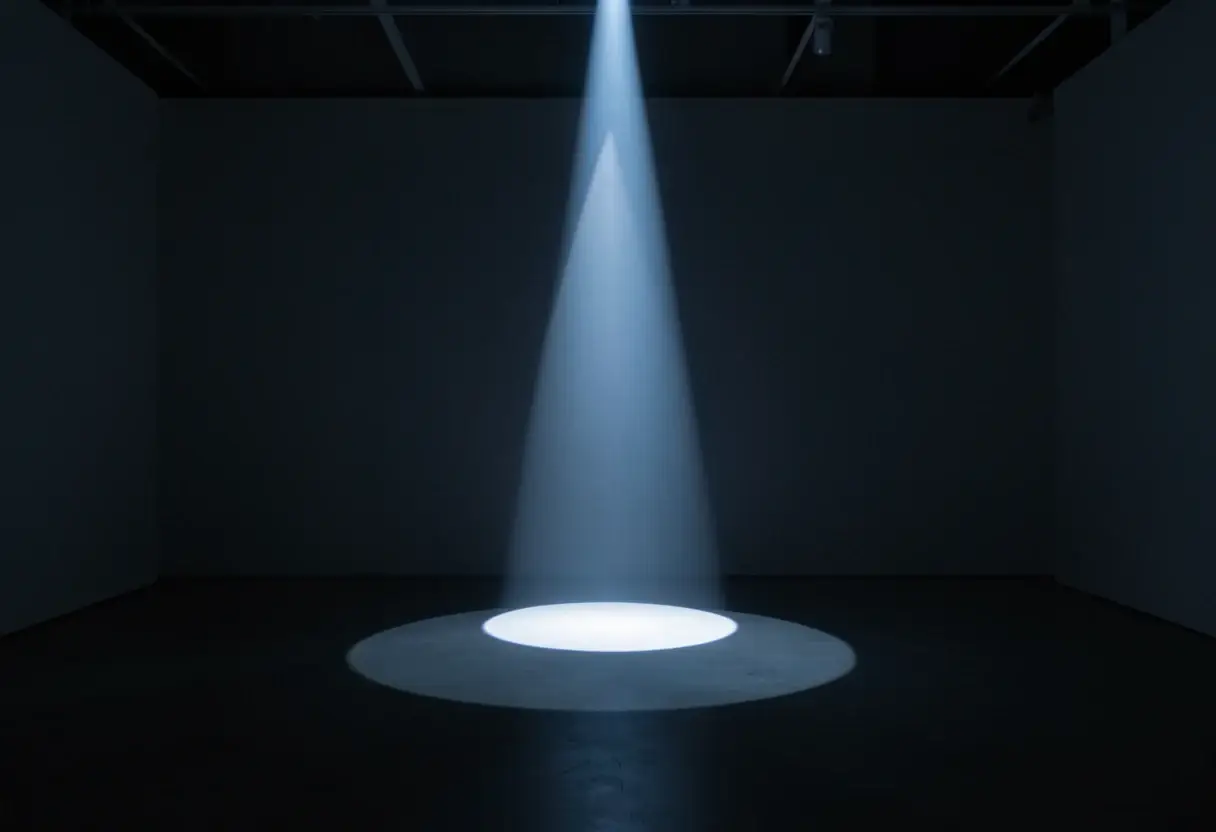
Anthony McCall is staging his seventh solo exhibition at Sean Kelly in Chelsea this fall, bringing together works from 1973, 2020 and 2026 — and visitors can finally walk through the beams rather than squint at them on a screen. The show marks the first in-person encounter, for many, with his "solid light" installations in a pitch-dark room where an obtrusive hum drones at the periphery. Arresting. Existential and scientific at once.
McCall's decades-long CV includes the Centre Pompidou in Paris (2026), the Guggenheim in Bilbao (2024), Tate Modern in London (2024) and Pioneer Works in New York (2018). At the gallery entrance hangs the schematic for his breakthrough work, Line Describing a Cone (1973). The famous story says he drew it mid-Atlantic, on the boat from England to America. Not quite.
"No, that's a bit of an old wives' tale," McCall says. "But it's true that by the time I arrived in this country on that boat trip, I had gotten the idea of a beam as volume."
Where did the solid light films come from?
Most accounts of McCall start with Landscape for Fire (1972), a seven-minute film of performers dressed in white lighting pots of gasoline in tight choreography, arranged in a grid across a flat plane at dusk. "My early work as an artist began with performance events conceived for a camera," he says. Filming the outdoor performance pulled him into editing, and toward artist filmmakers, until he found himself "increasingly struck by the idea of rendering down a film to its most basic components."
That reduction produced Line Describing a Cone, his first solid light film and the piece that made his name. The idea, he says, "was to reverse the convention of viewing a film by facing a flat screen, turning instead toward a projector and a volumetric form in space."
Then came a 20-year intermission. McCall worked as a graphic designer — "I made a living," he says flatly — running a studio and designing art catalogs until the Whitney Museum's 2001 exhibition Into the Light: The Projected Image in American Art, 1964–1977 revived his career. There, Line Describing a Cone hung alongside Yoko Ono's Sky TV (1966), Paul Sharits' Shutter Interface (1975) and Andy Warhol's Lupe (1966). The piece fit a material puzzle in the understanding of 1970s filmmaking — a self-reflection on a medium in flux. The Whitney's iteration ran in modern format, minus the tobacco smoke and cobwebs that hazed the original.
What do the installations actually look like?
Viewed orthographically, Line Describing a Cone gives little away. Like looking at a stitched sweater from the inside, the circle on the screen is a handless clock, looping once every 30 minutes. On the projector's side, that circle becomes a volumetric beam. Visitors are encouraged to put their backs to the screen and study the object-ness of the light itself, flecked by remnants of the original analog print.
The current work has moved to digital projection, which lets McCall build vertical beams — the premise of Skylight (2020). Shown at the Centre Pompidou for Nuit Blanche this June after six years of iteration, the piece draws viewers to a pedestal topped by a cone of light. Its face is a composite form inside a circle, illuminating ridges and edges intercut with flashes, with the sound of a rolling thunderstorm thrumming underneath. McCall works frequently with sound producer and composer David Grubbs; Skylight aimed to synthetically produce a storm.
What does McCall's work change for cinema?
In his own framing, the pieces sit between categories. "It's that idea of a Venn diagram with overlapping properties: sculpture is one, cinema is another, and motion as well," he says. "They become pieces that are not really one thing or another, but something in between."
If the 1973 pieces were static, they have grown steadily more cinematic. Swarm (2026) projects two oscillating circles scored with the sound of drones — McCall's depiction of 21st-century violence, taking in the war in Ukraine and the climate crisis. His read of the storm imagery is blunt: "A slowly moving thunderstorm can easily be construed — or misconstrued — as an explosive device, a bomb."
With Sean Kelly mounting show number seven and the Pompidou date behind him, McCall's in-between cinema keeps moving from the flat screen into the room — and, on this evidence, deeper into sound and dread.
Key points
- Anthony McCall is staging his seventh solo exhibition at Sean Kelly in Chelsea, spanning works from 1973, 2020 and 2026.
- Line Describing a Cone (1973) was revived by the Whitney Museum's 2001 show Into the Light, ending a 20-year design intermission.
- Skylight (2020) was shown at the Centre Pompidou for Nuit Blanche this June after six years of iteration.
- Swarm (2026) pairs two oscillating circles with drone sounds, addressing the war in Ukraine and the climate crisis.
Source: Google News: photography exhibition
Marcus Bennett
Show full bio
Correspondent covering companies, deals and strategy in Photography exhibitions, photographers, photo books, festivals and awards at Lens Gazette.