Dala Nasser Wins Inaugural Frieze Abu Dhabi Award With Shrine Work
Dala Nasser's Qubbat Duris, the inaugural Frieze Abu Dhabi Artist Award commission, turns charcoal rubbings of an airstrike-damaged Lebanese shrine into an atrium installation.
Lebanese artist Dala Nasser has won the inaugural Frieze Abu Dhabi Artist Award with an installation built around Qubbat Duris, a 13th-century Muslim shrine near Baalbek that Israeli airstrikes damaged as recently as 15 October 2024. Her work, titled after the shrine, will stand in the atrium of the fair at Manarat Al Saadiyat from 19 to 22 November.
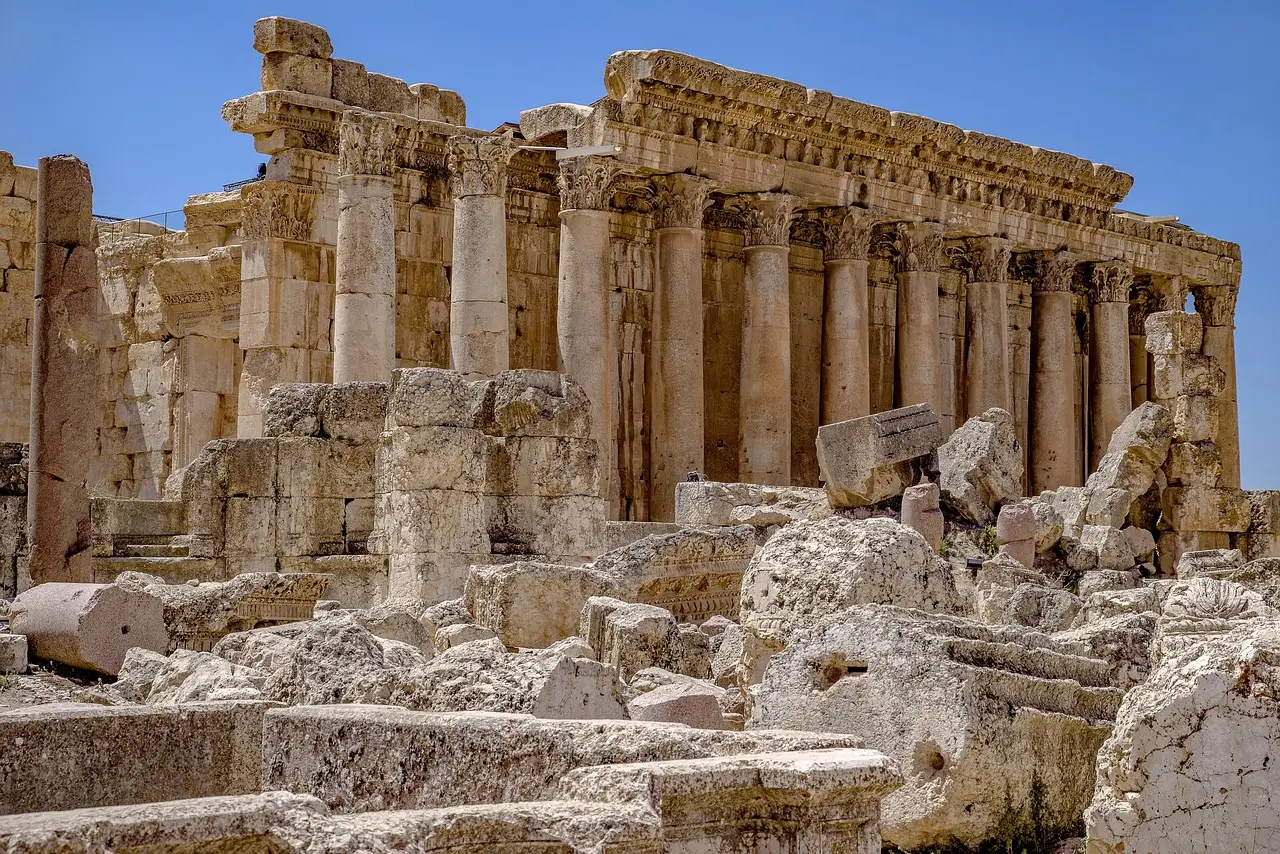
The site itself is an archaeological hybrid. Granite columns lifted from Baalbek's Temple of Jupiter support limestone sarcophagi taken from a necropolis — two Roman ruins repurposed into Islamic devotional architecture. Nasser's installation echoes that assemblage: a timber frame evoking the shrine's structure, draped with fabrics carrying charcoal rubbings of the remaining ruins and painted with ash, raw clay and terracotta.
She is not the first artist to look at Qubbat Duris. That lineage, she argues, is the problem. "The site has already been extensively imagined and reimagined in art historical painting," Nasser told The Art Newspaper. "From Orientalist depictions to the backdrop to one of Gertrude Bell's most circulated photographs, taken in costume on horseback." Bell's staged image, in other words, used the shrine as scenery. Nasser's frottage method does the opposite: it presses the site's own surfaces into the work.
What does the rubbing technique actually record?
Nasser is best known for her archaeological frottage paintings, made directly on the surfaces of endangered historical sites. The practice treats the artist as a recorder rather than an inventor — someone who reproduces and bears witness rather than composes freely. It is documentation as much as image-making, and documentation is the point. Lebanon's cultural artefacts face genuine risk of erasure, particularly from Israel's longstanding and continued occupation of the country. The record shows the stakes plainly: the October 2024 strike left slight damage, and during the 2006 Israel-Lebanon war an earlier Israeli airstrike dislodged one of the shrine's stones.
"I'm interested in how a place like Qubbat Duris carries physical evidence of everything it's endured, including scars of damage," Nasser says. The rubbings capture those scars alongside the carved ornament. Wear, repair and bombardment end up on the same cloth.
A correction to the Western archive
This is not her first attempt to repaint a misrepresented landscape. Adonis River (2023) and Wedding at Qana (2024) both took on places that, in her words, "loom large in historical painting but look nothing like the landscape itself in Western Asia, either overwhelmed by Orientalist tropes or painted as scenes of European countryside, betraying the artists' lack of knowledge and limits of imagination". European painters, she notes, rendered the Levant as something closer to home. Her stated aim is blunt: "I am trying to make paintings that are truthful to the landscape."
Truth, for her, also means layering. "It exists as a palimpsest from the second century AD until today, carrying all of the traces in between," she says of the shrine — Roman spolia, Muslim devotional use, war damage, and now an art-fair atrium in Abu Dhabi. Whether a commercial fair can hold all that weight is a fair question. The award at least puts the commission at the centre of the fair's architecture rather than its margins.
The inaugural prize sets a precedent. If Frieze Abu Dhabi continues to commission artists working with contested heritage at this scale, Nasser's shrine may be remembered as the template — and the test case.
Key points
- Dala Nasser wins the inaugural Frieze Abu Dhabi Artist Award for her installation Qubbat Duris.
- The shrine near Baalbek sustained slight damage from Israeli airstrikes on 15 October 2024; a 2006 strike dislodged one of its stones.
- The work shows at Manarat Al Saadiyat from 19 to 22 November.
- Qubbat Duris is a 13th-century Muslim shrine built from Roman ruins: Jupiter-temple granite columns and necropolis sarcophagi.
Source: theartnewspaper.com
Daniel Okafor
Show full bio
News editor covering companies, deals and strategy in Photography exhibitions, photographers, photo books, festivals and awards at Lens Gazette.