10,000 Photographs Carved in Basalt: Inside India's Buddhist Caves
Scholar David S. Efurd's 10,000-image Artstor archive documents 25 years inside India's rock-cut monasteries, from Ajanta's solstice alignments to living worship at Karle.
Updated
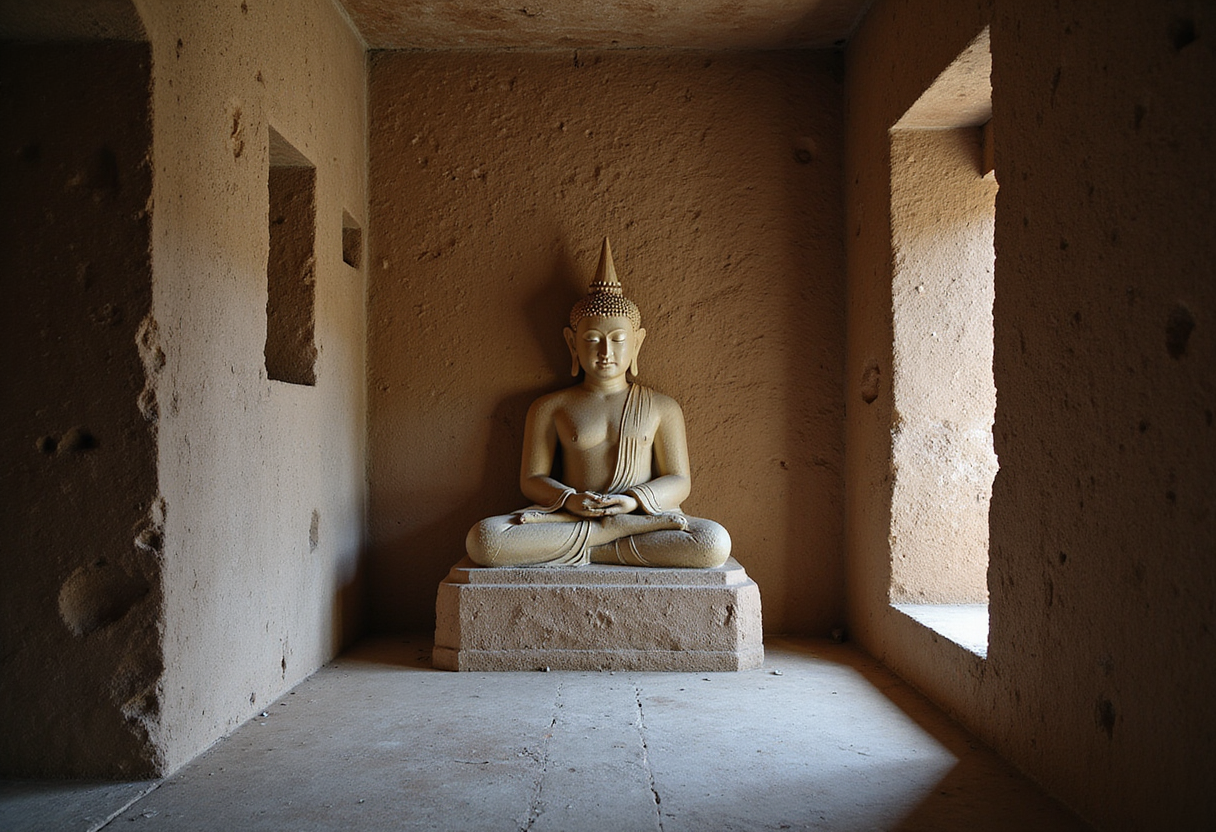
More than 10,000 photographs of over 80 rock-cut caves in western India are now publicly available through Artstor, the product of a quarter century of fieldwork by Dr. David S. Efurd, a two-time Fulbright recipient who chairs the department of art and art history at Wofford College's institutional equivalent — an associate professor and chair of art and art history. Armed with nothing more than a notebook and a handheld camera, Efurd has documented monasteries carved directly into volcanic basalt cliff faces, along with religious art, monuments, architectural details, and sacred spaces dating back to the second century BCE.
The archive spans sites from the second century BCE to the ninth century CE, including the Jain temple in cave 32 at Ellora, the great chaitya halls of Karle and Bedse, and the damaged prayer hall at Kondhane. One image shows monkeys amid the landscape at Ganesh Lena, Lenyadri; another captures worshipers inside cave 3 at Aurangabad, a site of the sixth to seventh centuries CE. Together, the photographs present these monuments not as frozen relics but as living places of religious expression and ongoing preservation.
Efurd's working method rests on what he calls "slow looking" — spending days in spaces that most visitors pass through in minutes. "Spending long periods of time in a cave, including over a number of days or during return trips, provides a means to gain deep insights about its design, layout, and spatial characteristics, as well as its decorative program," he says. Measurement matters as much as image-making: rock-cut caves are, in his framing, enormous sculpted spaces in which "deviations" from exacting straight and plumb lines "are typically invisible." His photographs, he argues, "often may serve as documentation while fulfilling aesthetic goals, including conveying through visual means the aesthetic experience of visiting the site."
The origin of the project was a chance encounter. Efurd was introduced to the caves by Walter Spink, the world's leading scholar of Ajanta, who rented a room year-round at the MTDC hotel near the caves and hosted an annual July site seminar for students. The seminar focused on the later caves of Ajanta and Ellora, but it also took Efurd to Pitalkhora, a ruined site from the second or first century BCE. "I had never heard of the place and was completely enthralled by what was left there and what the remains suggested it once was," he recalls. That was roughly 25 years ago.
The images also carry an argument about light. Spink discovered that two caves at Ajanta align with the winter solstice; each has a "caitya" window — an enormous round aperture carved into the facade — that once a year lets sunlight fall directly onto a sculpted Buddha within. At nearby Ellora, a cave with a much smaller aperture filters a narrow band of sunlight onto the Buddha's face twice a year, an achievement celebrated each March as Kirnotsav, the festival of the sun's rays. Efurd notes that in the earlier caves, the hour before sunset often yields the most dramatic effects.
His photography attends to the mundane alongside the monumental: monastic cells with rock-cut beds, modest chambers with a bench or shelf that may have served for meditation, low seats and inscriptions marking a refectory, cisterns and tanks cut into the rock that show how monks survived after the monsoon. The sites themselves were chosen for a mix of practical and religious reasons — durable basalt, shelter during the vassa monsoon retreat, and crucially, proximity to trade routes and villages that sustained the symbiotic relationship between monastic and lay communities.
The archive also records what happened to these places as Buddhism declined in India. Many sites were refurbished by Buddhists in the fourth and fifth centuries, with paintings and sculptures of Buddhas and Bodhisattvas added to previously unadorned walls. Remote sites like Ajanta were abandoned and largely forgotten; accessible ones like Karle were appropriated by Hindu communities, their halls rededicated to Brahmanical devotion, with some Buddhist images worshiped as forms in the Hindu pantheon. Efurd's photographs of Bhandara Hill show followers at a former Buddhist cave site now associated with the 17th-century Hindu saint Tukaram.
When he encounters people still living or worshipping in the caves, Efurd works as a respectful guest — sometimes invited into areas off-limits to others. On one unlocated visit, a return trip earned him entry to a locked, lower-level cave housing a colossal sculpture, whose dimensions explained its unusual entrance. "I felt very fortunate to be one of the few people allowed in to see it," he says.
Efurd believes discoveries are far from over. Isolated caves surface from time to time, and he suspects a major site remains unfound. Recently, workers removing a boulder to build steps at Ghatotkacha uncovered a carved nagaraja — a serpent king — unseen for at least half a millennium. His current Fulbright-supported research focuses on the caitya hall at Karle, where he is tracing mathematical relationships across its proportions, architectural features, and ornament; work at other early caves supports the use of similar proportional systems. Without close reading of these sites, he warns, "we risk not understanding the intent of creating these ancient sacred spaces."
Key points
- Dr. David S. Efurd, a two-time Fulbright recipient, has photographed more than 80 caves across India, producing over 10,000 images now available through Artstor.
- The archive covers rock-cut sites carved into volcanic basalt dating from the second century BCE to the ninth century CE, including Ajanta, Ellora, Karle, Bedse, Pitalkhora, and Aurangabad.
- Two Ajanta caves align with the winter solstice, casting light directly onto a sculpted Buddha once a year; at Ellora, a similar effect each March is celebrated as Kirnotsav, the festival of the sun's rays.
Original: jstor.org
Marcus Bennett
Show full bio
Correspondent covering consumer brands and retail at Lens Gazette.