Vivian Maier Retrospective Set to Open at Fotografiska Tallinn
Fotografiska Tallinn announces a Vivian Maier retrospective devoted to the Chicago nanny whose secret archive redefined street photography's recent history.
Updated
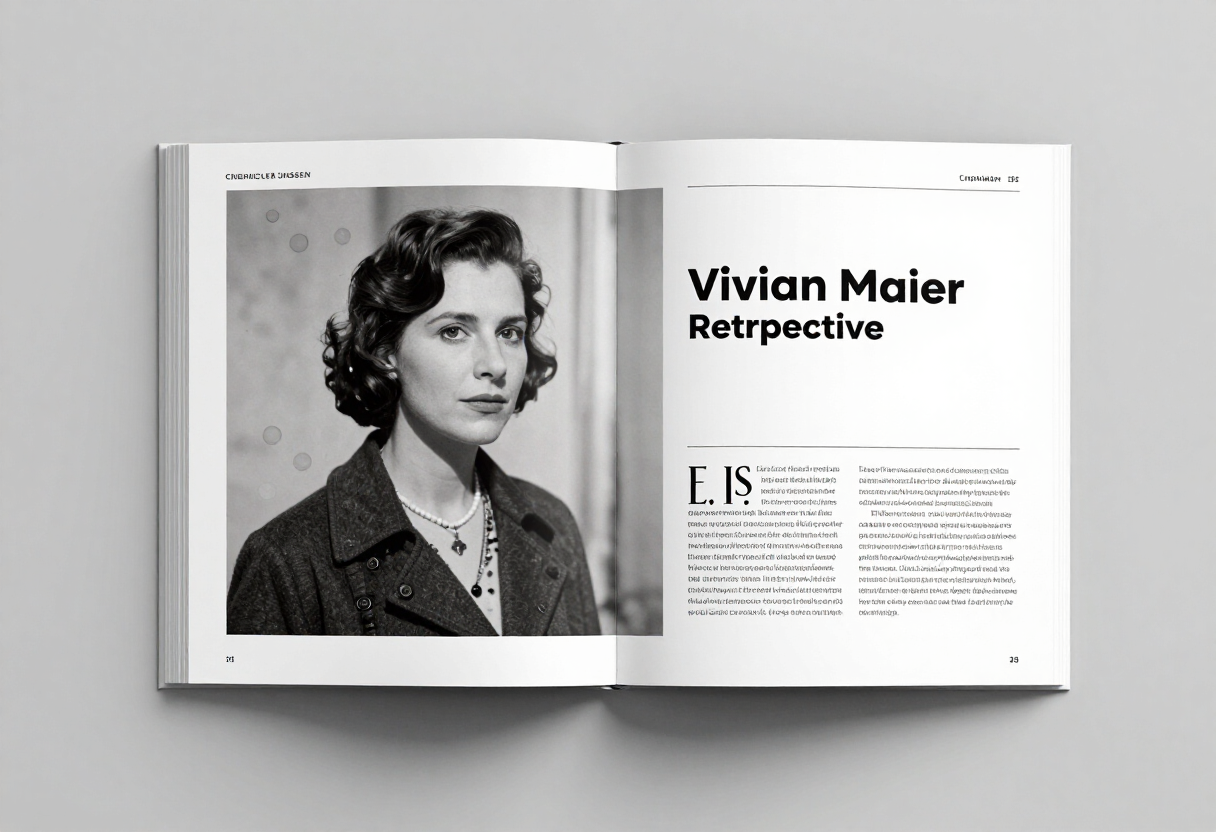
Fotografiska Tallinn will open a retrospective devoted to Vivian Maier, the Chicago nanny whose decades of clandestine street photography rank among the most startling discoveries in the recent history of the medium.
The announcement confirms the Estonian venue's continued commitment to the figures who shaped — and in Maier's case, secretly chronicled — the twentieth-century photographic canon. For a photographer who never exhibited in her lifetime, the institutional trajectory has been extraordinary.
Maier's story is by now familiar, yet it loses none of its strangeness on retelling. Born in 1926, she spent roughly four decades working as a caregiver for families on Chicago's North Shore, carrying a Rolleiflex wherever she went. She photographed ceaselessly — sidewalks, strangers, children, shop windows, the overlooked choreography of American urban life — and showed the results to almost no one. An estimated body of more than 100,000 images, many of them still undeveloped negatives and rolls of film, came to light only in 2007, when collector John Maloof acquired a portion of her archive at a Chicago auction house for a modest sum. Maloof's subsequent research and the 2013 documentary he co-directed, Finding Vivian Maier, transformed a completely unknown practitioner into an international name.
The title of the coming Tallinn exhibition — framing Maier as a "Chronicler of the Unseen" — captures the double meaning at the heart of her reputation. She photographed the unseen: the marginal, the fleeting, the faces that street photography has always claimed as its territory. And she herself remained unseen, a woman who made pictures with the discipline and appetite of a professional while living the life of a domestic worker, her archive stashed in storage lockers that were eventually sold off for unpaid rent.
That posthumous existence poses genuine curatorial and ethical questions that any Maier retrospective must confront. She left no statements of intent, no prints sequenced by her own hand, no instructions about what she would have wanted shown. Nearly everything audiences now see reflects decisions made after her death in 2009 — which frames to print, which negatives to scan, how to organize a body of work its author kept silent. The Tallinn presentation joins a growing list of institutions that have had to balance the power of the photographs themselves against the strangeness of an artist constructed almost entirely posthumously.
What survives the controversy is the work. Maier's strongest images stand comparison with the street photographers she is most often placed beside — Robert Frank, Helen Levitt, Lisette Model, whose New York school she absorbed and reworked through a Midwestern lens. Her self-portraits, frequently shot as reflections and shadows in mirrors and plate glass, carry a self-scrutiny that feels contemporary rather than period. Her eye for the dignity and isolation of children, the elderly, and the working poor gave her pictures a social gravity that transcends the novelty of her biography.
For Fotografiska Tallinn, the exhibition continues the venue's pattern of bringing major international photographic figures to the Baltic audience since it opened in the historic Fotohaus building in 2019. For Estonian and regional viewers, it offers a first-hand encounter with prints from one of the most consequential photographic archives of the last century.
The retrospective also keeps a debate alive rather than settling it. As more of Maier's archive is scanned, printed, and exhibited each year, the field will keep arguing about authorship, posthumous editing, and who gets to shape a legacy its creator deliberately left unspoken. The Tallinn show promises to be another chapter in that argument — and, for audiences, another chance to see the unseen city she spent a lifetime recording.
Key points
- Fotografiska Tallinn will host a Vivian Maier retrospective titled around her role as a 'Chronicler of the Unseen'.
- Maier's archive of over 100,000 images was discovered in 2007 when John Maloof bought part of it at a Chicago auction.
- Maier worked as a nanny for about 40 years and never exhibited her photography in her lifetime; she died in 2009.
Source: Google News: photographer retrospective
Daniel Okafor
Show full bio
News editor covering consumer brands and retail at Lens Gazette.