Dorothea Lange Retrospective Opens in Verona Under CAMERA Torino's Production
CAMERA Torino has produced a Dorothea Lange retrospective now open in Verona, bringing the American documentary photographer's full career arc to Italian audiences at scale.
Updated
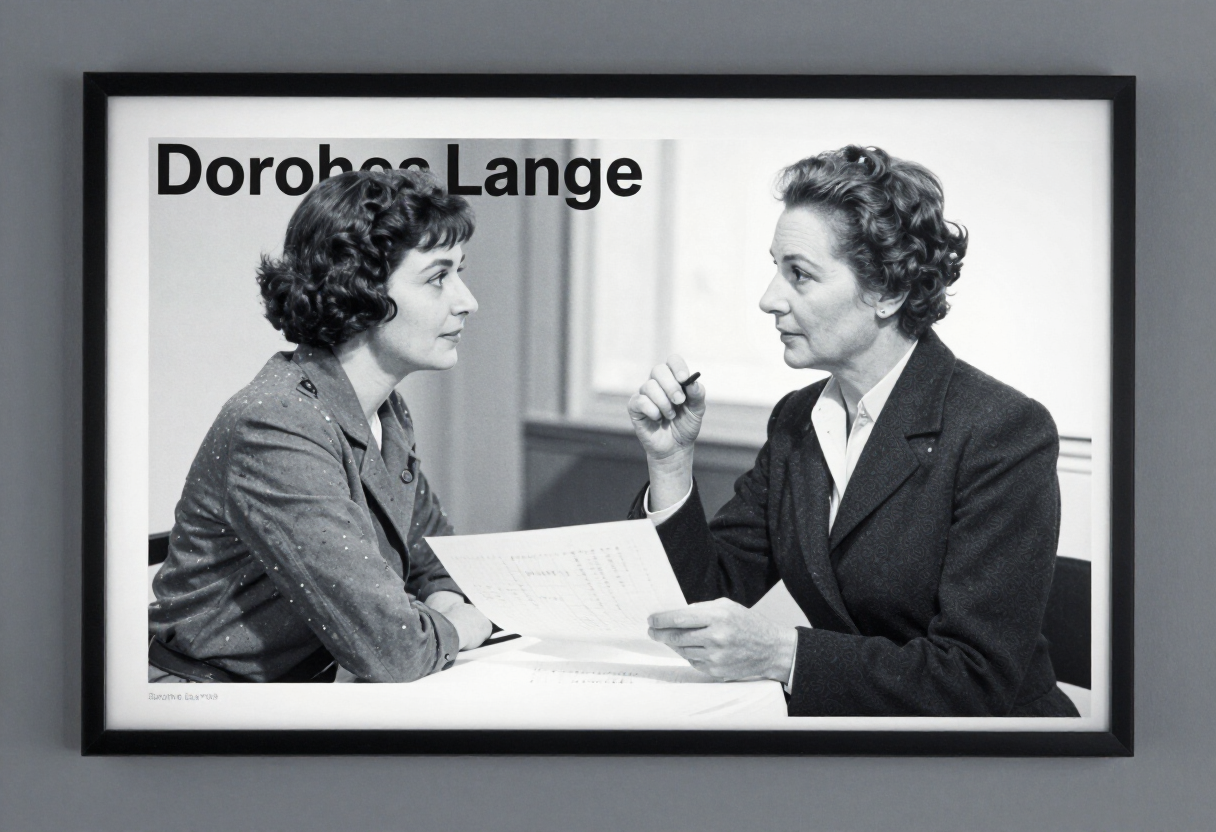
A retrospective of Dorothea Lange has opened in Verona, produced by CAMERA — Centro Italiano per la Fotografia in Turin, marking a significant moment for photography in Italy's north and a rare opportunity to see the American photographer's work assembled at scale outside the major Anglo-American institutions.
The exhibition confirms CAMERA's growing role as a producing institution rather than merely a venue. Since opening in Turin, the centre has built a reputation for staging ambitious surveys of canonical figures, and taking production of a Lange retrospective to Verona extends its reach into the Veneto — evidence of an institution exporting its curatorial and technical capacity across regional boundaries.
For audiences who know Lange through a single image — the 1936 portrait of a migrant mother in Nipomo, California, that became the defining photograph of the Depression era — a retrospective promises the fuller arc. Lange's career spans the Farm Security Administration assignments of the 1930s, during which she and colleagues including Walker Evans documented rural poverty for the federal government, through the wartime incarceration of Japanese Americans, which she photographed for the War Relocation Authority, and into the late fieldwork of her final decades in California and beyond.
What distinguishes Lange within the documentary tradition is the discipline of her restraint. Her FSA photographs rarely editorialise. She framed her subjects — sharecroppers, displaced farm families, migrant labourers — with a directness that made the economic facts of the Depression legible without reducing the people in front of her lens to symbols. That tension, between the documentary assignment as government record and the photograph as individual portrait, is what a full retrospective allows viewers to trace across decades rather than judge from a handful of icons.
A Lange survey also invites harder questions, ones that contemporary curators can no longer avoid. Her 1942 photographs of Japanese American families being forced into internment camps were commissioned by the very government carrying out the removal, and many of the images were impounded during the war. The retrospective format — with room for contact sheets, captions, assignment context and institutional archives — is the right one for presenting that history honestly rather than curating it away.
The Verona opening is notable for Italian audiences in another respect. Lange's work has been more consistently exhibited in Paris, London and Amsterdam than in Italy in recent decades, and CAMERA's involvement suggests an effort to correct that imbalance. A production of this scale — a full career retrospective rather than a themed selection — requires negotiated loans, sustained institutional partnership and a curatorial team capable of handling fragile period prints, and it signals that Turin's centre intends to compete with the Fondazione Formini in Florence region's programming and the larger European houses for major touring exhibitions.
For students of the medium, the timing is instructive. Lange has been subject to renewed critical attention internationally in recent years, with institutions reassessing the FSA archive, the ethics of Depression-era documentary practice, and Lange's own position as a woman working within federal propaganda structures. A retrospective produced in Italy now lands in the middle of that reappraisal, and the degree to which its curatorial framing engages with it — rather than presenting a straightforwardly celebratory canon — will determine whether the exhibition is a landmark or merely a respectful tribute.
Details of the exhibition's dates, venue and accompanying catalogue accompany the opening in Verona, and CAMERA's production role suggests the show could travel further after its run — a prospect that would extend Lange's audience in Italy well beyond a single city.
Key points
- A Dorothea Lange retrospective has opened in Verona.
- The exhibition is produced by CAMERA — Centro Italiano per la Fotografia, Turin.
- The show presents Lange's career arc, best known for her Depression-era Farm Security Administration documentary work.
Source: Google News: photographer retrospective
Olivia Hart
Show full bio
Staff writer covering industry trends and analytics at Lens Gazette.