Rockstar commissions about 50 artists for GTA VI’s Miami campaign
Rockstar commissioned about 50 artists for GTA VI. Its Wynwood Walls collaboration involved ten artists. A $3.9 million Miami campaign brought access, controversy and new questions about consent.
A Miami-Dade County government press release valued the partnership package at $3.9 million, including game-inspired lighting and signage at Miami International Airport and PortMiami.
Rockstar commissioned murals from around 50 artists for the game. The street-art-focused Wynwood Walls museum unveiled its collaboration with ten artists on 13 October, ahead of Art Basel Miami Beach. GTA VI launched globally on 19 November to universal critical acclaim.
What does the $3.9 million takeover include?
Through a joint partnership with Miami-Dade County, the Miami Heat rebranded player uniforms and the Kaseya Center in Downtown Miami as “Vice City.”
Large crowds attended a Heat game on 18 November, the eve of the release, to buy custom merchandise that was available only inside the Kaseya Center.
Some officials objected. One county commissioner told the Miami Herald that the game was “depicting Miami like a murder capital.”
These changes make the promotion part of how Miami functions and looks, not merely an advertisement placed inside it.
The campaign made public space part of the product, and not everyone accepted that trade.
How faithfully does Vice City reproduce Miami?
Rockstar set the game in “Vice City,” a satirical version of Miami and Florida, which the game calls “Leonida.” Its “Stockyard” reproduces Wynwood’s street art and graffiti culture.
- Club Space, the nightclub, becomes “The Vault.”
- Flanagan’s, the regional casual-dining chain, becomes “Uncle Jack’s.”
- The Pérez Art Museum Miami becomes “Future Leonida Art Museum,” also called “Flam.”
- The Wolfsonian–Florida International University design museum becomes “Hicksonian Museum of Art and Design.”
- Miami Beach’s Bass Museum of Art becomes the “Vice City Museum of Art.”
At the Bass, Rockstar transforms Ugo Rondinone’s Miami Mountain (2016) into a monumental stack of emojis. The current exhibition inside the virtual museum, Karl Bergstrom: Diaspora, cannot be visited because players cannot enter the building.
The fidelity gives real institutions unusually direct exposure, but it also makes their names and collections serve the game’s satire.
Vice City turns Miami’s cultural map into a set of narrative landmarks.
What do Wynwood Walls’ ten murals add?
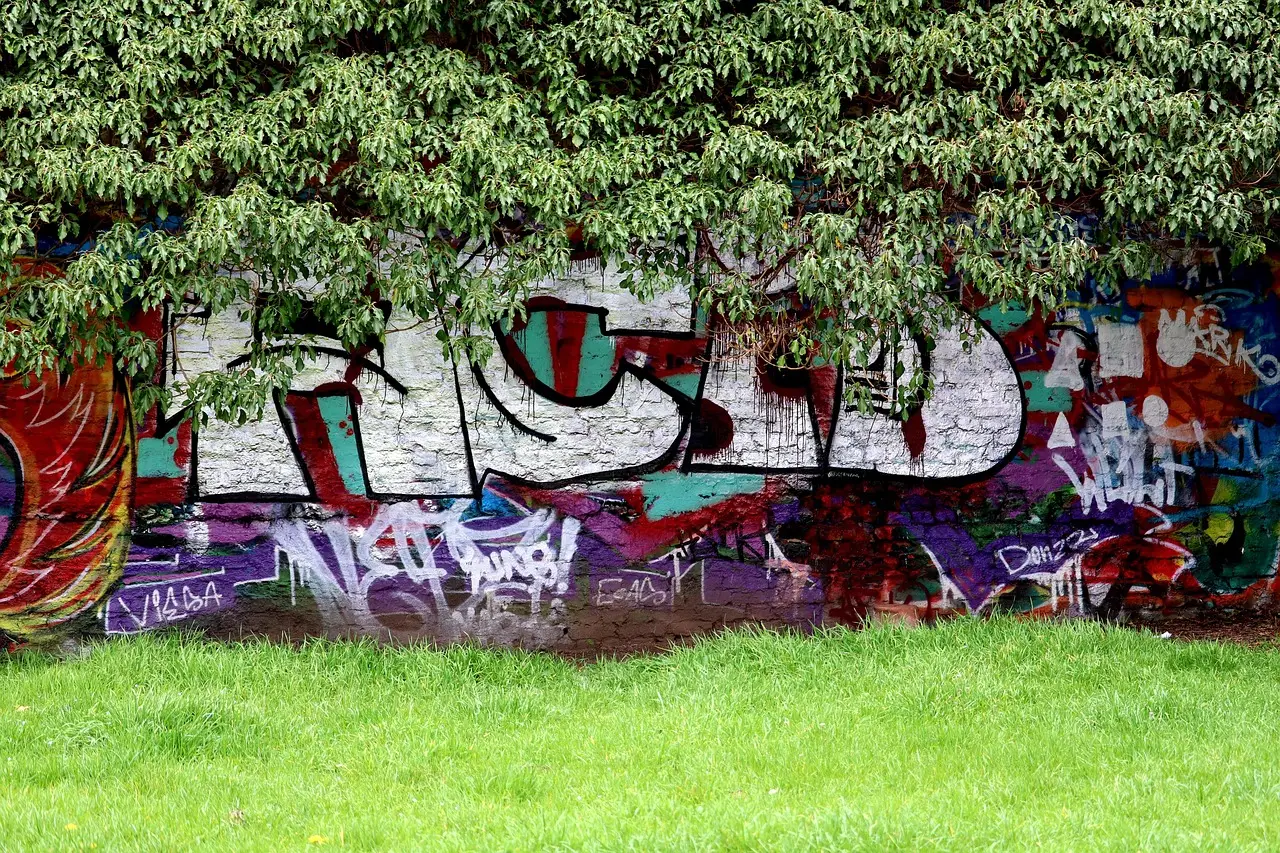
Wynwood Walls invited ten artists to create GTA-themed murals in and around the museum property. Their work expands a virtual campaign built through commissions to around 50 artists, many of whom had previously exhibited at the museum.
Jessica Goldman Srebnick, Wynwood Walls’ chief executive and curator, said: “Street art and gaming have a lot of shared cultural DNA, and they’ve influenced each other.”
She considered the proposal an obvious fit. She also praised the developer’s commitment to creativity, artists and Miami.
Outside the game, these images enter Wynwood’s existing wall culture rather than remaining scenery.
The physical murals remain on display until 1 January 2027 and resemble the images featured in the game. Queen Andrea’s piece reads “Welcome to Vice City” in curving, neon-like lettering. Ron English depicts grenades shaped like lightbulbs with the slogan “There’s nothing more dangerous than a good idea.”
The partnership also includes merchandise and free admission for every Miami-Dade County resident until the end of 2028. That reverses a pandemic-era policy under which Wynwood Walls sold tickets for the first time.
Wynwood gives the game a physical address while extending the visibility of artists whose work appears on its walls.
Why did one mural become a dispute?
The Miami New Times reported on 10 November that a GTA mural covered a work by the late Alex “Rect” Reyes, completed shortly before his death in 2022.
His family and friends regarded the wall as a memorial. They said no one informed them about its replacement.
Goldman Global Arts, which owns the wall and museum, said it had offered Reyes’s crew a different wall to make amends.
That remedy acknowledged the replacement, but did not answer the family’s concern about consultation or undo the removal of the memorial work.
The dispute shows that promotion can displace local memory when consultation comes after replacement.
What happens after the launch?
The game’s global release has now placed its version of Miami before an international audience. The physical Wynwood murals remain until 1 January 2027, while free county-resident admission lasts through the end of 2028.
Players who encounter the virtual Bass may visit the real museum in Miami Beach. That possible benefit is modest beside the scale of the rebranding.
Rockstar can introduce players to virtual counterparts of institutions they may not know. It cannot replace the experience of seeing contemporary work in the actual galleries.
As the murals remain through 1 January 2027, the next test is whether game-driven attention can become sustained support for Miami’s artists and museums.
Key points
- Wynwood Walls unveiled its Rockstar collaboration with ten artists on 13 October.
- Rockstar commissioned in-game murals from around 50 artists.
- GTA VI launched worldwide on 19 November.
- The Miami-Dade partnership package was valued at $3.9 million.
- Free county admission runs through 2028, while the Wynwood murals remain through 1 January 2027.
Source: theartnewspaper.com
Grace Kim
Show full bio
Senior reporter covering companies, deals and strategy in Photography exhibitions, photographers, photo books, festivals and awards at Lens Gazette.