Inside Berghain, an AI Rebuilt a 4,000-Year-Old Temple That No One Ever Recorded
For sixteen October days, Halle am Berghain hosted an AI-reconstructed Mithraic cave temple and chants in Proto-Indo-Iranian, a language with no surviving texts at all.

An eight-minute 4K video loop drifted through a digitally reconstructed Mithraic cave temple for sixteen days this autumn, and it did so inside Halle am Berghain, the former power station better known for techno than theology. Ala Roushan and Charles Stankievech's installation A Shroud of Woven Solar Threads ran 2–18 October, presented by the Berlin initiative House under director Juliet Kothe, co-curated with Nadim Samman and co-presented by the Autotelic Foundation.
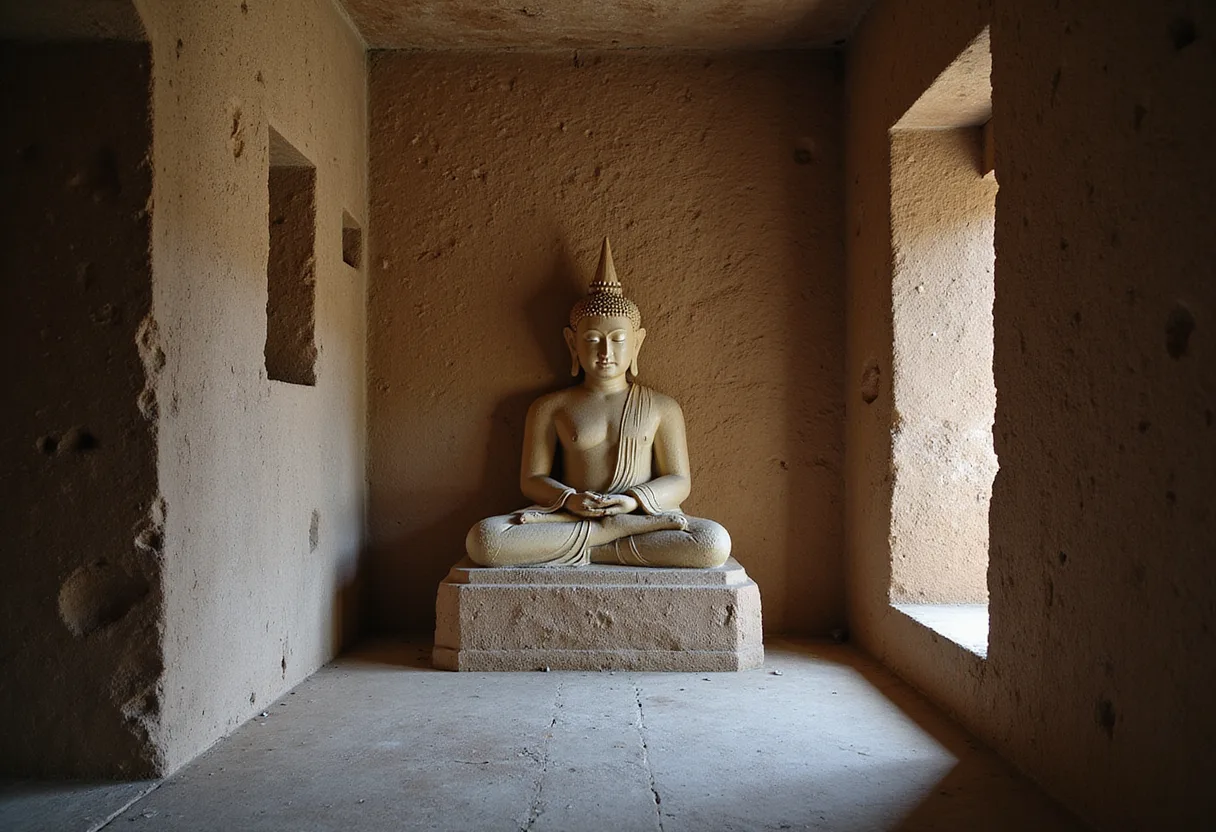
The centerpiece was built from 3D scans of the ancient site. Originally made for a 2025 exhibition in Lausanne, the work was expanded to exploit the hall's cavernous scale — a space, the writer noted, reminiscent of Tolkien's Khazad-dûm. The camera floated through the temple on loop while visitors stood at the center, encircled by human-height black monolithic speakers.
What did the chants sound like?
Each speaker carried a different voice, chanting in AI-generated Proto-Indo-Iranian (PII). Here is the catch, and it is a big one. PII is the ancestor of the Indo-Aryan and Iranian language families, including Sanskrit and Avestan, and there are no historic documents or written texts in it — let alone documented Mithraic chants from that era. Nothing survives to check the work against.
To build the sonic layer anyway, the artists worked with Miguel Andrés-Toledo, a University of Toronto professor specializing in Zoroastrian languages and literature. They drew on comparative linguistics to reconstruct plausible forms, then used AI to voice the speculation. One of the chanters was trained on the voice of Roushan's own mother, she said. The chant opened with "Mithra…" — the ancient solar deity, a lesser-known cousin of Ra — while incense filled the hall.
The setting did half the work. Near the ceiling, graffiti of the Eye of Horus predating the exhibition compounded the accumulation of ritual symbols already layered into the building. Bronze Age bell and relief replicas scattered through the space contextualized the spiritual dimension, though none carried the potency of the ever-burning incense.
Why stage ritual in a nightclub?
There is an inherent futility, the reviewer conceded, in worshipping an ancient sun god for wish-fulfillment. But ritual production and devotion persist — in our lit handheld screens, in the public dance events encouraging abandon, one of which ran the weekend of the opening, several metres and a few layers of concrete away. The placement was not incidental. It was the argument.
Nadim Samman, director of the Autotelic Foundation — whose whimsical take on AI art was a standout digital presentation at the most recent Venice Biennale — put the institutional case plainly. "We are all subject to digital change in society, economy, politics," he said. "These changes are massive, they are abrupt and they are intense. Making sense of it needs to come from below. Artists offer important ways to understand what this change means. Without artists, we are just stuck with the narratives and the images supplied by the companies that make the technology."
That is a strong claim. It is also, for now, an unfalsifiable one. What can be said: since no recordings of PII exist, it is hard to refute that AI contributed a vital component of the installation. The reviewer judged the exhibition's archaeological approach to speculative technology a welcome counterpoint to much digital art in recent memory, and ranked it among the highlights of a busy year for digital and AI-generated presentations.
The skeptic's ledger
Credit where due. Roushan and Stankievech blended archaeology, AI, acoustics, chemistry and sculpture without letting the gadgetry masquerade as content — the technology serves a genuine question about what we can and cannot know about the deep past. The romantic gesture of leveraging AI to reach back several thousand years, staged in a Brutalist power-station-cum-nightclub, pulled disparate threads together cleverly.
Still, note what went unsaid. We have no way to assess how close the reconstructed chants land to anything actually spoken in a Mithraic cave; the plausibility is linguistic, not historical. The claim that artists alone rescue us from tech-company narratives flatters the sector it funds. And sixteen days is a short run for a work whose ambition suggests a longer dwell.
The momentum, though, is real. With the Autotelic Foundation fresh off a strong Venice showing and House mounting work of this scale in Berlin, expect more speculative-archaeology installations that treat AI as an instrument of historical imagination rather than a novelty — and expect the debates over what counts as reconstruction to follow them.
Key points
- A Shroud of Woven Solar Threads ran 2–18 October at Halle am Berghain, Berlin, organized by the Autotelic Foundation and House.
- The centerpiece was an eight-minute 4K video loop through a 3D-scanned, 4,000-year-old Mithraic cave temple, expanded from a 2025 Lausanne exhibition.
- Chants were generated in AI-reconstructed Proto-Indo-Iranian, a language with no surviving written texts, with input from University of Toronto professor Miguel Andrés-Toledo.
- Juliet Kothe directed the presentation for House; Nadim Samman co-curated and directs the Autotelic Foundation.
Source: theartnewspaper.com
Daniel Okafor
Show full bio
News editor covering companies, deals and strategy in Photography exhibitions, photographers, photo books, festivals and awards at Lens Gazette.