Ilanit Illouz's Salt Prints Weep — and That's the Point
Ilanit Illouz's salt-fossilised prints weep, warp and crystallise over months. Her Dead Sea series Les Dolines, running since 2016, turns photography into a rugged object — a fragment of a disappearing landscape.
Ilanit Illouz makes photographic prints that absorb moisture from the air and form droplets on the paper — as though the images were weeping. She calls them "the weepers" or "the witches." They are salt-fossilised prints, each a 1-of-1, developed at a scale of materiality that stopped interviewer Yogan Muller dead in the visitor flow at Paris Photo in 2025.
That interview, published as Overshoot #15 on Lenscratch, is the fullest account yet of a decade-long practice. Illouz's series Les Dolines began in 2016 after a residency in the Judean Desert, between Israel, Palestine and the Dead Sea. The work continued earlier research around a former transit camp in Marseille, where she built a method on walking, observation and collecting materials. An installation of Dolines showed at the Fata Morgana exhibition at the Jeu de Paume in Paris, from 22 March to 22 May 2022.
What is the work actually about?
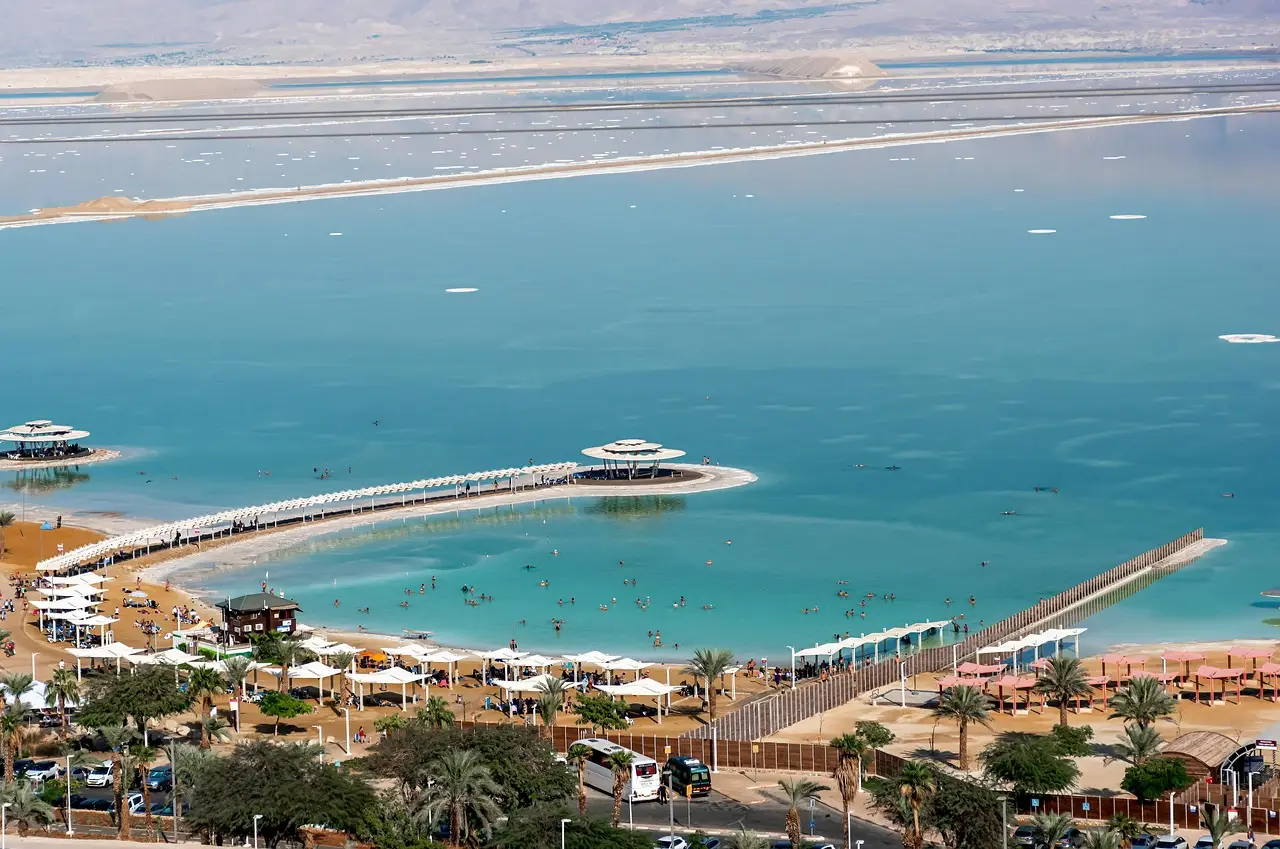
The Paris Photo body focuses on the gradual disappearance of the Dead Sea — a large salt lake shrinking largely through mineral extraction and the reduced flow of the River Jordan. The landscape, as Illouz puts it, bears the traces of its own disappearance. Salt was not the plan. It was simply everywhere: rocks, vegetation, ground, shore. What hooked her was that "salt preserves as much as it corrodes." It is essential to life and to photography.
Back in the studio, she began immersing her prints in baths. Water — and above all its disappearance — was already the heart of the project. Crystallisation depends on salt concentration, evaporation, humidity, temperature and the seasons. Each print develops over several weeks, sometimes months. She has learnt to work with the phenomena rather than control them. The result, in her words: "Photography ceases to be merely a surface and becomes a rugged object, almost a fragment of a landscape."
That claim deserves stress-testing, and Illouz herself supplies the caveat. Her practice sits on the ecological contradictions of a medium built on minerals, water and chemicals — a history that began, as she notes, in Judean bitumen before silver salts and copper plates. She does not claim to escape those contradictions, only to be pushed toward more mindful material choices.
Where else has the work travelled?
Beyond the Dead Sea, her extraction-focused projects include:
- Petra, working with copper — a material pulled from the earth, raising questions about the violence of extraction.
- Au bord du volcan, on Mount Etna, including works dated 2025 and 2026, focused on the geological memory of rocks and ash.
She sometimes burns plants to ash for pigments she incorporates into the prints. Gathered sand, dust and stones become materials, not mementoes. The landscape's own matter makes the images.
Is this walking-as-method or walking-as-myth?
Muller connects her slowness to walking, and Illouz confirms it — usually aimless wandering, no fixed route, letting the landscape guide her steps. Observation matters as much as the shutter. Her summary of the process is a loop: "Walking, looking, collecting, photographing, remembering, immersing oneself, waiting, returning: these are actions that form the same process." Fair enough. But the studio half of that loop — weeks of immersion, failed experiments, uncontrollable crystal growth — is where the prints earn their strangeness. The walking alone doesn't.
On France's sweltering, wildfire-scarred summer, she invokes philosopher Vinciane Despret: when a species disappears, the relationships and ways of inhabiting the world associated with it fade too. She does not want to depict catastrophe spectacularly, but to capture its traces as "a sensory archive of a world in flux." Asked about photographing in a warming world, she reaches for Chris Marker's 1977 film Le Fond de l'air est rouge — a reminder, she says, that climate cannot be separated from human, social and political crises, even if her own approach stays sensitive and poetic.
What comes next?
Les Dolines carries an end date of 2026, and Au bord du volcan is already producing dated 2026 works, so the atlas of images and materials she describes keeps expanding — toward Etna's ash, and away from any surface photography has occupied before.
Key points
- Ilanit Illouz's series Les Dolines began in 2016 after a Judean Desert residency and runs to 2026.
- Dolines was exhibited at Fata Morgana, Jeu de Paume, Paris, 22 March–22 May 2022.
- Each salt print is a 1-of-1 developing over weeks to months; the Dead Sea project debuted at Paris Photo 2025.
- The Dead Sea's decline is driven by mineral extraction and reduced River Jordan flow.
- Ongoing projects include Petra (copper) and Au bord du volcan on Mount Etna (2025–2026 works).
Original: ilanitillouz.com
Daniel Okafor
Show full bio
News editor covering companies, deals and strategy in Photography exhibitions, photographers, photo books, festivals and awards at Lens Gazette.