Paris Photo's Digital Sector Asks Whether 'Digital' Even Means Anything
Paris Photo's fourth digital sector, curated by Marco De Mutiis, mixes AI imagery with photograms — and one artist felt compelled to write 'not IA' on his booth.
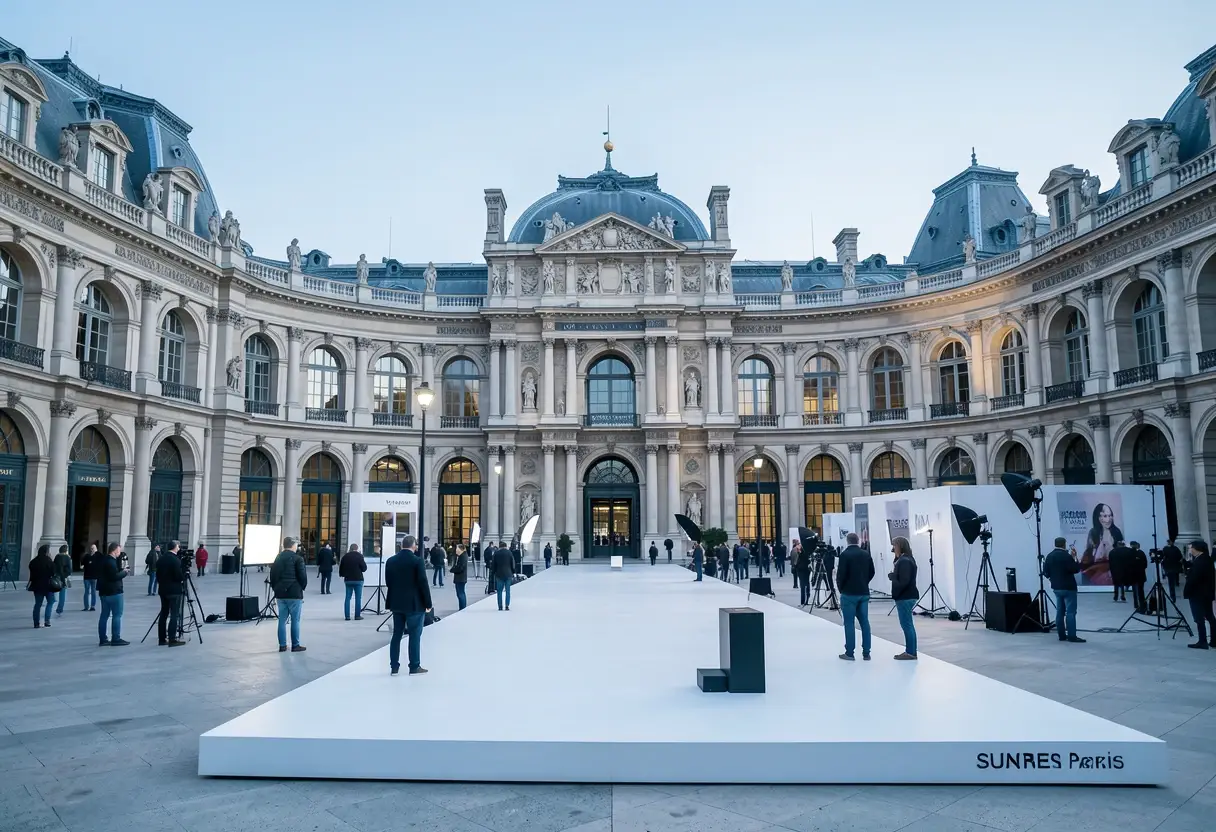
The 29th edition of Paris Photo has filled the Grand Palais through 15 November, and its digital sector — twelve exhibitors, now in its fourth year — arrives with a curatorial handover and an exhibition programme that quietly questions the sector's own reason for being.
Marco De Mutiis of Fotomuseum Winterthur has taken over the digital section from Nina Roehrs, who curated the first three editions. Alongside the stands, the École Cantonale d'Art de Lausanne has organised Soft Photography, a pedagogical programme of interactive exhibition and talks devoted to placing AI and CGI within photography's longer history. Two weeks after an abbreviated Art Basel Paris, the fair is at least offering something the medium badly needs: a conversation rather than a panic.
What's actually on the walls?
AI imagery is present but not dominant. New York's Heft Gallery presents Alkan Avcıoğlu's Disreality series, an extension of the surreal landscape aesthetic he first developed in a collaboration with Edward Burtynsky. Yet the sector also contains analogue work — photograms, even — enough to make one wonder how separate a section this really needs to be. A similar dynamic played out in the Zero 10 sector at Art Basel in Basel last June, where "digital art" was stretched so broadly that the dedicated zone began to look redundant.
The strongest stands reward close looking:
- Carmen Araujo Arte (Venezuela) shows Alejandro Cartagena's mosaic-cut collages, built from found photographs as a manual interpretation of how generative AI assembles pixels. The works ask sharp questions about authorship while proving, rather sweetly, that human hands make things algorithms don't.
- Palo Gallery installs Orejarena & Stein's American Glitch series, which interrogates simulation theory and our screen-filled reality. Glitch Typologies (2020-24) floats seven channels of images on the walls of a 3m-by-3m glass cube, projectors hanging like CCTV cameras at its core. It sits somewhere between David Lynch and surveillance footage. It's a highlight.
- Licheng Ling Projects gives Yumo Wu her first solo presentation in Europe, spanning AI and darkroom manipulation. Technique becomes secondary; the images simply ask to be beheld. One of them appears in Paris Photo's selection marking the bicentennial of photography's invention.
- Au Cube presents Vincent Fournier's Flora Incognita: large-scale portraits of speculative flowers, mutated by alien radiation or gravity. They look AI-generated but were built in Houdini — comparatively old-school CGI — and framed in wood with golden plaques, channelling 18th-century botanical illustration. The Grand Palais's own beaux-arts architecture makes the conceit sing.
- Nguyen-Wahed shows Los Angeles photographer Summer Wagner's unframed, grainy, coolly-lit portraits — digital only insofar as they were shot on a digital camera. Wagner describes the work as dealing with reality after "we've collectively succumbed to the tsunami of cultural and technological changes that have thrown image-making into an existential crisis."
Why did one artist write 'not IA' on his booth?
Facing the digital sector, Ruttkowski 68 gives François Hallard a solo stand of large-scale Polaroid flower prints titled "Conversations avec Claude." By the second preview day, countless visitors assumed Claude meant AI — Anthropic's chatbot, not Monet — so Hallard handwrote "(Monet) not IA" at the top of the booth. An AI engine has now eclipsed one of the 20th century's most consequential painters, at least in first-name recognition.
The terminology problem runs deeper than one booth. The dealer Howard Greenberg has said he favours "lens-based" to separate camera work from computer-generated images, and that once seemed adequate. But artists now routinely run digital imagery through enlargers and analogue processes to human-wash it, so "lens-based" no longer draws a clean line. "Synthetic photography" has a nice ring but conjures latex and carcinogenic sunscreen. For the moment, "soft photography" may be the best we have.
The digital sector and its accompanying programme make their case deftly: digital art predates most of the technologies currently being debated, and its applications in contemporary photography are legion. Whether the sector still needs its own walls is the question next year's edition will have to answer.
Key points
- Paris Photo's 29th edition runs at the Grand Palais until 15 November, with 12 exhibitors in its fourth digital sector.
- Marco De Mutiis of Fotomuseum Winterthur curates the digital sector, taking over from Nina Roehrs.
- Yumo Wu's stand with Licheng Ling Projects marks her first solo presentation in Europe.
- François Hallard handwrote '(Monet) not IA' on his booth after visitors assumed his Polaroids referenced AI.
- Orejarena & Stein's Glitch Typologies (2020-24) projects seven channels of images inside a 3m-by-3m glass cube.
Source: theartnewspaper.com
Olivia Hart
Show full bio
Staff writer covering people, launches and day-to-day practice in Photography exhibitions, photographers, photo books, festivals and awards at Lens Gazette.