Fairywrens of Australia documents 10 species across 15 years
Howard Loosemore and fellow photographers spent 15 years documenting all 10 Australian fairywren species, their changing plumage, cooperative family life and difficult field conditions.
By Marcus Bennett
Howard Loosemore has spent 15 years working with fellow photographers to document all 10 Australian fairywren species, and has brought that field record together in the newly published Fairywrens of Australia.
Photographs credited to Michael Chay, Jan Wegener, Darren Stephens and Laurie Ross extend the campaign beyond Loosemore’s own encounters. Their images place plumage beside behaviour, from insect feeding to nest building and cooperative care.
Within the natural-history book tradition, the volume makes photography carry taxonomic and behavioural evidence. It adopts the taxonomic logic of a field guide while retaining the visual argument of a photographic essay, combining species-by-species coverage with the field conditions required to find, wait for and photograph birds.
What does the book change for a reader?
The answer is taxonomic and practical: readers can compare a species’ breeding and eclipse appearances instead of encountering it through isolated wildlife portraits. Loosemore sought each of the 10 Australian species at each stage of plumage development, a requirement that took more than a decade to fulfil.
Social partnerships are no less varied. All fairywrens form long-term social partnerships and defend territories together, though both sexes may also mate outside the social pair. In superb fairywrens, extra-pair paternity has been recorded in up to 95% of broods. Purple-crowned fairywrens are unusually faithful by comparison, with rates as low as 5%, far below most other species.
Fieldwork proved exacting.
Loosemore said: “In late 2022, I was searching for purple-crowned fairywrens near Fitzroy Crossing.”
He added: “In pre-wet season temperatures above 40C, I dug a small waterhole in the dry creek bed near a family of purple-crowned fairywrens and replenished it from a jerrycan, hoping the birds would discover it. I then waited for hours beneath camouflage.”
He lay on a bodyboard to protect himself from the scorching rocks and wore an ice vest kept frozen in his car freezer. This attempt began with a possible water source, then demanded a concealed, prolonged wait.
His search for the male blue-breasted fairywren shows the cost. After years and repeated trips into the West Australian wheatbelt, Loosemore reached Dryandra Woodland on his 15th trip and finally photographed the bird in vibrant nuptial plumage. The image resolves a gap left open by years of attempts.
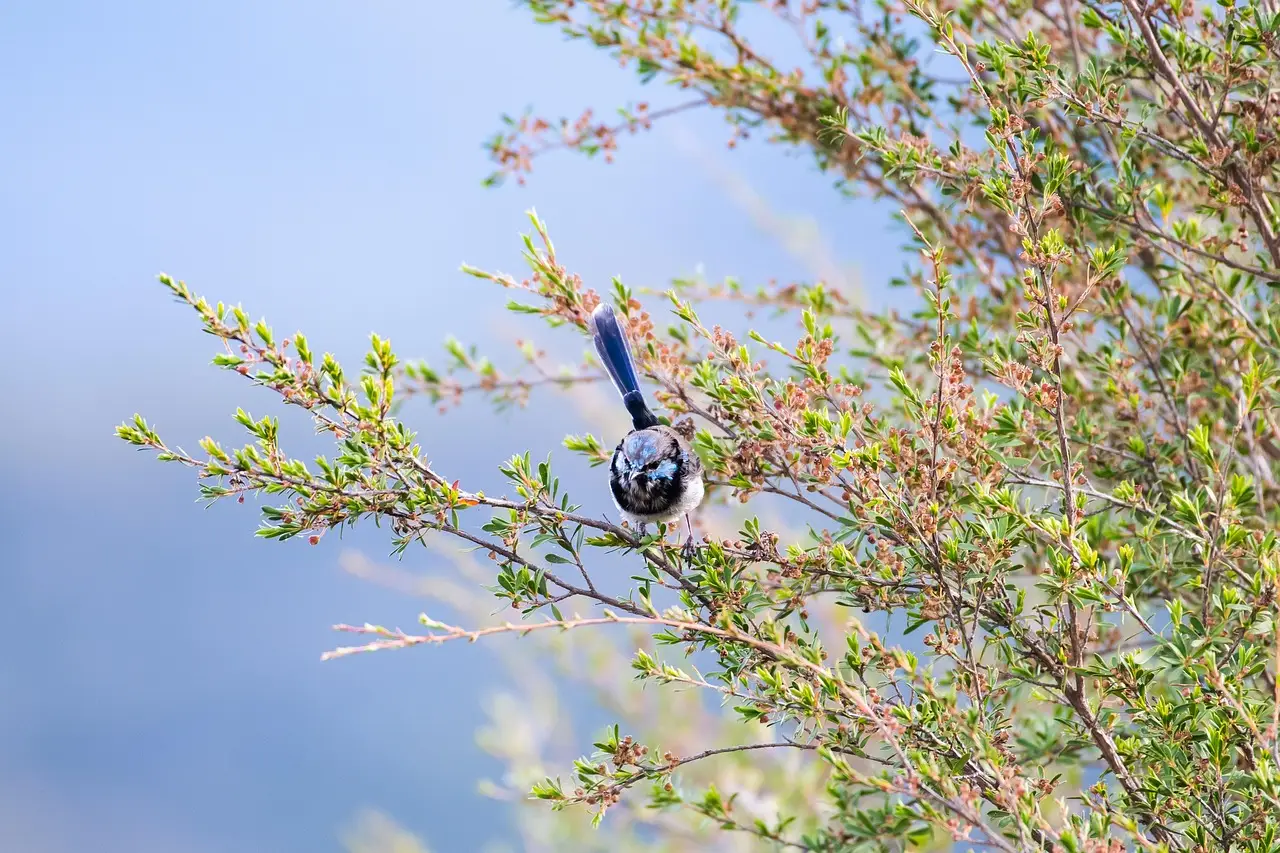
Plumage changes complicate the portrait. In nine of the 10 species, sexually mature males replace dazzling nuptial feathers with dull brown-grey eclipse plumage after breeding, which makes them less conspicuous to predators.
The red-backed male is the only male to lose every brilliant breeding colour, including its tail feathers. It changes from red and black to brown, and its bill shifts from black to reddish or pale pink. The result is very difficult to distinguish from an eclipse female. A Jan Wegener photograph records the transformed bird.
The lovely fairywren, endemic to Cape York Peninsula, reverses the usual sequence. Mature males retain brilliant nuptial colour throughout the year instead of moulting into the subdued form seen in males of the other nine Australian species. A Laurie Ross photograph shows two female lovely fairywrens.
Colour also extends beyond human sight. Red-winged and some other fairywrens possess ultraviolet-sensitive vision and can perceive reflections that remain invisible to us. The red-winged male’s blue plumage may therefore appear even more brilliant to a female than it does to the photographer.
The white-winged fairywren is the most widely distributed of all fairywrens. Its mainland male owes its cobalt-blue plumage to microscopic structures within its feathers that scatter light rather than to blue pigment. A layer of melanin beneath intensifies the colour. Loosemore’s image makes the structural blue the subject, not merely a field mark.
Subspecies divergence adds another layer. Female nominate purple-backed fairywrens across Australia appear grey, brown, tan or cream. Yet Malurus assimilis rogersi and Malurus assimilis dulcis look entirely different, an unusually dramatic difference within one fairywren species. A Laurie Ross photograph illustrates that divergence.
Loosemore’s three stated principles for stronger bird photographs were:
- Shoot at the bird’s eye height.
- Place yourself between the sun and the bird to avoid shadows on the bird.
- Move position to compose a cleaner, less cluttered background.
Together, these choices form a compact account of photographic craft: viewpoint establishes relation, light reveals form, and background controls attention. Each decision serves the work rather than the photographer’s display.
Fairywrens feed mainly on insects and other small invertebrates, gleaned from foliage, bark and the ground. When insect prey is scarce, they may also eat small amounts of seeds and fruit. A Michael Chay photograph accompanies the feeding account.
Nest construction falls exclusively to females in all fairywren species. In some species, males gather or deliver nesting material, but they do not weave or build the nest itself.
Unlike most birds, fairywrens are cooperative breeders, extending social life beyond the breeding pair. Young birds may remain with their parents after reaching maturity and act as helpers, feeding nestlings and fledglings and defending the territory. Some helpers eventually replace a breeding bird when a vacancy arises.
Taken together, Fairywrens of Australia offers photographic completeness grounded in patience: 10 species, seasonal plumages, subspecies differences and family behaviour held within one field record. Now published, its next test is whether that 15-year archive can make specialist natural history legible to a general reader without flattening the birds’ transformations or the physical conditions of the photographs.
Key points
- 15 years and 10 species: Howard Loosemore and fellow photographers documented all Australian fairywren species for the book.
- 9 of 10 species: sexually mature males replace nuptial plumage with brown-grey eclipse plumage after breeding.
- Late 2022 and above 40C: Loosemore searched for purple-crowned fairywrens near Fitzroy Crossing.
- Up to 95% versus as low as 5%: extra-pair paternity ranges from superb to purple-crowned fairywrens.
- 15th trip: Loosemore finally photographed the male blue-breasted fairywren in nuptial plumage at Dryandra Woodland.
Source: theguardian.com
Marcus Bennett
Show full bio
Correspondent covering companies, deals and strategy in Photography exhibitions, photographers, photo books, festivals and awards at Lens Gazette.