Eckart Bartnik Stacks Minutes Into Single Frames at Staatsgalerie Stuttgart
German photographer Eckart Bartnik layered two to eleven minutes of tourist traffic into single images of Iceland's best-known sites, shown at Staatsgalerie Stuttgart in 2026.
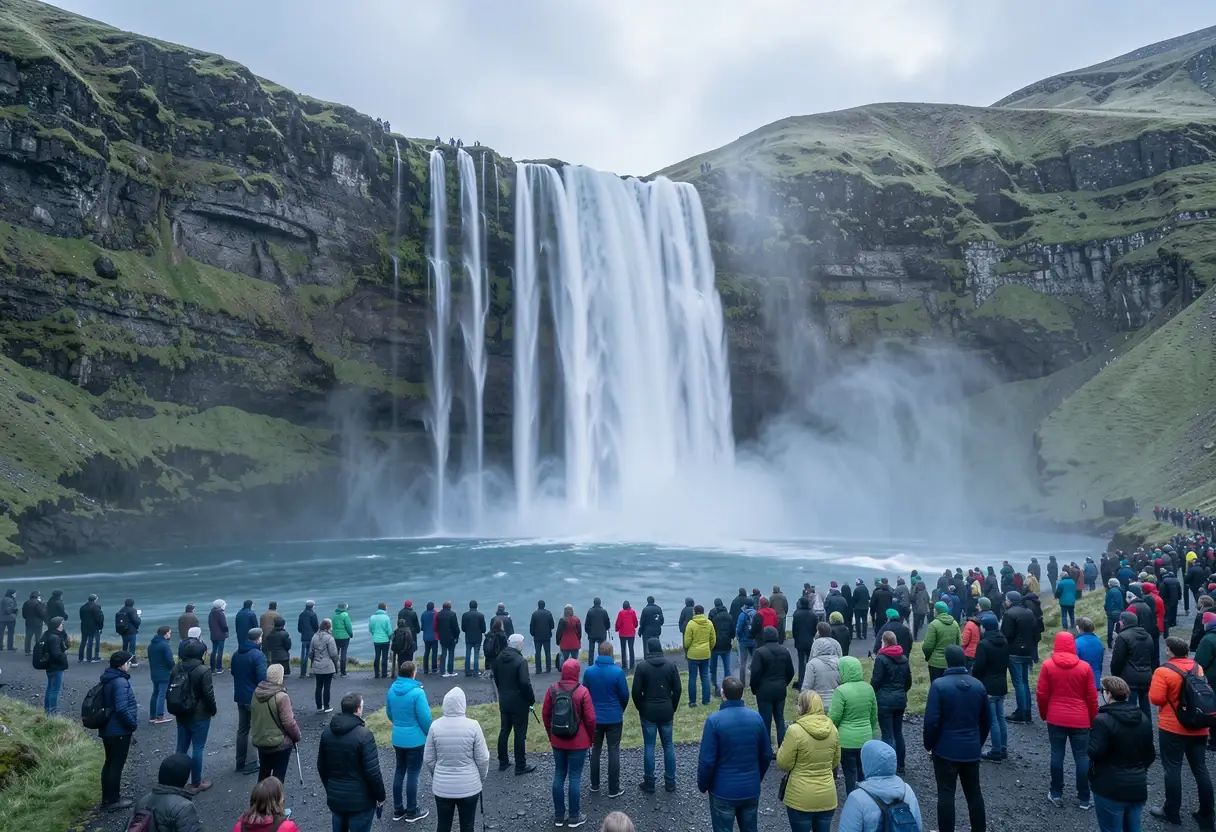
Eckart Bartnik's series SPHERES COLLIDING was presented in 2026 at THE GÄLLERY, Staatsgalerie Stuttgart, as part of the UNORDNUNG exhibition during Fotosommer Stuttgart. The work compresses minutes of tourist movement at Iceland's most visited natural sites into single, layered images. The German photographer, based in Wiesbaden, also showed the series at Kolga Tbilisi Photo 2026. His earlier series FLOOD received a Prix Pictet nomination in 2025.
The project began with a return trip. Bartnik went back to Iceland in 2024 and noticed how much the experience of famous natural sites had changed. Places that once felt open and almost boundless now ran on paths, viewing platforms, parking areas and directed routes. He watched visitors repeat the same pattern. They arrived, stopped, looked, photographed and left.
He described the starting point in his own words: "When I returned to Iceland in 2024, I became increasingly aware of how profoundly the experience of many well-known natural sites had changed." The observation was not yet a project. It was a sense that something was taking shape. He made first experimental sequences, returned home, and tested ways of combining them.
How are the images made?
The method is simple and exact. Bartnik photographed the same scene repeatedly over several minutes. He then combined the exposures into a single image. The span varies by location, from roughly two to eleven minutes. One frame, dated 21 June 2025 at Gullfoss, records the interval between 16:52 and 16:57.
The result refuses the single moment. Bodies overlap, dissolve and merge into collective patterns. "The resulting images do not represent a single moment," Bartnik writes. "They contain many moments at once." Photography usually isolates a fraction of a second. Here, many moments occupy the same pictorial space, and the photograph becomes a field where time accumulates.
In the Gullfoss close-up, overlapping visitors fill the foreground. Railings and the path edge contain their movement. Spray partly obscures the view beyond. The camera sits inside the crowd, where the encounter with the falls happens at close quarters and in company.
What does the title mean?
Two temporal spheres collide in every frame. The first is geological. Icelandic landscapes form through volcanic activity, glacial movement, erosion and tectonic shifts across immense periods. The second is human. A visitor's presence is extremely brief against that duration.
The pairing produces a deliberate instability. The landscape appears stable, yet it changes constantly. The visitors seem fleeting, yet accumulation turns them into a dense, dark mass that threads through the scene. Individual figures become hard to distinguish. Individual gestures and identities disappear. The repeated movements of arriving, stopping, looking and leaving become almost choreographic, and the images reveal how paths and viewing areas shape the encounter with a place.
Where was the work made?
Bartnik returned to Iceland in 2025 and photographed the full series on that journey. The sites include:
- Silfra
- Jökulsárlón
- Diamond Beach
- Fjaðrárgljúfur
- Svínafellsjökull
- Skógafoss
- Gullfoss
Each place has its own physical character. Yet similar patterns of human behaviour appear again and again across all of them. That repetition, made visible, is the core finding of the work.
Is this a criticism of tourism?
Bartnik says no, or not only. "I do not see these photographs primarily as a criticism of tourism," he states. "I am part of the same system: I travel to these places, I look, and I photograph. The work arises from participation rather than distance."
Still, a concern sits beneath the surface. He points to growing visitor density, the finiteness of space and the pressure placed on natural environments. He keeps that concern as an underlying tension, not an explicit argument. Through accumulation, places that appear vast become visibly occupied and structured by human movement. The images ask what happens when different scales of time, movement and attention occupy the same space.
At a certain point, the distinction between landscape and human activity becomes unstable. Geological duration and temporary presence begin to overlap. Photography, Bartnik argues, makes this collision visible.
Who is Eckart Bartnik?
Bartnik worked for more than three decades as a cell and molecular biologist before turning to photography. The scientific background still shapes his seeing. His stated interests are structures, transformation, materiality and the relationship between microscopic and macroscopic scales.
His work moves between two complementary approaches. The first uses abstraction to explore natural processes and perception. The second reflects on the relationship between people, places and their environments. His projects begin with close observation and grow into explorations of how images shape perception. He does not use photography mainly to explain the visible world. He looks for moments when certainty dissolves and familiar subjects open to new readings.
Bartnik is a member of the German Photographic Society (DGPh). His work has been exhibited and published internationally. The takeaway: SPHERES COLLIDING turns crowd management into evidence, one layered frame at a time.
With the Stuttgart and Tbilisi showings behind it and a Prix Pictet nomination for FLOOD in 2025, Bartnik's accumulated-time method now stands as his most public argument for photography as an instrument of duration rather than of the instant.
Key points
- SPHERES COLLIDING was shown at THE GÄLLERY, Staatsgalerie Stuttgart, in the UNORDNUNG exhibition during Fotosommer Stuttgart 2026.
- Each image combines exposures made over approximately two to eleven minutes at the same scene.
- Bartnik's series FLOOD was nominated for the Prix Pictet in 2025.
- Sites photographed in 2025 include Gullfoss, Skógafoss, Jökulsárlón, Diamond Beach, Silfra, Fjaðrárgljúfur and Svínafellsjökull.
- Bartnik worked for over thirty years as a cell and molecular biologist before focusing on photography.
Source: Dodho Magazine
Grace Kim
Show full bio
Senior reporter covering companies, deals and strategy in Photography exhibitions, photographers, photo books, festivals and awards at Lens Gazette.