Digital projection restores the colours of Taharqa’s Oxford shrine
Digital colour research will bring the Shrine of King Taharqa back into view at Oxford’s Ashmolean from 13 November, revealing red, yellow and Egyptian blue.
By Grace Kim
What will visitors see on 13 November?
On 13 November, the Ashmolean Museum in Oxford will begin a free digital projection restoring the original colours of the Shrine of King Taharqa. The almost 3,000-year-old sandstone monument dates from 690 BC to 654 BC and came from northern Sudan. The museum describes it as the only freestanding building in Britain dating to the time of the pharaohs.
The projection will be free for every visitor to the Ashmolean’s Ancient Egypt and Sudan galleries. Digital light, rather than new paint, will supply the missing surface. The projection offers a reconstruction, not the survival of an intact painted surface.
The opening makes colour the first point of entry.
How was the lost palette recovered?
The projection follows extensive research into surviving scraps and traces of pigment. Red paint remains in the crevices of the sandstone carvings. Researchers also used microscopic analysis and hyperspectral imaging, a method that combines photography with spectroscopy.
Together, these methods revealed colours that the naked eye can no longer see, including yellow and Egyptian blue. Egyptian blue was a brilliant pigment used to depict divine figures. Each recovery method adds a different layer to the reconstruction.
Taken together, microscopy and spectral imaging extend the visible record into colours that remain present only as microscopic traces within the ancient stone surface. The scientific work turns scattered traces into a clear visual account that rests on evidence.
What story do the carvings and inscriptions tell?
According to Liam McNamara, the Ashmolean’s keeper of antiquities, the carvings and inscriptions explain the shrine’s construction. They describe a young Taharqa, before he became king of Kush in Nubia and pharaoh of Egypt, travelling north towards Thebes.
He saw the ruins of an earlier brick temple to Amun-Re, which Tutankhamen had built; the inscription records, “the sand drifted to its roof.” At his coronation, Taharqa vowed to restore the ruined temple. He then built a shining new shrine within a new temple.
Scorch marks on the shrine’s stones, also revealed in the project, record the monument’s eventual destruction in turn. The shrine thus carries both Taharqa’s act of restoration and evidence of its later ruin.
How does Taharqa appear?
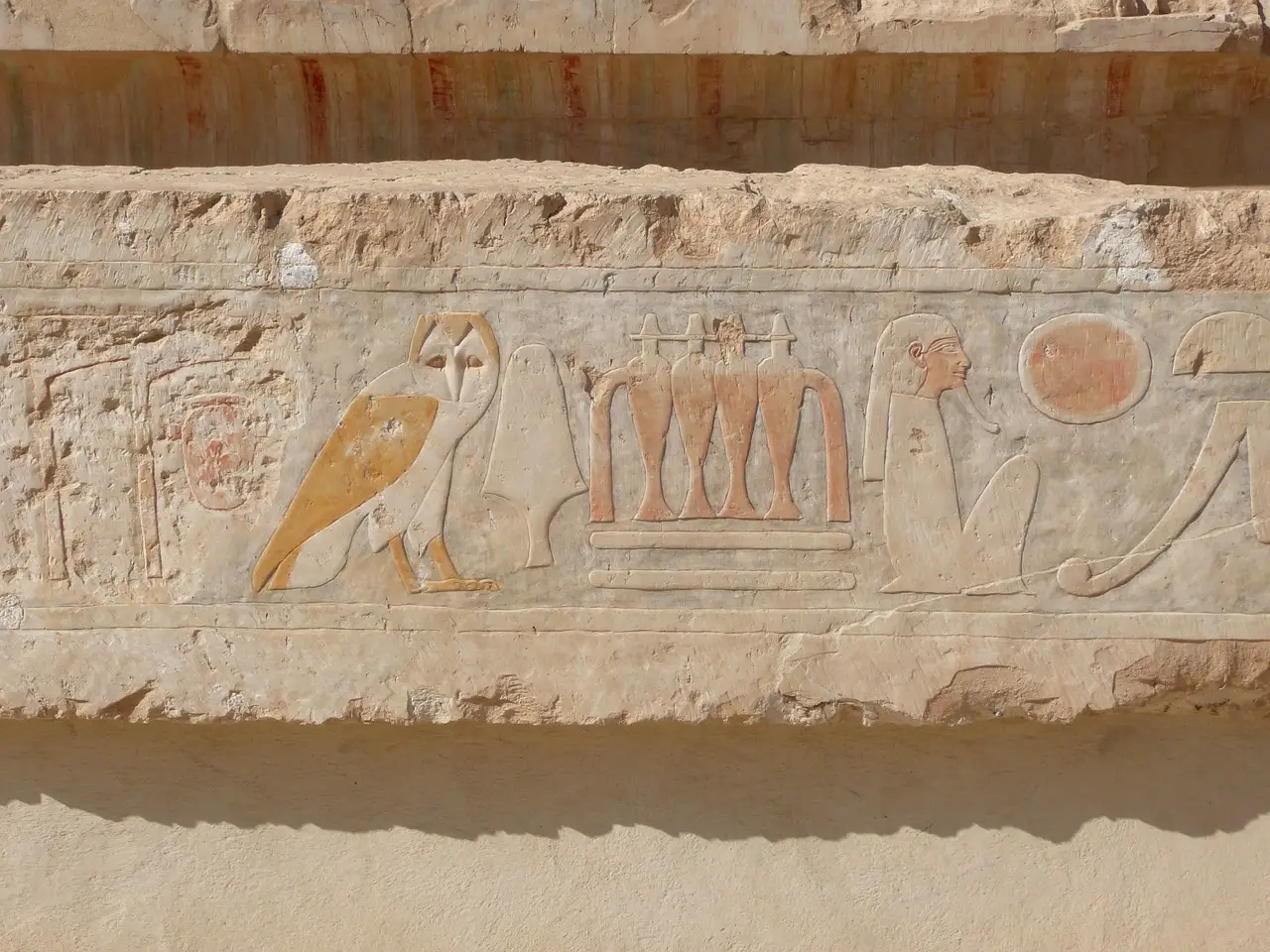
The relief sandstone blocks originally carried plaster and bright paint. Scenes show Taharqa with the gods of Memphis and Heliopolis. Amun-Re appears both as a Theban deity and as the local Gematen deity.
Taharqa himself appears in two forms. As an Egyptian pharaoh, he wears the Double Crown of Upper and Lower Egypt. His Kushite guise includes ram’s-head and sun-disc earrings, together with a Kushite crown surmounted by two cobras.
By combining regalia rather than merging the figures, the programme keeps the Egyptian pharaoh and the Kushite king visually distinct within one unified shrine. The double portrayal makes his claim to both traditions visible.
How did the shrine reach Oxford?
About 90 years ago, 150 crates travelled from Khartoum to Oxford. The Sudanese government gave them to the Oxford University Excavations in Nubia, which had excavated the shrine and other monuments over several seasons.
In 1936, Nora Griffith gave the shrine to the museum in memory of her husband, Francis Llewellyn Griffith. Griffith had led and largely paid for the expeditions. He taught himself Ancient Egyptian at Oxford because the university had no department for it. He later became the first professor of Egyptology and a renowned scholar.
The gift joined an ancient monument to a modern history of excavation, scholarship and transfer.
What does the project add now?
The work has the support of James Lupton, the Ashmolean’s chair of the board of visitors, and his wife, Béatrice. McNamara describes the monument as a fascinating insight into the art and archaeology of ancient Sudan. He says: “The new projection—and the scientific research behind it—will allow visitors to appreciate and understand the shrine’s original painted decoration like never before.”
The display makes that research public within the galleries. From 13 November, visitors can compare projected colour with surviving paint, sandstone and the marks of destruction. The shrine’s lost colour becomes a public reconstruction that visitors can compare against the evidence.
Key points
- The Shrine of King Taharqa dates from 690 BC to 654 BC.
- A free projection begins in the Ashmolean’s Ancient Egypt and Sudan galleries on 13 November.
- Microscopy and hyperspectral imaging identified red, yellow and Egyptian blue.
- The shrine arrived from Khartoum in 150 crates about 90 years ago.
- Nora Griffith gave the shrine to the museum in 1936 in memory of Francis Llewellyn Griffith.
Source: theartnewspaper.com
Grace Kim
Show full bio
Senior reporter covering companies, deals and strategy in Photography exhibitions, photographers, photo books, festivals and awards at Lens Gazette.