150 machines trace electronic music in Jean-Michel Jarre’s new book
Jean-Michel Jarre’s £50 Thames & Hudson book profiles 150 machines and connects Oxygène’s 1976 home-studio methods to electronic music history, supported by live-performance imagery.
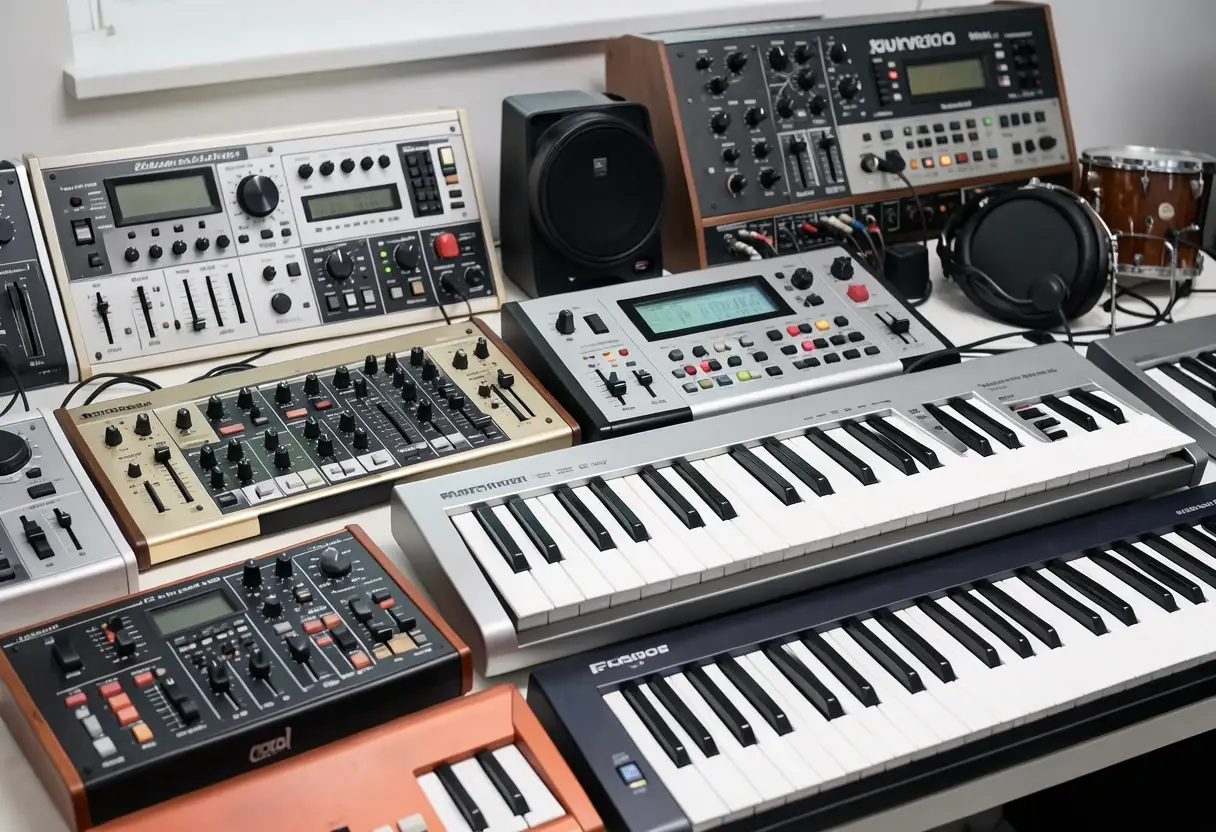
Jean-Michel Jarre’s Machines: A History of Electronic Music profiles 150 electronic instruments and devices, from early drum machines to present-day music tools, in a £50 Thames & Hudson monograph available through JeanMichelJarre.com during the 50th-anniversary year of Oxygène.
Jarre wrote the volume himself, combining a chronology from the early 20th century with personal recollections of acquiring equipment and turning it into an extensive discography. That makes the book more than a collector’s inventory, although history and memoir occupy the same voice.
Jonathan Bell characterises Jarre as “always seemingly poised between cutting edge and deeply cheesy” and “a genuine pioneer in the use of synthesizers.” The double verdict is useful: the French composer’s technical daring has coexisted with a showman’s instinct for spectacle, which the book neither hides nor fully examines.
What does Oxygène reveal about analogue craft?
Oxygène arrived in 1976, made in a home studio with a Korg Mini-Pops 7, analogue delays and reverbs, and tape-based editing. Jarre also used traditional tape to hold down keys on the original instruments.
The album preceded MIDI and digital recording. Its precise, icy synthesiser tones came from tape edits and manual performance, making those techniques central to the record rather than incidental production detail. This is where Machines earns its premise: the tools explain the music.
How does the chronology move across 150 machines?
Across 150 entries, the chronology reaches from the context of Futurist manifestos to playable sculptures and room-filling devices such as the Arp 2500. It also records custom machines commissioned by Jarre and built by his longtime collaborator Michel Geiss.
As the decades advance, the hardware shrinks while its capability expands. The book names the Fairlight CMI Series 1 and E-Mu Emulator II as early sampling workstations, then reaches the Teenage Engineering OP-1 and the Orchid from Telepathic Instruments.
A separate section examines Soviet-era synth design. Placing it and the Futurist material alongside consumer instruments gives the chronology an art-historical frame rather than a straightforward parade of products.
The description promises a complete sweep, however, and gives no selection criteria or independent curatorial check. Calling every machine part of a story is a publisher’s claim, not a demonstrated editorial standard.
What do the images document beyond the hardware?
Spreads present the synthesisers as photographed objects rather than merely functional diagrams. Three dated performance captions extend that hardware history into Jarre’s live and multimedia work:
- 5 April 1986: Rendez-Vous Houston: A City in Concert in Houston, Texas, showing Jarre’s bespoke ergonomic keyboard.
- 14 July 1990: Paris La Défense: A City in Concert at La Défense, Paris, with its pyramidal stage and Bastille Day fireworks display.
- 31 December 1999–1 January 2000: footage stills from The Twelve Dreams of the Sun at the Pyramids of Giza, Cairo, Egypt.
The visual account also includes the covers of Oxygène from 1976 and Equinoxe from 1978, extending the chronology into the graphic identities attached to Jarre’s records.
Whose history is Machines?
Quotes and reflections come from a broad group of electronic-music figures, including but not limited to:
- Vince Clarke
- Richie Hawtin
- Johnny Marr
- Gary Numan
- Gillian Gilbert
- Nick Rhodes
- Hans Zimmer
These voices broaden the narrative, but the book identifies no separate curator, museum partner or academic editor. Nor does the description specify the form of those contributions. Machines therefore reads as an authored cultural history: authoritative through proximity, but not an institutionally certified account.
Jonathan Bell has written for Wallpaper* magazine since 1999 and now serves as its Transport and Technology Editor. He has written and edited 15 books, including Concept Car Design, 21st Century House and The New Modern House, and co-edits the long-running things weblog.
Do physical machines still matter?
A mid-range laptop can now emulate and deploy almost all of this equipment simultaneously, a contrast that makes the earlier systems easier to see. Physical scale and complexity did matter, but only in relation to musical decisions.
Bell’s sharpest formulation is that artists like Jarre “wrestle them to product coherent sounds.” The phrase compresses the craft: delays, reverbs, edits and key holds become decisions through which separate sources acquire a shared identity.
That point remains persuasive, though physical scale does not by itself prove authorship. The available description does not disclose how its technical narrative was checked, leaving some claims to rest on Jarre’s memory and Bell’s account.
What happens next for the 50th anniversary?
Special 50th-anniversary editions of Oxygène are now in stores. Jarre’s Oxygène-Reimagined portal also lets users splice their own sonic ideas with the album’s audio palette using AI, extending the anniversary from print and playback into participation.
That move carries a caveat: processing a familiar palette does not automatically make a new work. Users still have to supply the musical decisions that physical machines once enforced through their limits.
The immediate future offers a productive test. Print preserves evidence of instruments whose constraints shaped records; the portal asks whether those sounds can support new work. The anniversary’s next verdict will fall on whether the experiment develops an identity of its own, rather than merely demonstrating that the old palette can be processed.
Key points
- The 150-machine monograph is written by Jean-Michel Jarre and published by Thames & Hudson at £50.
- Oxygène was made in a home studio in 1976 using a Korg Mini-Pops 7, analogue delays, reverbs and tape.
- Performance records span 5 April 1986, 14 July 1990 and 31 December 1999–1 January 2000.
- Named contributors include Vince Clarke, Richie Hawtin, Johnny Marr, Gary Numan, Gillian Gilbert, Nick Rhodes and Hans Zimmer.
- Special 50th-anniversary editions of Oxygène are in stores alongside the AI-powered Oxygène-Reimagined portal.
Source: wallpaper.com
Daniel Okafor
Show full bio
News editor covering companies, deals and strategy in Photography exhibitions, photographers, photo books, festivals and awards at Lens Gazette.