Inside the Belly of a Steinway: Charles Brooks' Endoscope Photos Reach Monumental Scale in Adelaide
Former cellist Charles Brooks threads endoscopes into flutes, pianos and yidakis, stacking thousands of frames into cathedral-scale views — now three metres high in Adelaide until 5 December.
A former cellist turned photographer has spent his lockdown years threading endoscopes into cellos, flutes and didgeridoos, and Adelaide is now showing the results at three metres high. Charles Brooks' exhibition Architecture in Music runs at the Immersive Light and Art gallery until 5 December — the first time his images have been displayed in Australia at monumental scale, on a curved screen roughly three metres high and eight metres long.
Brooks, 48, was born in New Zealand and is based in Melbourne. When Covid lockdowns stopped musicians performing, he photographed instruments sitting in repair. 'The moment I saw these photos coming together I realised there was something special here. I had to get into other instruments,' he says.
How does he do it?
He works with modified endoscopes — lenses a few millimetres thick — plus Lumix cameras and a Laowa Probe lens on a Lumix S1R. Because the tiny lens keeps only a small area in focus, he shoots anywhere between a few hundred and many thousands of frames per instrument, shifting focus and rotating the lens a fraction of a millimetre at a time, then stacks the results in software. One shot takes at least eight hours to capture; assembly can take a couple of weeks.
'I'm very careful with the instruments. They're never modified at all,' Brooks says. He adjusts lighting and uses temperature monitors to make sure nothing is damaged. String instruments and guitars get cleaned first, because at this magnification 'specks of dust look as long as an arm' — his method is dry rice swilled around inside, binding dust by static electricity, 'the way they've been cleaning these instruments for hundreds of years.'
What's actually in the pictures?
The catalogue is substantial:
- A Muramatsu 14k rose gold flute owned by Orchestra Victoria's Jessie Gu, handmade in Japan, its barrel lined with thousands of abrasion marks from daily cleaning. 'These are the marks of them being played,' Brooks says. 'They're not sitting in a museum.'
- A yidaki whose ridges were hollowed by termites, not human hands, with ochre from the mouthpiece migrating inward. 'With the light coming through the end, it looks like a nebula.'
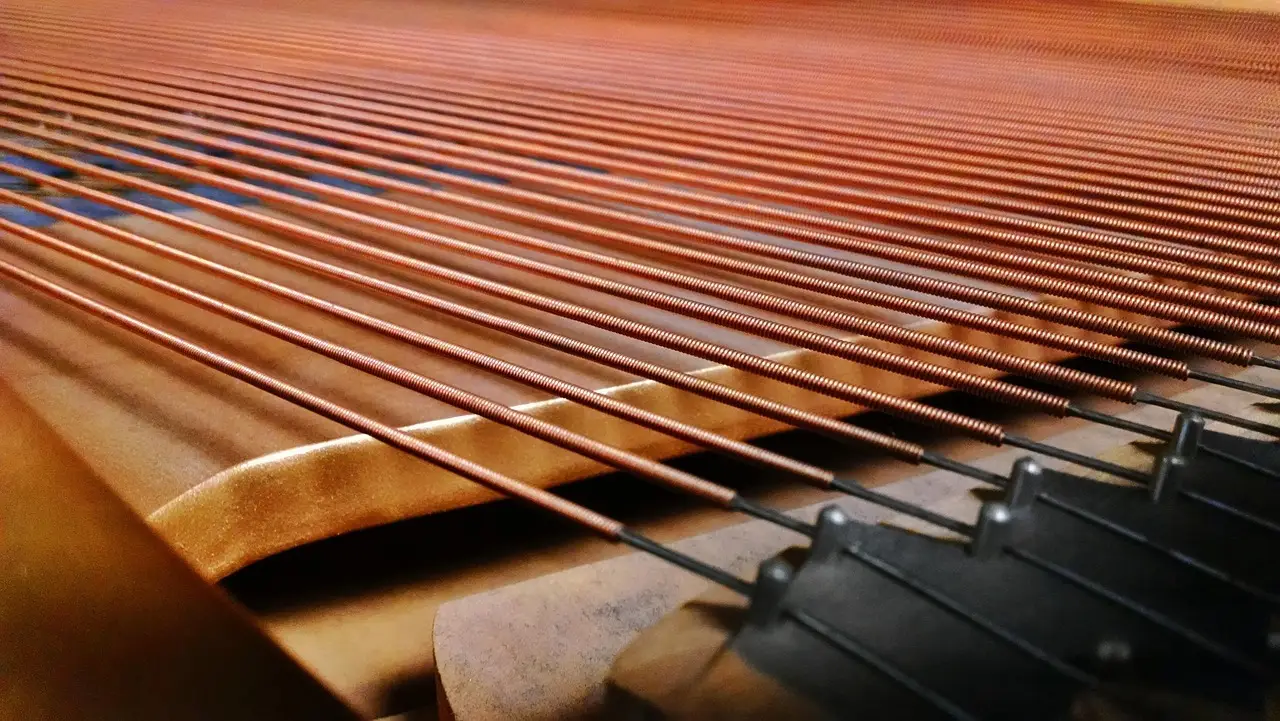
- The wippen, spoons and springs of a Steinway grand — 'probably the most complex wooden thing that's still handmade anywhere,' Brooks says, its strings exerting about 20 tons of pressure on the frame. He finds that level of craftsmanship 'just mind blowing.'
- A German-made bandoneón, cousin of the accordion and inseparable from Argentine tango, whose bellows suggest 'walking up stairs inside a European opera house.'
- Timpani loaned by Orchestra Victoria's principal timpanist Guy du Blêt, whose coin-sized discs read as modernist architecture.
- A Martin D-35 guitar of Madagascar rosewood, owned by Melbourne musician Peter Mrkusich, that feels like a warm concert hall; a guitar played by Nick Granville with the New Zealand Symphony Orchestra; a Buffet Crampon Prestige Low C bass clarinet of African blackwood, lit through its brass bell like a tunnel.
- A c.1780 Lockey Hill cello owned by the Stringed Instrument Company of New Zealand, mid-restoration, bearing original tool marks.
- A double-belled bass trombone made by Bret Gustafson in Adelaide and played by Orchestra Victoria's Ben Anderson.
- Hand-hammered 17-inch Zildjian K symphonic cymbals, stacked flat with a tiny gap. 'They're from the oldest musical instrument company that's still running,' Brooks notes; the surfaces read as seascape or sunset.
Why 'Architecture in Music'?
The premise is scale confusion. By making instruments sharp from back to front, 'your brain doesn't think it's small.' A clarinet becomes a dark tunnel, a Steinway a futuristic train station, organ pipes under a centimetre across become a bamboo forest — Brooks climbed into the tower of St Mark's church in Auckland for those.
The images also double as instrument history. 'You're also looking inside the history of these instruments,' he says. 'All the marks you're seeing are from them being cleaned or repaired, or by the maker themselves.'
The Adelaide display pushes the conceit further than print ever could. 'Suddenly you're not just looking at a picture of a space, you are standing physically inside the belly of a Stradivarius violin or a magnificent Steinway piano,' Brooks says. Photography by Charles Brooks, words in the original series by Emma Joyce. Whether monumental screens become a permanent venue for the series is the question Adelaide's visitor numbers will now answer.
Key points
- Architecture in Music runs at Immersive Light and Art, Adelaide, until 5 December, on a screen about 3 metres high and 8 metres long
- Each image takes at least 8 hours to shoot and up to a couple of weeks to assemble from hundreds to thousands of frames
- Brooks uses modified endoscopes a few millimetres thick plus a Lumix S1R and Laowa Probe lens
- The series began during Covid lockdowns, photographing instruments in repair
- Subjects include a c.1780 Lockey Hill cello and 17-inch Zildjian K symphonic cymbals
Source: theguardian.com
Olivia Hart
Show full bio
Staff writer covering people, launches and day-to-day practice in Photography exhibitions, photographers, photo books, festivals and awards at Lens Gazette.