Ten Years, One Bicycle: Chris Dorley-Brown's East London Holds Still
Chris Dorley-Brown spent a decade photographing East London's intersections, compositing each frame into what Geoff Dyer called a picture of eternity — past, present and future at once.
Chris Dorley-Brown spent roughly ten years photographing East London street corners, and Geoff Dyer, reviewing the series for The New York Times, titled his piece "How to Photograph Eternity." That's the verdict most photographers would frame and hang. Dyer remarked that the images show the past, present and future all at once — a claim Dorley-Brown himself considered spot on.
The series, titled The Corners, began as something else entirely: research for a personal project on his own family history, tracing Irish immigration and how newcomers navigated and settled into the East End. The research took over.
How do you build a photograph without a centre?
Dorley-Brown's answer was to photograph each part of the image separately and composite them, so that no single feature dominates. The result is, in his words, "a collection of details that reflected the act of 'seeing'" — a deliberately democratic composition where architecture, passers-by and pavements get equal billing.
This is a direct challenge to Cartier-Bresson's "decisive moment." Instead of one frozen instant, Dorley-Brown constructs his frames the way a painter or a film director would, layer by layer. The corners of the title are literal: street intersections, places where people meet, cross, negotiate space and walk off into the distance.
The look he chased was a mid-century Kodachrome palette, achieved with digital tools rather than film. The switch mattered practically, too. Once his Nikon DSLRs offered enough resolution, he abandoned the large- and medium-format film cameras he'd been using and went mobile — a bicycle, one small camera, a single lens. In London's confined streets, that's not a minor detail. It changed his entire approach to documentary work.
What was London becoming while he watched?
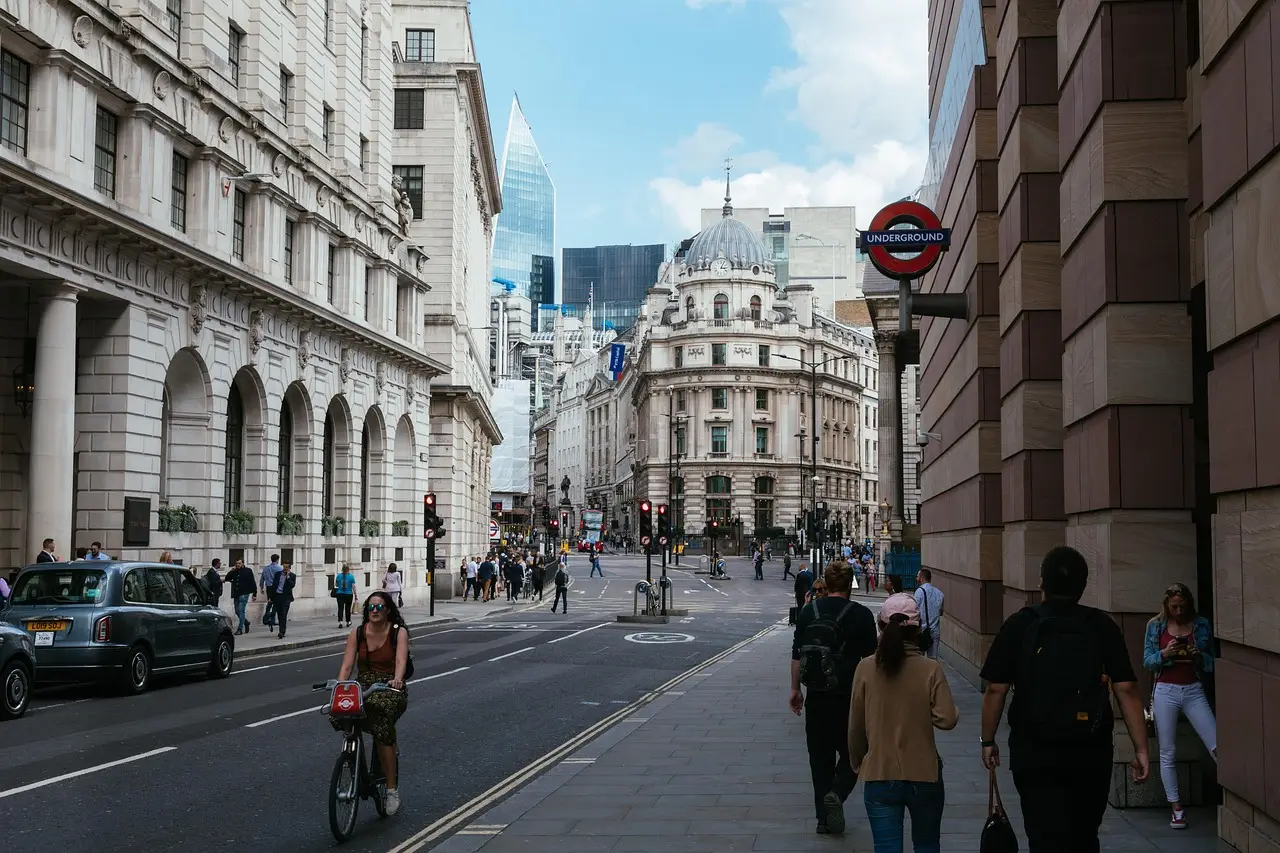
Dorley-Brown is clear-eyed about his subject: a city shifting from a working-class centre of industry into a regenerating, gentrifying one with a more affluent, leisure-based economy. He wasn't comfortable with the transformation. He also admits, with disarming honesty, that he was "part of the problem rather than part of the solution." The middle-class photographer on a bike, documenting the changes he's implicated in — that tension sits inside every frame.
He describes the work as an archive of deliberately ordinary places, made for an audience that didn't exist yet. "I felt that perhaps I was making photographs for people who hadn't been born yet," he says, though he adds he was working instinctively, in a kind of fugue state, letting music, books and conversations drift through his head while shooting.
He's candid, too, about the odd social position of the street photographer — self-appointed recorder of fractions of time, carrying what he calls both a privilege and a responsibility, approached "with the lightest touch I can manage."
Why the corners, specifically?
The title arrived late. Only as the project neared completion did he notice the pattern: every location he'd chosen was an intersection. Junctions, it turns out, are where a city's choreography is most visible — crossing, meeting, dispersing. Fitting subjects for pictures that refuse to settle on any single moment.
Ten years is a long apprenticeship to one idea. Dorley-Brown funded it with commercial work for architects and galleries, plus occasional editorial commissions — a reminder that decade-long projects rarely pay for themselves.
He continues to work in and around London, and his archive of the city in flux only grows more valuable as the flux continues.
Key points
- Chris Dorley-Brown's series The Corners took around ten years to complete.
- Geoff Dyer reviewed the series in The New York Times under the headline "How to Photograph Eternity."
- The images are composites: each part of a frame photographed separately to remove any central focus, challenging Cartier-Bresson's 'decisive moment'.
- Dorley-Brown shot handheld with a Nikon DSLR and one lens, travelling by bicycle, after abandoning large- and medium-format film.
- The project grew out of research into his family's Irish immigration to the East End.
Source: Dodho Magazine
Olivia Hart
Show full bio
Staff writer covering people, launches and day-to-day practice in Photography exhibitions, photographers, photo books, festivals and awards at Lens Gazette.