The Guardian Surveys Martin Parr's Career in a Picture Gallery
The Guardian surveys Martin Parr's career in pictures, from early monochrome documentary work to the saturated colour of The Last Resort and beyond.
Updated
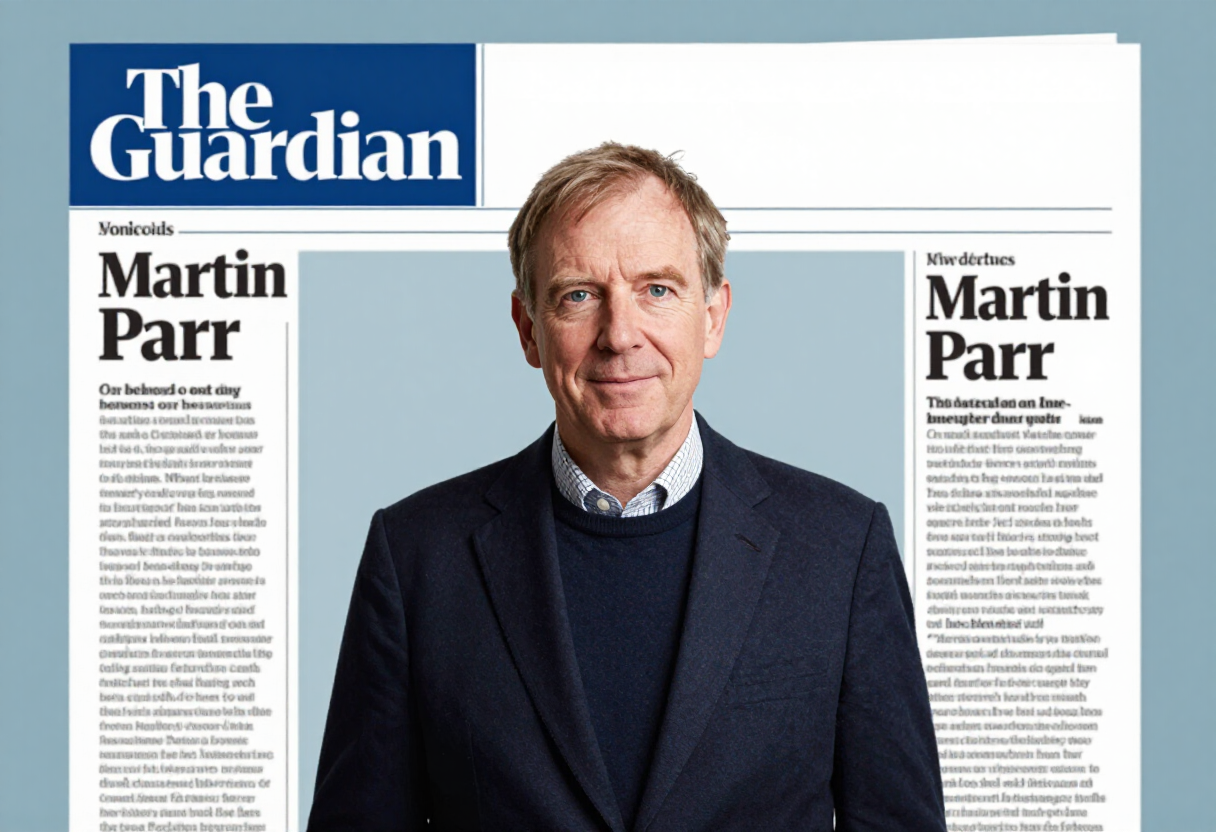
The Guardian has published a career-spanning picture gallery of Martin Parr, one of Britain's most widely recognized — and most argued-over — photographers. The collection walks readers through the phases of a working life that has stretched across more than four decades, from his early black-and-white documentary projects to the saturated colour work that made his name synonymous with a particular strain of social satire.
Parr's career divides, broadly, into two halves. The first belongs to monochrome. In the 1970s and early 1980s he photographed communities in the north of England and in Ireland — work made in the tradition of British documentary practice, but already tilted toward the absolving, unsentimental attention that would define him. These early pictures are quieter than what followed. They observe rather than prod, and they show a photographer learning how much a frame can hold when the subject is ordinary life.
The turn came in the mid-1980s. Parr moved to colour, adopted a macro lens and fill-flash, and produced The Last Resort (1983–85), photographing day-trippers on the faded seaside of New Brighton, near Liverpool. The series landed with force. Litter, sunburn, fried food and restless children filled frames of aggressive clarity. Critics split sharply: some accused Parr of cruelty toward his working-class subjects, while others recognized a more complicated operation — a photographer holding his own culture up to an unflattering, evenly lit mirror. The debate did his reputation no harm.
The technique itself mattered less as signature than as method. Macro lens and flash compressed space, flattened detail and made everything — a chip, a slogan on a t-shirt, a sunbather's pose — equally available to inspection. Parr used the gear the way a satirist uses a sharpened pencil. The pictures look simple. They are not.
The Guardian's gallery traces how Parr widened the territory after The Last Resort. The Cost of Living (1987–89) turned the same gaze on the English middle class of the Thatcher years. Small World (1987–94) followed international tourism to its converging dead ends, the same souvenirs and photo-ops repeating across continents. Common Sense (1995–99), published to coincide with his large 2002 retrospective at the Barbican in London, pushed the colour and the close-up to near-claustrophobic intensity: food, badges, consumer detritus, the small purchases through which people announce themselves.
Alongside the series work, Parr built a parallel reputation as a collector and cataloguer. His holdings of photobooks and documentary ephemera — postcards, propaganda, badges — became a body of work in their own right, and fed his editorial projects as much as his photography fed his reputation. In 2014 he became a full member of Magnum Photos, an institution he had once seemed to satirize from the outside, and in 2017 the opening of the Martin Parr Foundation in Bristol gave his archive, his collection and his advocacy for British photography a permanent home.
Whether Parr's pictures constitute affection or contempt remains the question every viewer must settle alone. The strongest of them refuse to resolve it. They let people be funny and self-serious at once, generous and vain at once, exactly as people are. That refusal is why the work has outlasted the complaints.
The Guardian's gallery arrives as Parr's place in the canon continues to consolidate — through the foundation's programme in Bristol, through international retrospectives, and through the steady scholarly attention his archive now attracts. His career in pictures, laid end to end, reads less like a satire of Britain than a long, brightly lit inventory of how the country has looked at itself.
Key points
- The Guardian has published a picture gallery tracing Martin Parr's career
- Parr's breakthrough series The Last Resort (1983–85) depicted New Brighton day-trippers in saturated colour with macro lens and flash
- The Martin Parr Foundation opened in Bristol in 2017, housing his archive and collections
Source: Google News: photographer retrospective
Olivia Hart
Show full bio
Staff writer covering industry trends and analytics at Lens Gazette.