Seth Cook’s Pollution Images Earn Art + Science Mention
Seth Cook’s “Closer to the Sun” earned an Honorable Mention in States of Change, linking Atchafalaya Basin and Buffalo pollution to unstable, metallic darkroom prints and a watershed-scale expansion.
Lenscratch named Seth Cook an Honorable Mention in its Art + Science Competition, States of Change, in an announcement dated 12 November 2026. The brief sought photography examining art and science through transition, transformation and instability. It ranged from gradual or abrupt change to shifts visible or difficult to perceive, including emotional and environmental conditions.
What does “Closer to the Sun” document?
Cook’s ongoing, multi-year Closer to the Sun studies industrial pollution and altered landscapes. It combines conservation documentation of Louisiana’s Atchafalaya Basin with a material metaphor. Icarus links industrial progress and unchecked ambition to environmental vulnerability.
Heavy metals and chemicals from industrial runoff permeate natural resources. Fieldwork connects apparently quiet sites to industrial legacy across the Mississippi watershed, giving the work documentary force rather than a picturesque account of wetland decay.
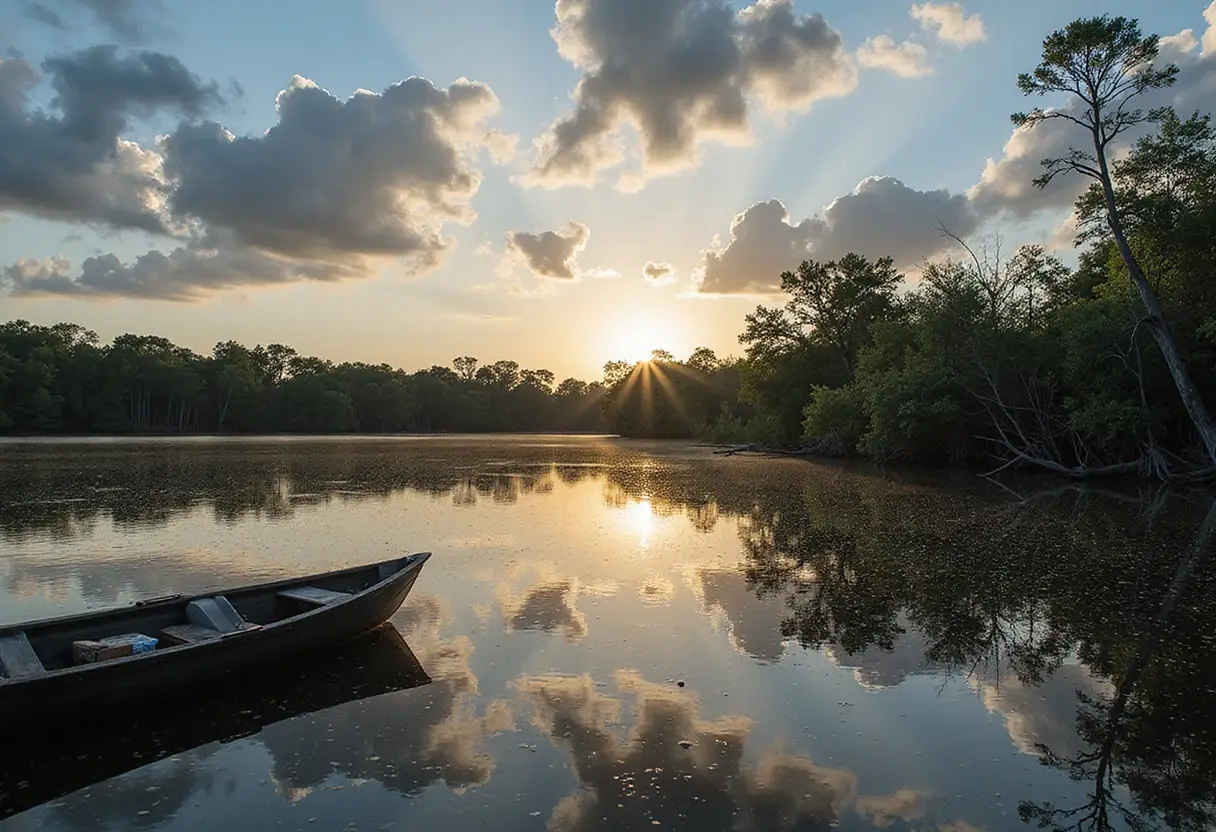
The project began in 2022 with an exploration of the Atchafalaya Basin, described as America’s largest wetland. Active and inactive petrochemical infrastructure occupies its waterways. Guided by the Atchafalaya Basinkeepers and later McGee’s Swamp Tours, Cook photographed terminals, control stations, barges and abandoned highway. These routes and remnants become evidence of hidden contamination.
The series treats the wetland as both a living system and a record of industrial consequence.
How does the darkroom process carry the argument?
Cook renders final prints with the Chromoskedasic Sabattier process, a darkroom technique manipulating silver particles. Black-and-white photographs acquire iridescent gold and silver surfaces. Tonal reversals remain unpredictable, metallic sheens shift and vibrant colours enter. The process is unstable and only partly controllable.
That instability carries the central metaphor: the print’s chemical sheen echoes oil slicks and heavy metals while retaining its black-and-white record. Contamination becomes a physical property of the photograph, not merely its subject. Chemistry and conservation documentation intermingle. Contaminated, re-engineered and quietly poisoned places become evidence and reflection at once.
The series asks how industry reshapes land and the image of America, linking documentation to industrial regulation and environmental preservation. The gamble is that tonal reversal may obscure documentary specificity; the gain is that uncertainty becomes part of the environmental record.
The darkroom makes instability part of the subject.
How has the project moved beyond Louisiana?
In 2026, Cook expanded the work to industrial pollution around Buffalo, New York. A CEPA Gallery-supported residency enabled documentation of surrounding areas and the polluted histories of Love Canal, Tifft Nature Preserve and Silo City. That experience shaped the next phase: the entire Mississippi River watershed.
Cook will centre Superfund and National Priorities List sites along the Arkansas, Missouri and Ohio Rivers. Each corridor has a distinct pattern of industrial and agricultural pollution. A broader drainage-basin view places those differences within one system, making pollution a regional inheritance rather than a local exception.
The scope has moved from one wetland and one industrial city to a connected watershed.
Who is Seth Cook?
Cook comes from Louisiana’s Bayou Teche region, where swamps and marshes shape a studio practice combining photography with other media, materials and techniques. Reviews appeared in Lenscratch, SHOTS Magazine and Analog Explorations.
His work belongs to the permanent collections of the Museum of Contemporary Art of Georgia, Manifest Gallery and the Creative Research Center. Grants include GCSU’s 2026 Academic Affairs Creative Research Grant and the 2024–2025 Digital Humanities Collaborative Grant. He was a 2025/2026 Critical Mass Top 200 Finalist and serves as Assistant Professor of Photography at Georgia College and State University.
Cook’s regional grounding gives the project both subject and method.
What do the jurors bring?
The competition’s jurors were Linda Alterwitz and Ben Hickey.
Linda Alterwitz is an independent interdisciplinary artist focused on photography. For over two decades, she has combined art and science to examine unseen systems linking humanity, technology and nature. A high-resolution thermal camera and other digital and analogue techniques visualise phenomena beyond perception. Her work encourages dialogue about choice, trust and collective experience.
Traditional exhibitions and site-specific installations include FORMAT25 in Derby, UK; the Museum of Art & History in Lancaster, California, for Getty’s PST ART: Art & Science Collide initiative; and the New Mexico Museum of Art in Santa Fe.
Her collections include the Institute for Art + Environment in Reno, Center for Creative Photography in Tucson, Getty Research Institute in Los Angeles and Hilliard Museum of Art in Lafayette. They also include Santa Barbara Museum of Art Fearing Library in Santa Barbara and Rochester Institute of Technology’s Wallace Library in Rochester.
Her honours include Nevada Arts Council Fellowships for Visual Arts in 2025 and 2014, a 2023 Individual Artist Grant from Healthy Communities Coalition in Nevada and a 2020 Individual Artist Grant from the Montana Arts Council.
Ben Hickey is Executive Director of the Center for Exploratory and Perceptual Arts in Buffalo. He previously served as curator of exhibitions and Emily Cyr Bridges Endowed Professor of Art at the Hilliard Art Museum, University of Louisiana at Lafayette.
More than 100 exhibition credits include Brian Kelly of the Marais Press, Letitia Huckaby, L. Kasimu Harris, Robert C. Tannen, Richard Landry, Pat Phillips, Sonya Clark, Hasan Elahi, Dawoud Bey and James Surls.
His recent writing appears in Beili Liu: Mend, published by Art League Houston for Liu’s 2024 Texas Artist of the Year award. Other essayists include Bridget Bray, Annette DiMeo Carlozzi, Eddie Chambers, Katie Pfohl and Kay Whitney.
In 2023, a Samuel H. Kress Foundation Travel Grant supported his co-presentation of Marais Press campus research at the 51st Annual Art Libraries Society of North America in Mexico City. Earlier, he presented Reshaping Our Programming: The Artist in Residence Program at the New York Historical Society with an Association of Art Museum Curators annual conference.
Panelist or consultant roles include Villa Albertine, Joan Mitchell Center, Louisiana Endowment for the Humanities, PhotoNOLA and San Antonio Art League. Earlier posts include Masur Museum of Art, California Museum of Photography, Buffalo AKG Art Museum and Arts Council of Buffalo and Erie County.
Hickey remains active in the Association of Art Museum Curators, serving as trustee from 2015 to 2020. He holds a master’s in art history from the University of California Riverside and a bachelor’s in history from Canisius University.
Their backgrounds connect scientific perception, curatorial practice and institutional stewardship. The next phase moves Cook across the full Mississippi watershed, where three river corridors will test the limits of the metallic image language.
Key points
- Seth Cook received an Honorable Mention in States of Change, announced 12 November 2026.
- Closer to the Sun began in the Atchafalaya Basin in 2022 and expanded to Buffalo in 2026.
- The multi-year project uses the Chromoskedasic Sabattier darkroom process.
- The next phase covers Superfund and National Priorities List sites along the Arkansas, Missouri and Ohio Rivers.
- Cook received GCSU’s 2026 Academic Affairs Creative Research Grant and serves as Assistant Professor of Photography at Georgia College and State University.
Original: seth-cook.com
Grace Kim
Show full bio
Senior reporter covering companies, deals and strategy in Photography exhibitions, photographers, photo books, festivals and awards at Lens Gazette.