Paris Photo 2026: 246 exhibitors and a 200th birthday
Paris Photo's 29th edition at the Grand Palais, 12-15 November, marks 200 years of photography with 246 exhibitors, a Thomas Ruff wall, and a sector on images that destroy themselves.
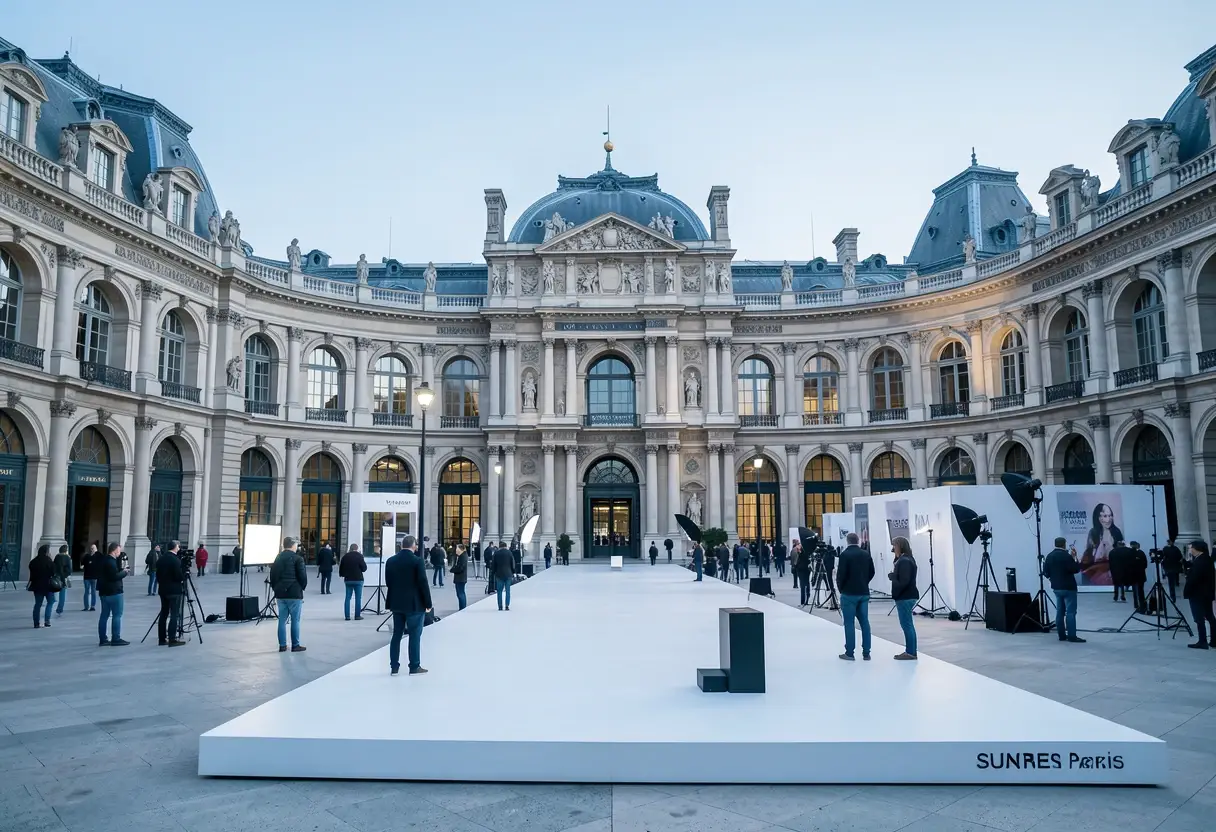
Paris Photo returns to the Grand Palais from 12 to 15 November 2026 with 246 exhibitors from 38 countries, and France itself marks the bicentenary of the invention of photography. The fair's 29th edition arrives at a strange moment. Photography is pulling in two directions at once: towards images no camera ever took, and back to silver, paper and chemistry. Visitors can see both forms this year, sometimes in the same room.
The reference point hangs over the week. In 1838, Louis Daguerre photographed the Boulevard du Temple in Paris. The exposure lasted minutes. Carriages and passersby vanished from the plate. Only two figures stood still long enough to register: a man with his foot raised, and another having his shoes shined. Those two lone figures in an empty city, often described as the first photographed people, set the question this fair keeps asking. What does a photograph hold on to, and what does it let go?
What greets visitors at the Grand Palais?
A 36m retrospective wall of Thomas Ruff's work lines the entrance. Conceived as an 'open book', it moves through more than 40 years of practice, from analogue images to digital simulations. Ruff joins Florian Ebner, head of the photography department at the Centre Pompidou, for a talk on his practice on Thursday 12 November at 2pm.
The bicentenary is at its most literal further in. Hans P Kraus Jr brings works by Daguerre and Talbot, alongside Anna Atkins. Her cyanotypes of British algae, bound into volumes from 1843, are often recognised as the first photobook, a year before Talbot's The Pencil of Nature.
What changes for women artists?
Atkins also reminds us how selectively photography's history has been told. The 'Elles x Paris Photo' path, curated this year by Aldeide Delgado, founder of the Women Photographers International Archive, takes that as its starting point. Since the 'Elles' path launched in 2018, the share of women artists at the fair has nearly doubled, from 20 to 38 per cent.
Delgado's selection, 'An Oceanic Beginning', uses the ocean to retell photography's history without a fixed centre. Among the chosen works is Ous de granota (2025), Alba Yruela's photograph of frogspawn suspended in murky water, each egg a dark pupil staring back. Yruela makes her Paris Photo debut with Barcelona gallery Chiquita Room in the 'Emergence' sector. Elle Pérez, with a solo presentation at Public Relations, also appears. On Friday 13 November, Pérez sits down with writer and curator Gem Fletcher for a conversation co-presented by Aperture and Fletcher's podcast, The Messy Truth. Its title asks: what is the work of photography today?
How does the fair treat digital images?
The 'Digital' sector offers one answer. Its new curator, Marco De Mutiis of Fotomuseum Winterthur, argues that we no longer 'see' through optics alone, but through layers of Photoshop, social media aesthetics, facial recognition and memes. He also contributes an essay to ECAL's 'Soft Photography', a research project led by the late Milo Keller, the school's head of photography, which serves as this year's educational programme. The project turns computation towards emotion: images built to anger, soothe, or keep us scrolling, from rage-bait to ASMR. Rather than asking whether an AI-generated image looks real, it asks what it is designed to make us feel. De Mutiis discusses the project with artist Charlie Engman on Thursday 12 November at 5pm.
Where do the books live?
Friday 13 November belongs to books. At 3pm, the Paris Photo-Aperture Foundation PhotoBook Awards are announced at the fair. At 6pm, Palm* Studios launches Molly Matalon's Lil Big Beach Book, a first look at a larger archive of beach pictures by the California-based photographer.
For many, the book's real home is on the water. At Port de Solférino on the Seine, the photobook fair Polycopies opens on the Concorde-Atlantique boat from 1pm on Wednesday 11 November. It has grown from around 35 publishers at its founding in 2014 to nearly 100 publishers and booksellers, spread across the boat and the quay.
Among the tables is Ciao Press, the Swiss imprint Nicolas Polli founded at the end of 2017 and describes as a 'publishing playground'. Polli launches Dominique Teufen's Rays of Light – Reflected Realities with Éditions Images Vevey, in which a reflective silver surface turns fragments of urban landscapes painterly, with no digital manipulation. In an age of AI, it makes a quiet case for what light can still do alone. Polli's Polycopies picks include Skinnerboox, Yogurt Editions, Fraglich Publishing and Deadbeat Club. The last, based in Los Angeles, makes its Paris Photo debut with work by Daniel Dorsa, Cole Barash and Taylor Galloway, among others.
What happens beyond the fairs?
Photo Days, now in its seventh edition, brings exhibitions across Paris throughout November. At the Maison Européenne de la Photographie, Nanténé Traoré's 'pays des merveilles', the artist's first museum solo show, uses pictures shot in Brittany on expired 1990s film. The Fondation Henri Cartier-Bresson presents 'Nicaragua, Histoire, Mémoire', following Susan Meiselas's photographs of the 1978-79 revolution onto T-shirts, stamps, matchboxes and murals, used sometimes to celebrate the revolution and sometimes to contest it. The Bibliothèque nationale de France's François-Mitterrand site shows 'Photographies japonaises', drawing on one of the first Western collections of postwar Japanese photography, begun in the late 1960s: around 250 prints and 50 rare books, including a section on Japanese photographers looking at Paris.
Opening night is the busiest. On Thursday 12 November at 6pm, ECAL opens 'Soft Photography' at Espace Commines for just two days; among the student works, Min Dai's Rate My Cake renders a mouth in glossy orange, sweetness pushed until it repels. At 7pm, Francesca Allen launches 'Hair' at Cahier Central, her second volume on long hair, following 26 women who gathered in Las Vegas to compete for the first Miss Rapunzel title, photographed away from the stage, their hair spilling across hotel beds and through the casinos. Later, Dans le Bain opens 'Wild Ember Orchestra' at La Montgolfière in the tenth arrondissement, co-created with Pomegranate Press as a transatlantic exchange between American and French artists, Myles Loftin and Sarah Balhadère among them, open until 11pm.
Why does disappearance frame the week?
By Sunday 15 November, Daguerre's street image deserves a second thought. Its two figures are visible only because they stood still; everything else moved too fast for the plate. The problem has now almost reversed. Images are made faster than anyone can look at them. The 'Voices' sector, curated by Zasha Colah and Francesco Zanot, takes disappearance as its theme: photographs made to fade or destroy themselves, and AI images that look like photographs but record nothing. As the bicentenary unfolds, that reversal looks set to define the fair's next century of questions.
Key points
- Paris Photo 2026 runs 12-15 November at the Grand Palais with 246 exhibitors from 38 countries.
- Women's share of artists at the fair has nearly doubled since 2018, from 20 to 38 per cent.
- Polycopies has grown from about 35 publishers in 2014 to nearly 100 in 2026.
- A 36m retrospective wall of Thomas Ruff's work spans more than 40 years of his practice.
- France marks the bicentenary of photography in 2026.
Source: wallpaper.com
Grace Kim
Show full bio
Senior reporter covering companies, deals and strategy in Photography exhibitions, photographers, photo books, festivals and awards at Lens Gazette.