Kostis Argyriadis Turns AI Fragments Into an Archaeology of Ruin
Kostis Argyriadis turns AI-assisted fragments, worn-film grain and scenes of ruin into an uneasy archaeology of algorithmic dystopia, collapse and survival.
By Olivia Hart
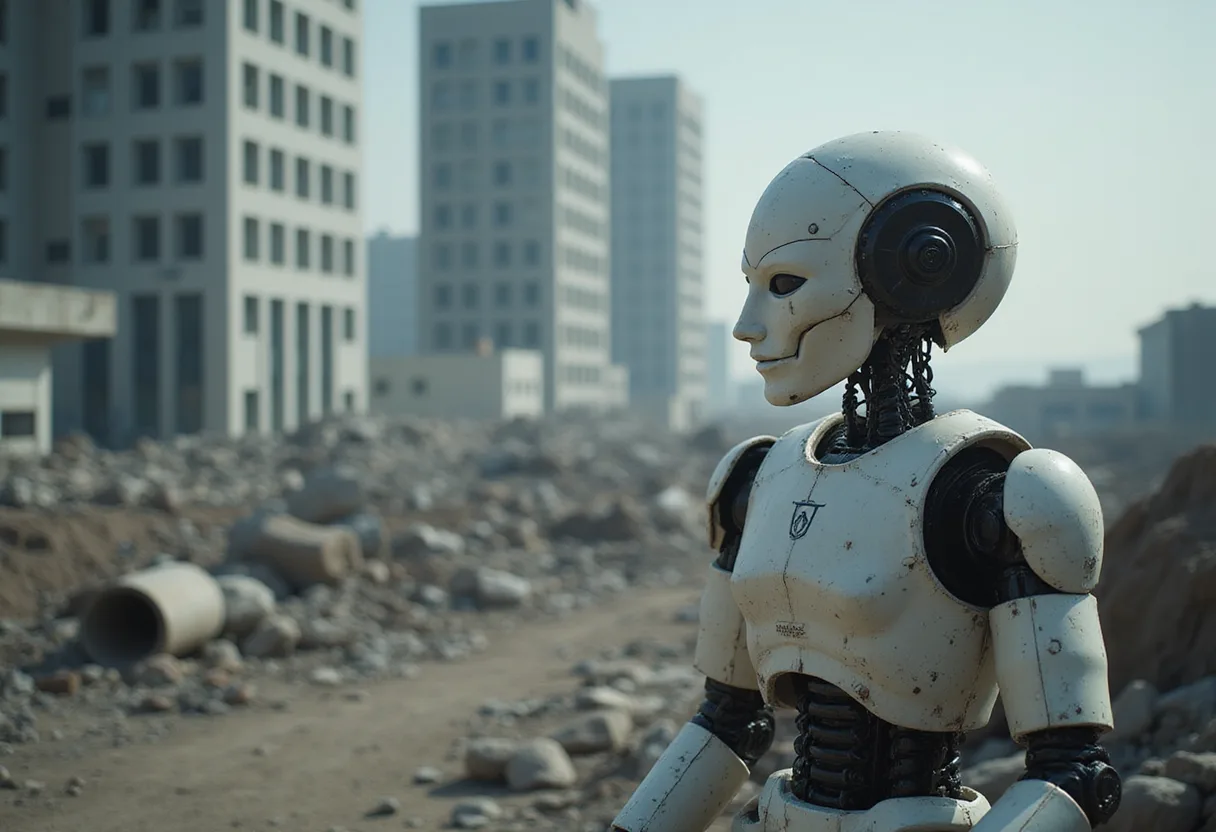
Kostis Argyriadis’s Notes for the End of the World assembles a dystopia through artificial intelligence, photographic fragments, worn-film grain and cut-paper collage. Argyriadis’s project statement defines its method and scale: “This is not merely a depiction of destruction but a world assembled from fragments, photographic remnants, and scattered narratives converging into a shared, ruined landscape.”
Argyriadis frames the premise grander than a single ruin: “Every era bears its own ghosts and its own fears.” For the project, the end of the world is not one historical forecast but a recurring, almost primordial condition across cultures and historical turning points.
The present decade supplies, in its account, algorithmic automation, the fragility of the human condition, climatic destabilization, wars of attrition and an incessant flow of information, misinformation and noise. The body of work grows from that pressure.
The resulting picture feels less like a single scene than a provisional assembly. Its figures hover in perpetual transition. Some function as cold artifacts from a probable, irrevocable future; others act as dark reminders of a present already coming apart. Catastrophe appears both projected and inherited, with scattered narratives converging into a shared ruined landscape.
How does AI serve the pictures?
Artificial intelligence (AI) functions here as a mechanism of memory rather than a generator of seamless spectacle. That distinction matters. Argyriadis uses grain recalling worn film, cut-paper surfaces, shadows and surreal interventions, placing digital construction against the material evidence of decay. The image is made, but appears to have been handled, aged and salvaged. AI is the mechanism, not the spectacle.
The project names two visual poles: studium, a cultural reading, and punctum, the raw detail that unsettles it. The first organises a cultural reading of the era; the second arrives through skeletal figures, severed bodies and cataclysmic terrain. The pictures ask to be interpreted, then decline to settle into a single allegory.
What does the imagery archive?
The project calls this an archaeology of tomorrow. The phrase is arresting, but its motifs sharpen it. The archive includes:
- skeletal figures;
- landscapes resembling nuclear or geological cataclysms;
- severed bodies;
- symbolic objects.
Together, these elements form what the text calls a society in a state of waiting. Technology does not stand outside the ruin; it is tangled with older agonies of belonging and perishing. The synthetic and the archaic occupy the same surface, which gives the work more force than a clean opposition between machine and nature.
The conceptual frame is survival. Every end-of-the-world narrative, Argyriadis argues, is really about survival—not only biological survival, but existential survival: the human impulse to make meaning, sustain discourse and create art while its surroundings change shape, dissolve or lose meaning. Death and transience seep into the cracks of everyday life in a world that refuses to quiet down.
The project therefore attempts to map that anxiety with unusual specificity. It becomes, in the artist’s formulation, a visual confession: a way of holding together the pieces of a shattering reality while converting fear into aesthetic form and contemplation. That ambition is more modest than a forecast: it treats looking as a survival practice.
What does Argyriadis bring to this vision?
Born in Thessaloniki, Greece, in 1981, Argyriadis attended ESP Photography School on a scholarship. His first book, Every Day, Every City, appeared with Agra Publications; his second, DD-MMYYYY, and third, To Love, Fear and Consume, were self-published. He has since presented solo exhibitions in Greece and internationally.
His photobooks now sit in seven named institutional collections:
- Tate Britain Library;
- National Museum of Contemporary Art Athens (EMST);
- Estonian Museum of Photography;
- Greek Museum of Photography;
- Benaki Museum;
- Department of Visual and Applied Arts, Aristotle University of Thessaloniki;
- Basil and Elise Goulandris Foundation.
That reach gives the project context. Argyriadis is not arriving at digital collage as a technical novelty; he enters with an established record of bookmaking and institutional holdings. His stated current concern is the triviality and patterns of everyday urban life, alongside the absurdities, incongruities and transformations of reality.
On the evidence of the project text, the strongest feature is the friction between synthetic assembly and signs of material age. Grain, cut-paper surfaces and shadow stop AI from looking merely slick. Yet skeletal bodies and ruined terrain risk familiar dystopian shorthand; quieter details must keep those figures from becoming formulas.
Argyriadis’s stated attention now rests on ordinary urban patterns and transformations. Notes for the End of the World reads, then, as a hinge rather than a destination: the next test is whether that compressed, damaged archive can make the mundane feel equally unstable.
Key points
- Kostis Argyriadis was born in Thessaloniki, Greece, in 1981 and attended ESP Photography School on a scholarship.
- AI serves as a mechanism of memory rather than a tool for seamless spectacle in Notes for the End of the World.
- Argyriadis has published three photobooks; Agra Publications issued his first, Every Day, Every City.
- Seven named institutions hold his photobooks in their permanent collections.
- Four stated image motifs include skeletal figures, cataclysmic landscapes, severed bodies and symbolic objects.
Source: Dodho Magazine
Olivia Hart
Show full bio
Staff writer covering people, launches and day-to-day practice in Photography exhibitions, photographers, photo books, festivals and awards at Lens Gazette.