Kenya Sugai's Ten-Year Catalog of Tokyo's Crude Coincidences
Kenya Sugai's decade-long 'Portfolio A' captures Tokyo's spills, shadows and groomed pets with strobe and hard cropping; a book, 'First Decade Report', is in progress.
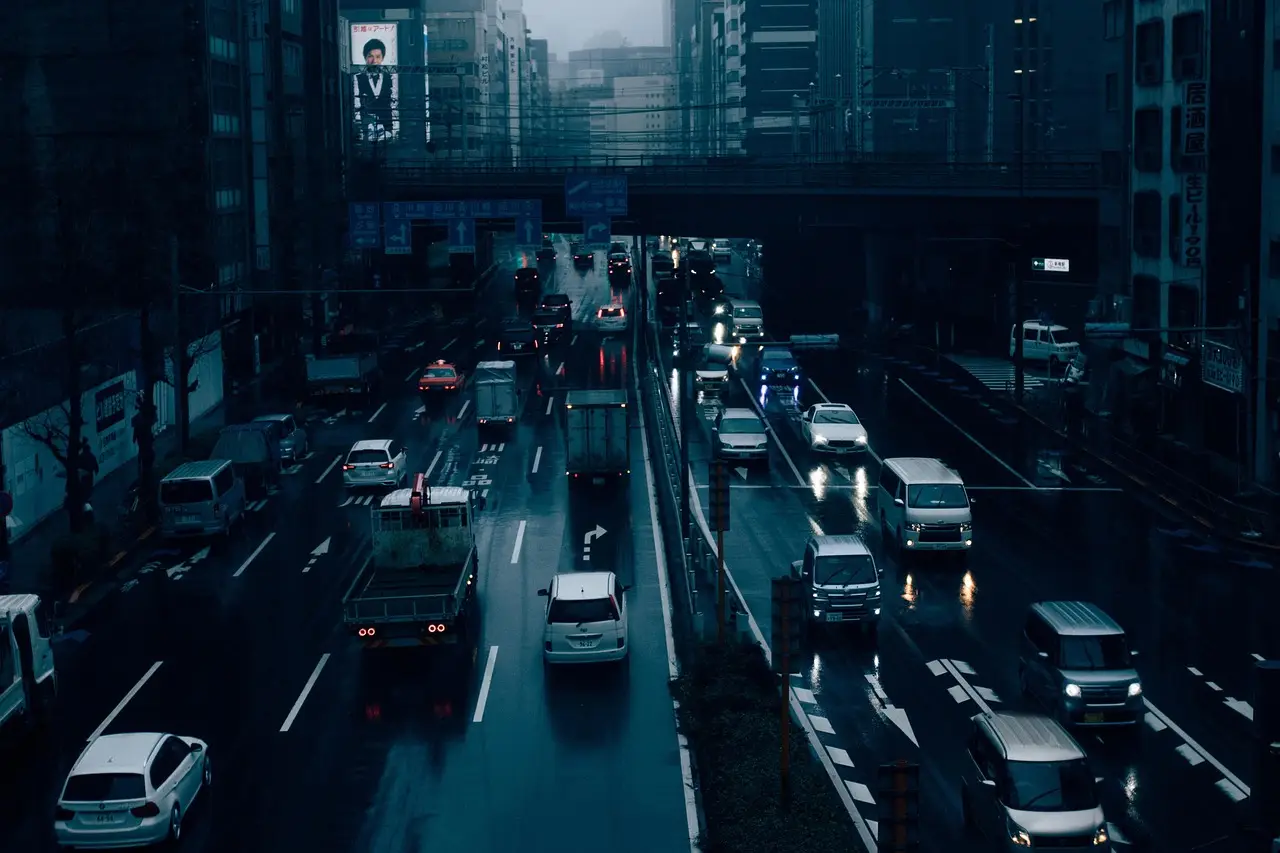
Kenya Sugai has spent more than ten years cataloging Tokyo's broken objects, accidental spills and stray reflections in a rolling archive he publishes year by year on his website as "Portfolio A." Now the Setagaya-based photographer is compiling the existing images into a publication titled First Decade Report, while the series itself continues.
The pictures cut against the city's immaculate image. Sugai hunts society's small errors — the trip, the spill, the eerie shadow — with a direct strobe and abrupt, disjunctive cropping. "I tend to look at the world a bit cynically," he says. "I've always been drawn to society's errors, like someone tripping over, or strange situations that come about by chance."
How did a drifter from Fukuoka find photography?
Born in Kyoto in 1977 and raised in Fukuoka, Sugai admits he drifted after high school. His parents, tired of watching him "drifting around," sent him to study in London. During introductory film studies he showed some of his street photography, and a tutor directed him to Martin Parr's Common Sense, published in 1999. "It had a real impact on me," Sugai says. "It showed me the kind of expression that was possible as a street photographer."
Parr opened a lineage: William Eggleston, then Paul Graham, Richard Misrach and the wider New Color Photography movement. When Canon's Shashin Shinseiki award invited Parr to judge several years later, Sugai entered. An honorable mention convinced him to pursue photography professionally.
What changed his shooting method?
After the award, Sugai began to feel the limits of the traditional snapshot, which struck him as too reactive and too dependent on chance. "It just wasn't interesting to me anymore," he says. "I wanted to figure out how I could bring my own expression into it."
His answer is a daily "personal training exercise" he has kept up for over a decade. He roams high-traffic zones of his home ward — mostly the four-lane Route 246 or the Kanpachi and Kannana ring roads — and caps himself at ten to twenty frames a day. The discipline shows in the work's deliberate abrasion.
The results are abrasive and strangely seductive at once: beauty and ugliness colliding under an unforgiving flash. Humans appear only obliquely, as half-torsos, blurred reflections or a spill on the sidewalk. The city's best-dressed pets — bichon frisés, giant poodles, chihuahuas — make frequent cameos. At times the archive reads as a catalog of urban texture: polished steel, rusted iron, corrugated shutters, shot between browning bushes and tree roots breaking through pavement.
What does a decade of editing reveal?
Sustained selection has changed what Sugai thinks he is photographing. "Over the years, as I kept shooting and selecting, the social meaning of the subjects, and my interest in that meaning, gradually faded," he says. "I started to lose track of details like where I took a photo. . . . The sense of distance, of time, of the situational context all started to dissolve. I began to realize I wasn't photographing the scene itself, but simply my own perception of it."
He reaches for a developmental analogy. "When we are newborns, the first things we see are just colors and shapes, with no distinction between, say, a person or a cup. . . . There's no social understanding yet," he says. "I want to see things that way as much as possible."
For practitioners, Sugai's trajectory offers a concrete case: the snapshot's dependence on chance can be engineered away through daily constraint — a fixed route, a frame quota, a strobe — until the work records perception rather than incident. With First Decade Report now in production and Portfolio A still accruing annual edits, the next decade will test whether that stripped-back way of seeing can sustain a second archive.
Key points
- Kenya Sugai has built the 'Portfolio A' archive of Tokyo street images for over ten years, 2016–ongoing.
- He caps his output at ten to twenty photographs a day along Route 246 and the Kanpachi and Kannana ring roads.
- A tutor in London pointed him to Martin Parr's 'Common Sense' (1999); an honorable mention in Canon's Shashin Shinseiki award, judged by Parr, turned him professional.
- He is compiling the existing images into a publication titled 'First Decade Report'.
Source: Aperture
James Calloway
Show full bio
Market editor covering people, launches and day-to-day practice in Photography exhibitions, photographers, photo books, festivals and awards at Lens Gazette.