Hubble and Webb Photograph the Cat's Head Nebula, 7,500 Light-Years Out
Hubble and Webb paired visible and infrared views of the Cat's Head Nebula, a star-forming pillar 7,500 light-years away in the Carina Nebula that stellar winds are slowly eroding away.
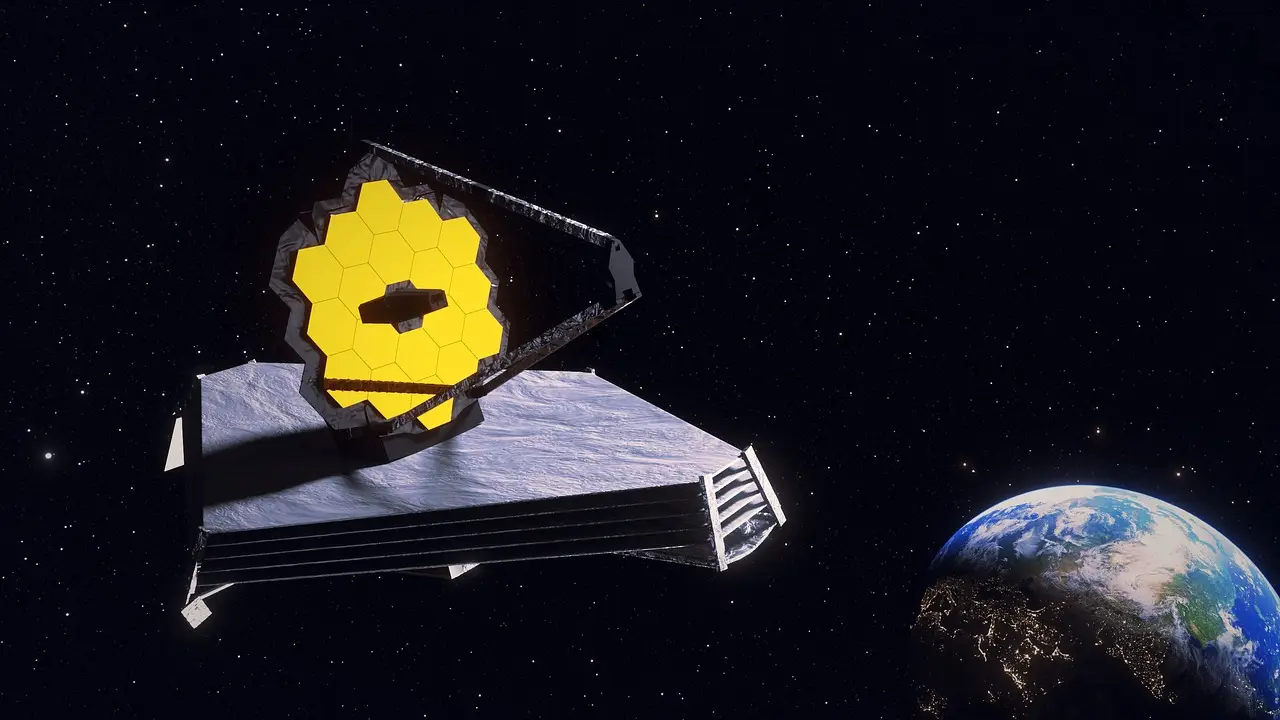
NASA's Hubble Space Telescope and James Webb Space Telescope have jointly photographed the Cat's Head Nebula, a star-forming pillar 7,500 light-years from Earth inside the Carina Nebula. The agency released the paired images as a Halloween feature, describing a "hauntingly dynamic star-forming scene." The release credits NASA, ESA, CSA and STScI, with image processing by Joseph DePasquale of the Space Telescope Science Institute.
The nebula earned its name from its shape. Seen from Earth, it resembles a cat sitting with its back to the viewer. The head turns to the right. A glowing eye completes the figure. NASA framed the object with suitably seasonal language: "Like a spectral form rising out of a cold mist, NASA's Hubble and James Webb Space Telescopes have captured a hauntingly dynamic star-forming scene."
Why two telescopes instead of one?
The answer lies in what each instrument can and cannot see. Hubble observes in visible light. Its view of the Cat's Head Nebula shows the opaque cosmic dust that forms the cat's body. That dust blocks the view of everything behind it.
Webb works differently. Its near-infrared and mid-infrared instruments peer through interstellar dust. Where Hubble shows the surface, Webb shows the interior and the stars forming inside it. The two views together give a fuller picture than either telescope could produce alone.
The most striking image comes from Webb's Mid-Infrared Instrument, known as MIRI. In that rendition the pillar takes on a cold, ghostly character that suits the season. The composite approach, pairing an aging visible-light observatory with a newer infrared one, has become a standard NASA practice for showing both structure and depth in nebulae.
Each telescope covers a wavelength range the other cannot reach, and the Cat's Head images show why the pairing matters.
What shaped the cat?
The feline silhouette is not random. It is the product of violence from nearby massive stars. Intense ultraviolet radiation and stellar winds from giant stars in the Carina Nebula carve into the surrounding gas and dust.
NASA explains the mechanism directly: "As this stellar feedback erodes the surrounding gas and dust, denser material within the feline-shaped pillar resists erosion, at least for now." Denser pockets of material withstand the blast longer than their surroundings. The surviving column takes the cat-like form. That form is temporary, held in place only while the dense material holds out.
The Carina Nebula, the larger structure containing the pillar, is a favored target for Webb and other space telescopes. It is one of the most active star-forming regions within reach of modern instruments.
What happens next to the nebula?
The cat will not last. NASA states that the Cat's Head Nebula will eventually disperse. The stars now growing inside it will change the region's complexion as they mature and radiate energy back into the cloud.
In the meantime, the nebula serves as fertile ground for studying star formation. The interplay of erosion and resistance, the dense knots that resist stellar feedback, and the young stars embedded in the pillar all offer data on how stellar nurseries evolve. The new images give researchers both the dusty exterior, from Hubble, and the hidden interior, from Webb, in a single comparative frame.
Who made the images?
The credit line names the institutional partners behind both telescopes: NASA, ESA, CSA and STScI. Joseph DePasquale of the Space Telescope Science Institute handled the image processing, turning raw telescope data into the released views.
Hubble, launched in 1990, remains productive in visible and ultraviolet light. Webb, launched in 2021, extends coverage into the infrared. Joint releases like this one show the two observatories functioning as complementary tools rather than rivals, and future combined presentations of Carina and other nebulae are likely to follow as Webb continues its infrared survey of star-forming regions.
Key points
- Hubble and Webb jointly imaged the Cat's Head Nebula, 7,500 light-years from Earth.
- The nebula sits inside the Carina Nebula and resembles a sitting cat with a glowing eye.
- Webb's MIRI mid-infrared instrument can see through the dust that blocks Hubble's visible-light view.
- NASA says stellar feedback will eventually erode and disperse the pillar.
- Images were processed by Joseph DePasquale of the Space Telescope Science Institute.
Original: science.nasa.gov
Grace Kim
Show full bio
Senior reporter covering companies, deals and strategy in Photography exhibitions, photographers, photo books, festivals and awards at Lens Gazette.