Four Decades of Susan Silton Question Identity at LA Municipal Art Gallery
Susan Silton's four-decade retrospective at the Los Angeles Municipal Art Gallery traces her scanner-distorted self-portraits, political prints and ongoing Whistling Project.
Susan Silton's four-decade retrospective is now on view at the Los Angeles Municipal Art Gallery, charting a career spent pulling identity categories apart — and asking who benefits from keeping them intact. Silton works as a conceptual artist across prints, photography, video, installation and performance, and the show documents her investigations into queerness, illness, the environment and the politics surrounding them. Her projects are often collaborative and participatory, built around inclusivity and community engagement rather than the solitary-studio model. That is the pitch. Whether a municipal gallery can hold four decades of multimedia practice without flattening it is a fair question, and the exhibition's own framing doesn't fully answer it.
The earliest landmark here is political. Silton was already an established graphic designer when she produced the print "Target" (1991), which superimposes labels denoting gender, nationality and sexual orientation onto an image of a man with a target on his back. The image is blunt by design. It criticizes a culture that reduces people to identity categories instead of recognizing their shared humanity — a critique that read as sharp in 1991 and reads, if anything, sharper now.
What did she do with the scanner?
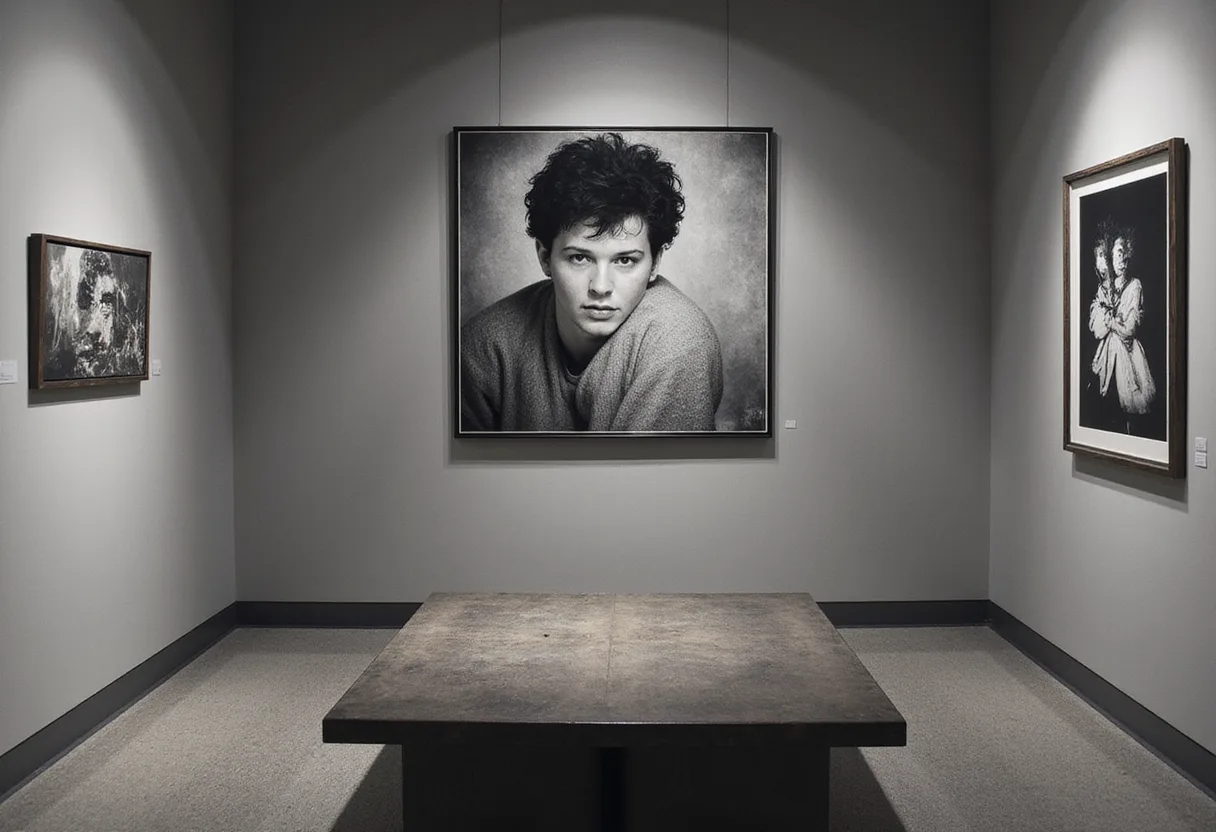
Silton's most inventive move came from repurposing office equipment. She created a series of self-portraits by moving her face across an active scanner, letting the machine smear and stretch her features. In "Self Portrait #4" (1995), her physiognomy distorts into something resembling a malleable substance. The effect works as a metaphor: queerness, in Silton's view, is only one aspect of a person's identity, and it can be fluid. The scanner — a device built to reproduce documents faithfully — becomes an instrument of deliberate unfaithfulness. It's a simple inversion. It's also the strongest idea in the retrospective.
A related strategy produced the series Aviate (1998–2000). Silton scanned and manipulated images of early 20th-century bird illustrations, pushing them into sublime, colorful, linear abstractions. The birds, she suggests, fly freely — no longer defined solely by their behavior or physical characteristics. The parallel with her portraits of fluid identity is clear, perhaps a shade too neat. Where "Self Portrait #4" earns its metaphor through the violence of the distortion itself, Aviate leans on prettiness to carry the argument. Beauty is doing some of the political lifting here, and a skeptical viewer will notice.
The exhibition also reaches into Silton's more recent and ongoing concerns, including "The Whistling Project" (2010–ongoing). The installation "Silver Whistles" (2012) consists of six silver-plated bronze masks — objects that sit at the intersection of sculpture, performance prop and instrument, made to be worn and sounded rather than merely looked at. The series fits the participatory thread running through her career: work that only completes itself when other people engage with it.
Where does the work go from here?
What the retrospective establishes is consistency of theme under constant change of medium. Prints, scanner portraits, abstracted birds, bronze whistles — all interrogate the same pressure point: the gap between how people are labeled and how they actually live. What the gallery materials leave unsaid is how the participatory projects functioned in their original community settings, as opposed to under exhibition conditions. That gap matters for an artist whose stated focus is engagement.
"The Whistling Project" remains ongoing, and its future iterations — who wears the masks, where, and to what end — will test whether Silton's collaborative model can outlast the retrospective frame built around it.
Key points
- Susan Silton's four-decade retrospective is on view at the Los Angeles Municipal Art Gallery.
- "Target" (1991) superimposes gender, nationality and sexual-orientation labels onto a man with a target on his back.
- "Self Portrait #4" (1995) was made by moving her face across an active scanner.
- The series Aviate (1998–2000) manipulated scanned early 20th-century bird illustrations.
- "Silver Whistles" (2012), from "The Whistling Project" (2010–ongoing), comprises six silver-plated bronze masks.
Source: hyperallergic.com
Daniel Okafor
Show full bio
News editor covering companies, deals and strategy in Photography exhibitions, photographers, photo books, festivals and awards at Lens Gazette.