Diane Arbus Gets Her Largest-Ever Retrospective
The largest retrospective of Diane Arbus's career pairs her portraits of celebrities with images of society's outsiders, reopening the debates her camera started decades ago.
Updated
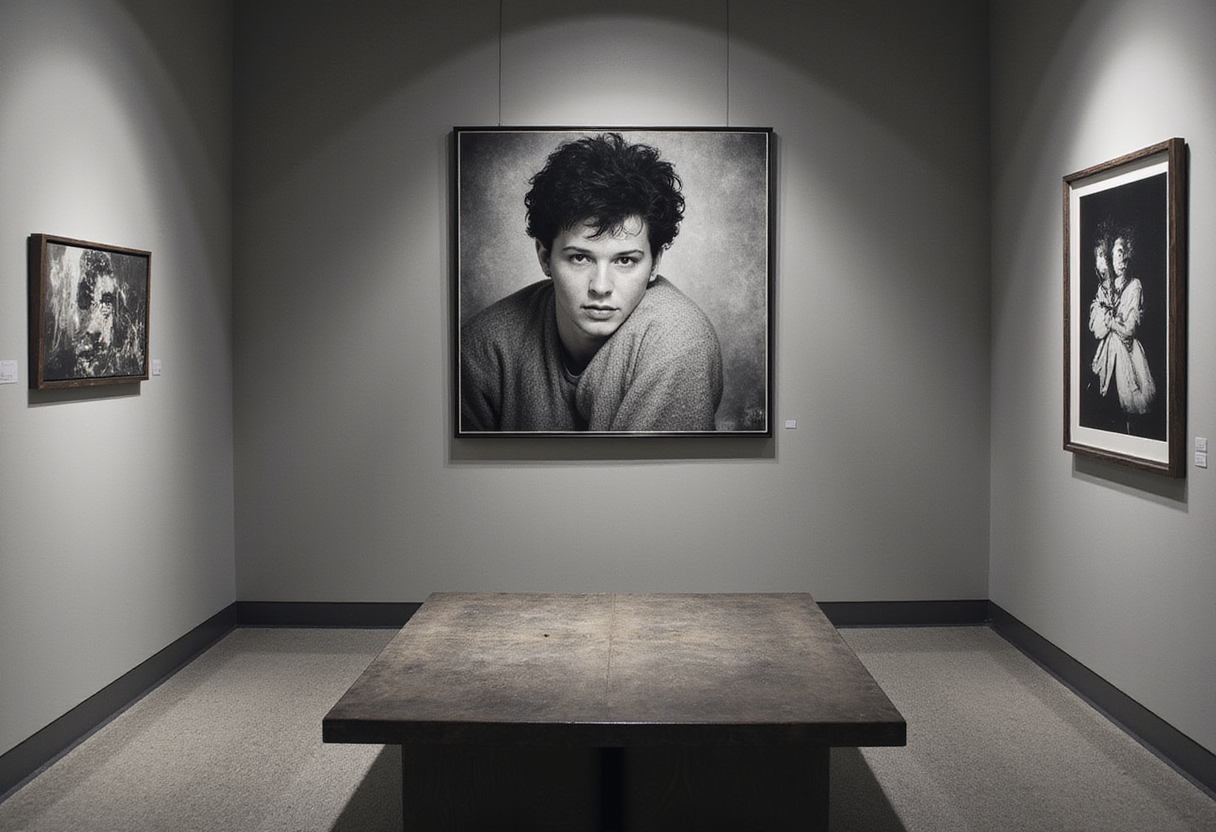
The largest retrospective ever devoted to Diane Arbus is now drawing visitors, and its scale alone marks an institutional milestone for one of the twentieth century's most argued-over American photographers.
According to Smithsonian Magazine, the exhibition assembles photographs spanning Arbus's career, bringing together her portraits of society's most celebrated figures and its most marginalized. That pairing is the essence of her practice. Arbus built her reputation on direct-address portraits — circus performers, twins, socialites, strangers on the street — made with a Rolleiflex held at waist level, a position that forced her subjects to meet her gaze while she met theirs. The retrospective format allows curators to trace that lifelong preoccupation across decades rather than isolating a single famous body of work.
Arbus occupies contested ground in the history of photography. Since her death in 1971, critics have alternately cast her as a fearless documentarian of people whom mainstream society preferred to ignore and as an exploiter of vulnerable subjects. A retrospective of record-breaking size inevitably reopens that argument, because the accumulation of images makes her consistent method unmistakable: she photographed anyone and everyone with the same frontal intensity, refusing to distinguish between the famous and the forgotten.
The exhibition's stated framing — celebrated and marginalized figures presented side by side — suggests the curators lean into that ambiguity rather than resolve it. It is the strongest reading of Arbus available. Her best-known images, such as the 1967 photograph of identical twins in Roselle, New Jersey, and her portraits of performers and eccentrics, derive their power precisely from the viewer's uncertainty about where sympathy ends and unease begins. Seeing celebrities and outsiders hung in dialogue, rather than in separate chapters, reproduces the democratic — some would say merciless — equality of her camera.
A show of this scale also carries institutional weight. Arbus has been the subject of major museum treatments before, but a retrospective billed as the largest ever signals renewed institutional confidence in her centrality to the American photographic canon. Her estate, managed since her death, has tightly controlled prints and exhibitions; the volume of material on view here indicates unusual access to the full depth of her archive.
For a contemporary audience, the questions Arbus raised have only sharpened. Who has the right to photograph whom? Where is the line between bearing witness and taking liberties? The retrospective does not answer these questions, and its curatorial pairing of the celebrated and the marginalized seems designed to keep them open.
Visitors who want to test their own response against the accumulated evidence of a career will find this the most complete opportunity ever assembled to do so — and, on the strength of what Smithsonian reports, an exhibition that positions Arbus for renewed critical attention in the years ahead.
Key points
- The exhibition is the largest-ever retrospective of Diane Arbus's work
- It features photographs of both celebrated and marginalized figures in society
- The show renews institutional and critical attention to Arbus's decades-spanning portrait practice
Source: Google News: photographer retrospective
Olivia Hart
Show full bio
Staff writer covering industry trends and analytics at Lens Gazette.