Do Ho Suh’s First Major New York Solo Show Opens in 2027
The Guggenheim will open Do Ho Suh’s first major New York solo show in February 2027, with more than 50 works across four galleries and the world premiere of his Chelsea apartment installation.
By Marcus Bennett
The Guggenheim will open “I Dream in Another Language,” Korean artist Do Ho Suh’s first major New York solo exhibition, in February 2027, assembling more than 50 existing and new works from over three decades of practice.
The show’s four galleries will hold drawings, sculptures and large-scale installations, sourced from loans and the Guggenheim New York collection. The institutional mix places the museum’s own holdings beside outside loans and new work.
That breadth follows Suh’s account of how people move through places, carry memories and form communities. It also extends his sustained examination of the body and architecture, which he treats as both physical structure and psychological space for individual experience and collective imagination.
The apartment becomes the work
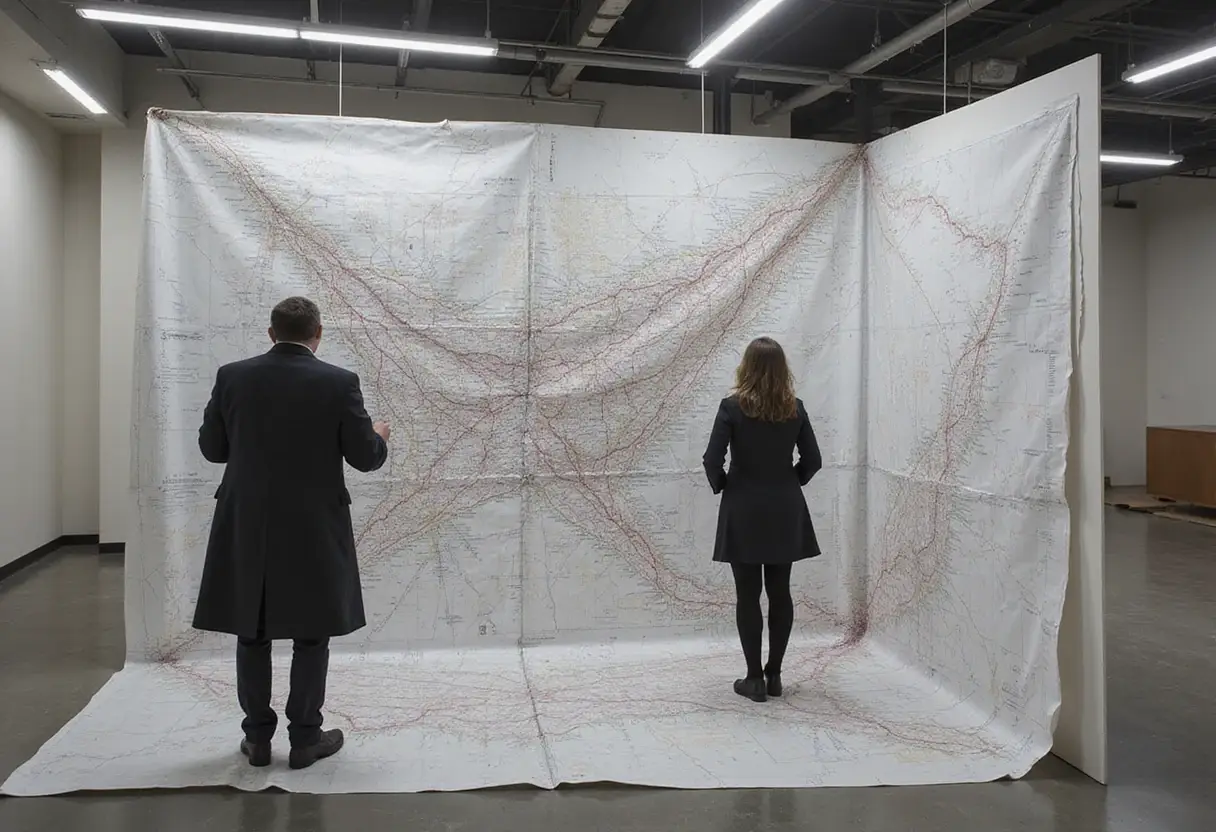
The exhibition will debut “Rubbing/Loving: Apartment A and B, 348 West 22nd Street, New York, NY 10011, USA (2014–26),” giving the New York installation its world premiere. Visitors will enter a full-scale reproduction of Suh’s former home in New York City’s Chelsea neighborhood, which he occupied for nearly 20 years. The work makes a lived address into an environment rather than an illustration of domestic space.
“In 1997 I began renting a half-basement studio apartment in Chelsea,” Suh said. “That space remains the home I have lived in the longest throughout my life. To debut the rubbings I made of that building’s interiors at the Guggenheim, in the city I called home for so long, is poignant, as well as conceptually interesting for me.”
“My work is as concerned with space and movement as it is [with] roots or home. New York brought so many of my ideas into focus and I remain indebted to the city always.”
Drawing with thread and pulp
Across the four galleries, drawings and works on paper will recur. Suh’s distinctive process transfers stitched lines from water-soluble sheets into wet paper pulp, leaving the threads embedded in the paper itself. The technique makes the stitched line a material fact of the sheet rather than only a mark described on it.
That line also carries the exhibition’s concern with translation. “The exhibition’s title points to multiple ways of being and of understanding as we live across geographies, histories and systems,” Suh said. “As someone who has had to wrestle with language, I do not take meaning for granted. In the same way, I do not take what we see for granted.”
“Suh’s work possesses a poetic capacity to move beyond the particularities and limitations of any specific language, culture, or knowledge, speaking to a human condition that anyone who encounters it can recognize,” said Asian Art Initiative Curator Kyung An.
“It offers a picture of what it means to course through this world as one, as other, and as us. It feels particularly apt that the New York ‘Rubbing/Loving’ installation will have its world premiere at the Guggenheim.”
“‘Rubbing/Loving’ is a work about arriving and leaving, loving and mourning. It is a love letter to New York.”
An’s reading fits the exhibition’s scale, but the announcement leaves the achievement unproven. A show of more than 50 works must make the apartment’s intimate force legible without reducing it to a theme; the galleries will have to connect objects, drawings and full-scale rooms.
The Guggenheim will also publish a catalogue containing scholarly essays, a short story and Suh’s own writings. That mix gives the publication the shape of an argument: Suh’s practice joins spatial invention to movement, memory and language. It also signals that the museum sees the exhibition as more than a sequence of objects.
What does this change for New York?
For New Yorkers, the concrete change is straightforward: a reproduced private home will become a public gallery experience. Visitors will enter the apartment at the heart of “Rubbing/Loving,” not merely look at images of rooms associated with its maker. The premiere completes the work’s loop in the city where Suh lived for nearly two decades and says he remains “indebted” to it.
That shift turns movement from a subject in the pictures into the viewer’s route through the exhibition. It also gives the Guggenheim a concrete way to test An’s claim about shared human experience: not in a general theme, but through an address, a body and the artist’s long residence in the city.
In February 2027, the show’s success will turn on whether those concrete encounters can sustain a language the artist says he has had to wrestle with, without pretending that either meaning or vision arrives without effort.
Key points
- “I Dream in Another Language” opens at the Guggenheim in February 2027.
- The four-gallery exhibition contains more than 50 existing and new works drawn from loans and the Guggenheim New York collection.
- The show spans more than three decades of Do Ho Suh’s practice.
- “Rubbing/Loving,” dated 2014–26, will premiere as an enterable, full-scale reproduction of Suh’s Chelsea apartment.
- Suh began renting the Chelsea half-basement in 1997 and occupied it for nearly 20 years.
Source: galeriemagazine.com
Marcus Bennett
Show full bio
Correspondent covering companies, deals and strategy in Photography exhibitions, photographers, photo books, festivals and awards at Lens Gazette.