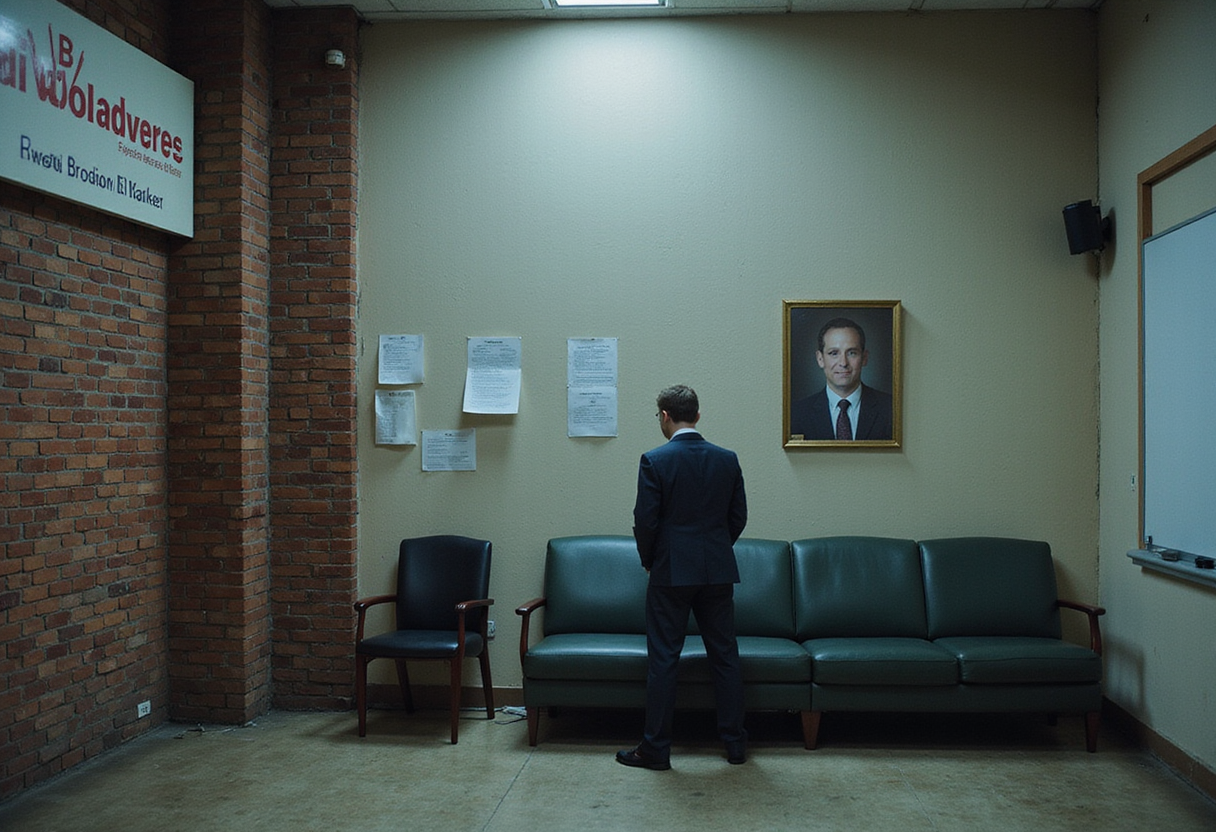
Katherine Hubbard's The Great Room Reaches Vienna's Secession
Hubbard's first institutional solo show outside the U.S. documents five years photographing her mother in Philadelphia, staging mirrors and skin-to-paper body prints at Vienna's Secession until 30 August 2026.
Updated

Katherine Hubbard's The Great Room runs at Vienna's Secession until 30 August 2026, and it marks the artist's first institutional solo exhibition outside the United States. The show documents five years Hubbard spent photographing her mother, Antonette Berger, in Berger's Philadelphia home, beginning in 2020 and continuing through Berger's diagnosis with LATE, a recently characterised brain disease whose symptoms can resemble Alzheimer's. A review by Peter Watkins, published on 23 July 2026 in 1000 Words, argues the exhibition is stranger and less settled than a documentary about dementia, caregiving or the ethics of consent. That unsettled quality, he writes, is the point.
What is actually on the walls?
Two kinds of images make up the exhibition. The first are large-format black-and-white photographs taken inside the house. Mother and daughter appear staged in doorways, on the mother's bed, surrounded by boxes and clutter in varying states of order. As the sequence progresses, the apartment seems to shed its contents, and the photographs lean increasingly on mirrors as props. Watkins singles out a portrait of Berger in the bath, her concentrated, intelligent gaze directed at the camera, as an image that stays with the viewer.
The second group are cameraless darkroom body prints. Berger, covered in Vaseline, was pressed directly onto photographic paper. Watkins reads these as the project's most radical move: where the other photographs sustain an umbilical tether between body and gaze, the body prints collapse that distance entirely. The cord becomes literal, skin against paper.
How does the space itself work?
Curator Bettina Spörr's installation structurally imports the domestic architecture of Berger's house. A dividing wall that once split the "great room" between bedroom and living room is rebuilt in the gallery, its bare studwork exposed and serving as an armature for the photographs. Watkins calls this skeletal structure a Frankenstein version of the curious Victorian-era addition Hubbard herself confessed to hating. The takeaway is simple: the exhibition rebuilds the room rather than merely picturing it.
Who holds the camera?
Hubbard and Berger looped through the apartment with two 4x5 cameras, tripods, mirrors and props, staging images alongside the routines of bathing, dressing and sorting possessions. Hubbard has called the camera a "structuring presence": it inserts pauses into the grind of care work, carving out time outside medical necessity. The circuits tighten, drawing, in Hubbard's words, "smaller and smaller concentric circles" around the false wall, tracking the constriction of Berger's cognitive world without settling into a documentary account of decline.
Mirrors repeatedly catch Hubbard herself, tripod and all, in the act of looking, a deliberate refusal of the invisible, omniscient viewpoint photography usually assumes. In one diptych the roles invert outright, and each woman photographs the other. It would be tempting to call this collaboration, but Hubbard resists the word. She has said she wanted to give her mother "all the power" assumed by the person behind the camera, meaning the inversion is something she designed, a fiction built for her mother to inhabit rather than a symmetry that simply existed between them. The fiction of "Antonette the photographer" runs through the project as a playful counter-current, insisting on respect for a woman whose social image could otherwise flatten into that of patient, elderly, demented.
What about consent?
Watkins had expected the ethics of the project to rest on whether a mother with declining cognition could meaningfully agree to being photographed nude, at her most exposed. Meeting Hubbard reframed the question. Her method, she says, is "homeopathic": rather than smoothing over what is uncomfortable in her mother's house, she uses the image to amplify it. And when Berger was no longer cognitively able to maintain the photographic rituals the two had built, they stopped the work immediately.
Hubbard has also said she loathes the framework in which she is "mothering her own mother," and wonders whether something closer to a theory of queer mothering is at stake: a relation that keeps swapping who holds the camera and who is held by it. At her opening talk, an interviewer offered a simpler reading, that Antonette's role was simply that of mother, and the conversation was left there.
Where does this leave the work?
Watkins places Hubbard in a lineage that includes Carol Mavor, who wrote through her own mother's Alzheimer's in Black and Blue and called the maternal "a cord (unsevered)." During the opening, on the Secession's roof beneath Olbrich's 3,000 gilded wrought-iron laurel leaves, Watkins observed Hubbard's composure briefly loosen, a recognition of the personal cost of rendering grief public. With its run at the Secession and its status as the artist's first institutional showing abroad, The Great Room now positions Hubbard, who is represented by Company Gallery in New York, for wider European attention.
Key points
- The Great Room runs at Secession, Vienna until 30 August 2026.
- It is Hubbard's first institutional solo exhibition outside the U.S.
- The project spans five years, begun in 2020, photographing Antonette Berger in Philadelphia after her LATE diagnosis.
- The show pairs large-format black-and-white photographs with cameraless Vaseline body prints.
- The exhibition was curated by Bettina Spörr; images are courtesy of the artist and Company Gallery, New York.
Original: patreon.com
Grace Kim
Show full bio
Senior reporter covering companies, deals and strategy in Photography exhibitions, photographers, photo books, festivals and awards at Lens Gazette.