Dayanita Singh Turned a Venice State Archive Into Her Museum
Dayanita Singh staged ARCHIVIO at Venice's Archivio di Stato, April 17–July 31, 2026, avoiding Biennale costs with friendship, students, and no sponsor.
Updated
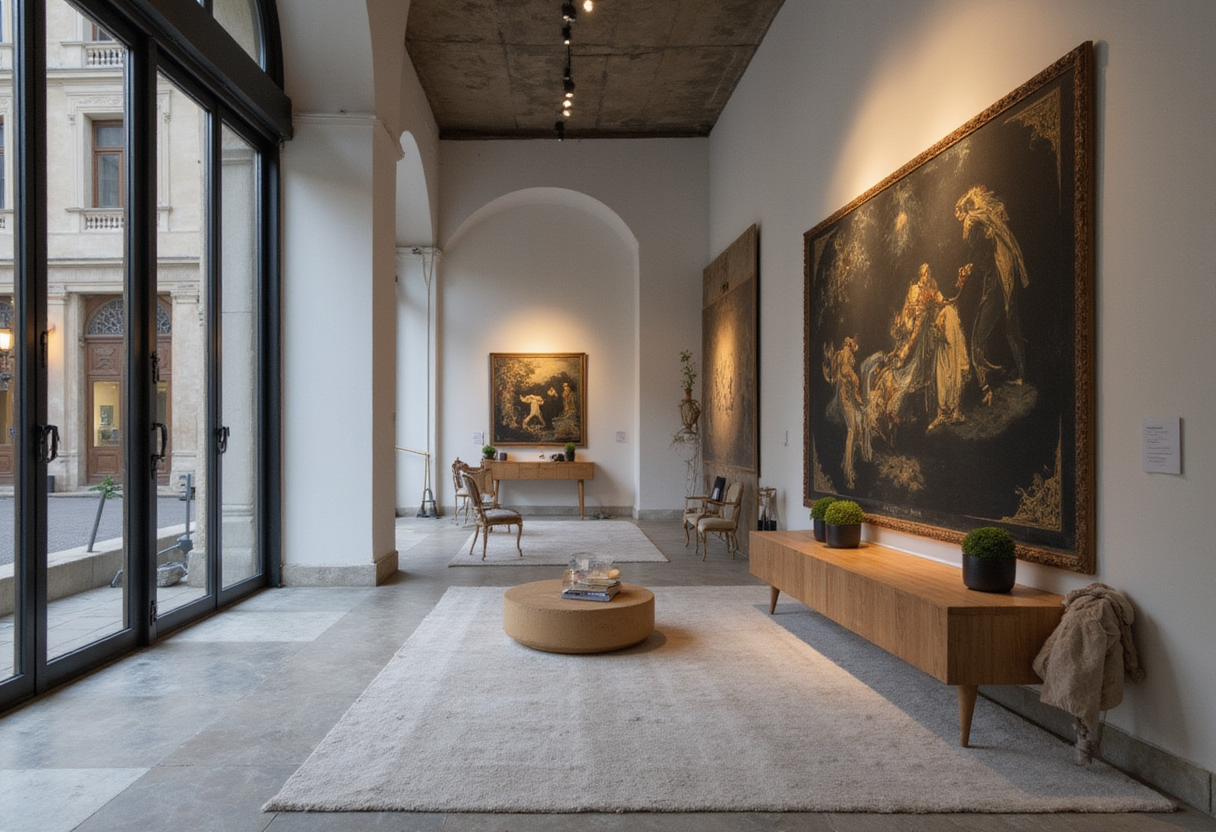
Dayanita Singh showed fifteen freestanding wooden pillars of black-and-white photographs inside the Archivio di Stato in Venice, in a storage room normally closed to the public. The exhibition, ARCHIVIO, ran from April 17 to July 31, 2026. It cost a fraction of a typical Biennale presentation. Singh staged it deliberately outside the Biennale calendar, opening instead with the literature festival.
Singh has photographed Italian archives for more than a decade. Her own archive has fueled many of her inventive installations. For ARCHIVIO, she excavated twenty-five years of her own pictures, all made in Italy. Curator Andrea Anastasio described the result as a "relational cartography."
By Grace Kim
How did the exhibition come about?
The story starts in 2002, at the Isabella Stewart Gardner Museum in Boston. Singh was an artist in residence there. She began photographing chairs. Pieranna Cavalchini, the museum's curator of contemporary art, sent her to Florence and to the furniture historian Fausto Calderai. That connection led her to the Corsini Archive, where, as she puts it, her jaw dropped.
A friendship network brought her to Venice around 2013 and 2014, through Barbara Bianchini and Luigi Vigevani, professors in Milan who owned work from her 2003 Hamburger Bahnhof show. Her friend Massimo Warglien, a professor at Ca' Foscari University, secured her permission to enter the Archivio di Stato, perhaps in 2015. She kept returning. She photographed in that room for ten years. Roughly a year and a half before the show, the archive's director invited her to exhibit there.
Singh's answer was simple. "Of course. It's a dream. I would love to."
The takeaway: a decade of patient access, built on friendships, produced the exhibition.
What does the artist mean by calling herself an archivist?
Singh rejects the label of photographer. In conversation with Sarah Meister, she said: "I am an archivist. And I think that's what I've done my whole life, is to archive places, people that I've been drawn to." Her archive is, she admits, completely subjective.
The material kept shifting. She once cataloged pictures by object—chairs, glass, statues. For ARCHIVIO she sorted by city: Palermo, Naples, Rome. Yet the images rarely show those places directly. Friends from Rome told her the pictures felt more Roman than any postcard view.
She found a structural parallel between her method and the archivists' own. An archivist told her she had never once asked to open a document. Archivists work that way; in a lifetime, one might go through only a single shelf. Singh enters a place the same way, with a map. Before visiting Texas, she would first look for a house museum. The idea of the archivist photographer, she said, has become an important thought for her.
The takeaway: Singh borrows the archivist's discipline and applies it to her own fluid, human record.
How did she avoid the costs of Venice?
Singh analyzed the budget of a typical Venice presentation and found it would run about 150,000 euros before making any work. Each line item became a problem to solve.
- Docents for six months would have cost 25,000 euros. Instead, she partnered with Ca' Foscari University. Students served as docents for course credit and her mentorship, part of what she calls her "friendship economy."
- Lighting the show properly would have cost 10,000 euros. She accepted the existing conditions and closed early, rather than running to November.
- The fifteen wooden structures were collapsible, keeping shipping costs minimal.
- There was no sponsor.
One core intention was access. The exhibition opened those doors to the public for the first time, letting neighborhood residents see the cloister and the room. Singh said the work "doesn't even feel like an exhibition, because to me, it feels like it just grew out of the floor."
She also made exhibition copies, because photography is too sensitive for four months of that light. The New York Times critic Aruna D'Souza captured the surprise: "What if I told you the most compelling art show in Venice right now consisted of black-and-white photos of Italian archives?"
The takeaway: refusal of the standard budget became the form of the work itself.
Why does Singh call herself an "offset artist"?
Her clearest statement of purpose came in the interview: "For me, art is dissemination. So, when I call myself an offset artist, it's not just the printing. It's the dissemination."
She believes photography can democratize the art world. Yet she sees the medium moving the other way, toward larger prints, smaller editions, and higher prices. She includes herself in that economy. Her answer is the book object.
Her next project is the wall book, which she describes as "that delicious space between being a print on the wall and a book in your bookshelf." Each book holds sixty images and comes in one of sixty different covers. Only sixty copies exist at any time. Buyers who arrive late choose from what remains. Everyone, in the end, receives the same interior—like her earlier Museum of Chance.
The takeaway: the book, not the print, is where Singh sees photography's democratic future.
ARCHIVIO was on view at the Archivio di Stato, Venice, from April 17 to July 31, 2026. Singh's wall book points to where her practice heads next.
Key points
- ARCHIVIO ran at the Archivio di Stato, Venice, from April 17 to July 31, 2026.
- Singh avoided roughly 150,000 euros in typical Venice presentation costs by using collapsible structures, student docents, and no sponsor.
- The exhibition presented fifteen four-sided freestanding wooden structures with black-and-white photographs drawn from twenty-five years of work in Italy.
- Singh photographed in the archive room for ten years before the director invited her to exhibit.
- Her next project is a wall book: sixty images, sixty covers, only sixty copies at any one time.
Original: iicnewdelhi.esteri.it
Grace Kim
Show full bio
Senior reporter covering companies, deals and strategy in Photography exhibitions, photographers, photo books, festivals and awards at Lens Gazette.