Christine Laptuta's Holga Frames Turn Berlin's Holocaust Memorial Into Repetition and Grief
Christine Laptuta's Holga-built series repeats Berlin's grey stelae into the horizon, a memorial essay shaped by her mother's search through 600 bodies for a killed husband.
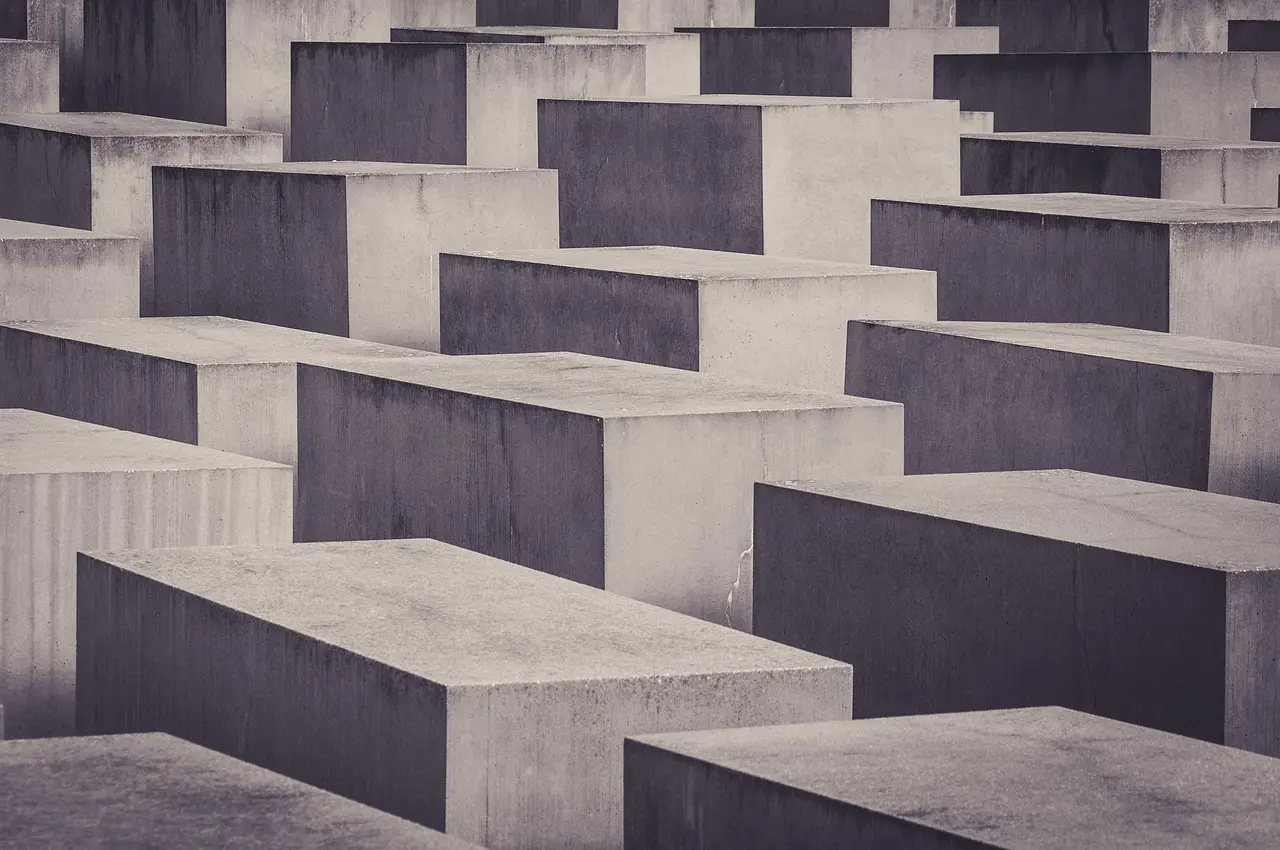
Christine Laptuta has built a photographic essay on Berlin's Memorial to the Murdered Jews of Europe, and the work's premise is simple: repeat the grey concrete stelae frame after frame until repetition itself carries the loss. Her series "Silence and Remembrance" extends those endless rows into the horizon through continuous, duplicated frames, converting Peter Eisenman's 2,711-stelae field — though Laptuta doesn't cite the figure — into an image of scale that no single viewpoint can hold. The photograph does what monuments struggle to do. It counts without counting.
That said, the source material says less about publication or exhibition than a reader might want. We know the portfolio exists and that it appears on her official website. What we don't know is where it has shown, who curated it, or whether any institution has acquired it. That gap matters. Memorial photography lives or dies by context.
What does the work actually look like?
Grey. Vertical. Relentless. Laptuta shoots the stelae in continuous frames, images that are "neither time-based, linear, nor static," then constructs them into composite views that fragment the space. The result blurs assumptions about where one slab ends and the next begins. The memorial's grid becomes something closer to a rhythm — and rhythm, sustained long enough, becomes grief.
She describes the visit itself with unusual honesty. "I did not expect to stay as long as I did or to take so many photographs," she writes, having anticipated a place of commemoration and instead finding herself confined, as she puts it, within a place of mourning. Hours passed. The silence held her.
Why does this memorial weigh on her personally?
Here the story sharpens. Laptuta is the daughter of Ukrainian refugees who lived through the war. Her father was imprisoned. Her mother's first husband was killed — and her mother went looking for him in a basement containing 600 other bodies, searching through everyone's clothing, then took the names to the newspapers so people would know who was there.
That is not abstraction. That is a woman identifying the dead by hand, then publishing the evidence. Laptuta's memorial frames, with their refusal to let any single stele stand for the whole, read differently once you know the basement. The monument, she writes, reminds us that war only destroys. "Grief is its only outcome." The claim is broad. Given the family history behind it, it earns its breadth.
How did a toy camera become her instrument?
Laptuta trained properly. She studied painting, printmaking and photography at the École des Beaux-Arts in Paris and took her BFA from York University in Toronto. In the 1970s she kept a painting studio in Ottawa while building multi-screen slideshows for the National Film Board of Canada's gallery; her photographs were exhibited and published by the Art Gallery of Ontario and the NFB.
The pivot came in 2006, at a photography workshop in Maine she attended to refine her platinum printing. Weather intervened. Organizers handed her a basic Holga — manual film advance, a single aperture setting — and that limitation stuck. She has now used the camera for more than 19 years.
The Holga suits her method. She only discovers what she captured after developing the 2¼-inch film, which forces openness to chance and serendipity. Her portfolios, built on reconstructed landscapes, explore dualities: humanity against nature, past against present, chaos against beauty. Earlier chapters include Los Angeles in the 1990s, where she worked with a Hasselblad on California landscapes, and Portland, Oregon, from 2000, where she ran a darkroom dedicated to platinum-palladium printing — a craft that makes the later embrace of a plastic camera look less like economy and more like argument.
Where does the work go from here?
There is an odd coda. After returning to Canada in 2016 and settling in Victoria, British Columbia, Laptuta took an unplanned sabbatical during which exposed film sat in a freezer for five years; the negatives were finally scanned in 2022. Today she works exclusively with an iPhone 15 Pro, using panoramic mode and no chemicals. Whether the memorial series predates that freeze or emerged from the 2022 scan remains unstated — a question the portfolio's future presentations may want to answer.
Key points
- Christine Laptuta's series 'Silence and Remembrance' photographs Berlin's Memorial to the Murdered Jews of Europe in continuous, repeated frames.
- She has shot with a basic Holga camera since a 2006 Maine workshop — more than 19 years.
- Her mother searched a basement holding 600 bodies for her killed first husband, then published the identities in newspapers.
- Exposed film sat in a freezer for five years before being scanned in 2022; she now works exclusively with an iPhone 15 Pro.
- She trained at the École des Beaux-Arts in Paris and York University, Toronto, and was published by the Art Gallery of Ontario.
Source: Dodho Magazine
Daniel Okafor
Show full bio
News editor covering companies, deals and strategy in Photography exhibitions, photographers, photo books, festivals and awards at Lens Gazette.