Children's Drawings Collide With Seoul in Yeondoo Jung's Photographs
Yeondoo Jung rebuilds children's illustrated worlds as life-sized staged photographs set against the realities of Seoul — where imagination wins the argument.
Updated
Yeondoo Jung's photographs bring children's illustrated worlds face to face with the realities of Seoul. That collision — the crayon imagination of a child rebuilt as a life-sized set, photographed in the South Korean capital — is the core of the project now receiving attention through Designboom's coverage of the artist's work.
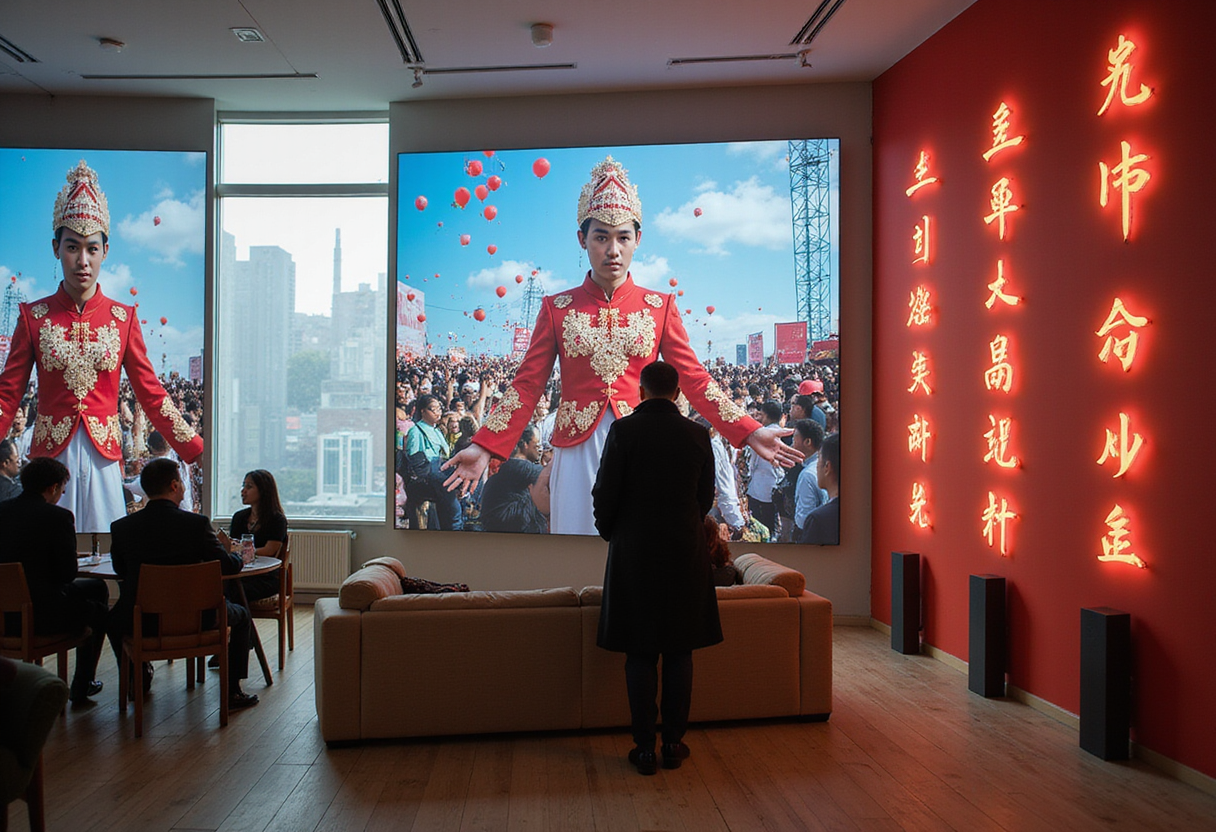
The premise sounds simple. It is not. Jung takes drawings made by children and treats them as complete creative briefs, translating their skewed proportions, invented colors and unlikely logic into staged photographic tableaux shot in and around Seoul. The city supplies the factual counterweight: real streets, real rooms, real light.
Why stage a child's drawing at full scale?
Because the mismatch is the subject. A child's drawing does not obey perspective, anatomy or municipal order. Seoul does. When Jung rebuilds the drawing as a photograph, every divergence between the two registers becomes visible at once — the audience sees both the original imagination and the adult world that must accommodate it.
The resulting images operate on two levels:
- as faithful reproductions of a child's invented world, with its strange colors and proportions intact;
- as documents of Seoul's actual environments — apartments, alleys, public spaces — pressed into service as backdrop.
The child, in effect, wins the argument. The city bends to the drawing rather than the reverse, and that inversion carries the emotional charge of the series. Viewers recognize the urban fabric; they also recognize the drawing's logic from their own childhoods.
Where does the work sit in contemporary photography?
Jung occupies a distinctive position in Korean contemporary art, one defined by staged construction rather than documentary capture. The photographs are built, not found: sets are designed, performers costumed, locations dressed until the child's two-dimensional invention acquires depth, shadow and weight.
This places the work in conversation with the broader tradition of constructed narrative photography, in which the camera records an event authored entirely by the artist. What distinguishes Jung's approach is the source of the authorship. The visual grammar belongs to children — artists without training, convention or self-censorship — and Jung acts as an unusually faithful executor of their vision.
The choice of Seoul as the grounding reality matters as much as the drawings. The city's dense, vertical, rapidly modernized environment is one of the most photographed urban fabrics in Asia. Against that familiarity, the illustrated intrusions read as gentle acts of resistance — evidence that imagination can still colonize the most regulated of spaces.
What do the photographs actually show?
Across the series, ordinary Seoul settings host the products of children's fantasy. The images hold the tension between the mundane precision of the locations and the deliberate wrongness of the illustrations' translation: colors a real street would never carry, figures scaled to a child's internal logic, details that obey memory rather than physics.
The photographs neither mock nor idealize their young authors. Jung's fidelity to the source drawings gives the work its critical dignity — the children are treated as artists whose decisions deserve exact realization, not as cute material for adult amusement.
What comes next for the project?
Designboom's feature signals growing international visibility for Jung's photographs, and the series' premise — granting children full authorial status within a staged photographic practice — continues to find new audiences beyond Korea. As the work circulates more widely, its central exchange between invented worlds and documented ones looks set to remain the artist's most durable contribution to contemporary image-making.
Key points
- Yeondoo Jung's photographs translate children's illustrated worlds into staged images set in Seoul.
- The project reconstructs child drawings at full scale in real urban locations.
- Designboom has featured the series, bringing it to an international design audience.
- The work belongs to the constructed, staged tradition of contemporary Korean photography.
Source: Google News: photography exhibition
Olivia Hart
Show full bio
Staff writer covering industry trends and analytics at Lens Gazette.