Why Portrait Photographers Keep Reaching for the 85mm Prime
SLR Lounge's Pye makes the case for the 85mm prime in portraiture: distortion-free close-ups, buttery depth of field, compression and background control — plus two real limitations.
A single focal length — 85mm — has held its place in portrait photographers' bags for decades, and SLR Lounge's Pye has now laid out four structural reasons why, in a video tutorial accompanying a detailed written breakdown.
The argument rests on craft, not marketing. Each point describes what the lens changes at the moment of shooting, from framing distances to how a background behaves behind the sitter.
Where does the 85mm actually outperform wider lenses?
The first advantage is distortion control across both full-length and close-up work. Wide primes such as 24mm and 35mm force photographers shooting tight to keep subjects centered in the frame, since edge distortion warps facial features. The author notes he uses that distortion deliberately — a 24mm frame filled with guests around a bride gains energy from the warp. Even a 50mm shows noticeable distortion in close portraits, so he caps that focal length at a medium angle. At 85mm or 100mm the problem disappears, freeing composition. A macro in that range adds an exceptionally short minimum focusing distance for detail work.
The second reason is depth of field shot wide open. Any aperture between f/1.2 and f/1.8 delivers what the author calls a "nutella-like-buttery-smooth" fall-off — a street portrait of friends, backlit and shot wide open, succeeds "pretty much every time" regardless of how busy the background. He reports the same effect from entry-level and premium 85mm primes alike. His one caveat: manual-focus examples such as the Zeiss Otus 85mm deliver tack-sharp results but prove cumbersome in high-pressure settings like weddings.
What does perspective compression change?
The third point distinguishes perspective compression from the loosely used term "lens compression." Standing farther back and zooming in creates the illusion of pulling the background toward the subject. Columns behind a couple appear closer than they are; repeating patterns fill the frame and add depth that 24mm, 35mm or 50mm cannot match. The 85mm-to-105mm range at wide apertures marks the sweet spot, and the same range pairs naturally with leading lines — wall geometry steering the eye directly to the subject.
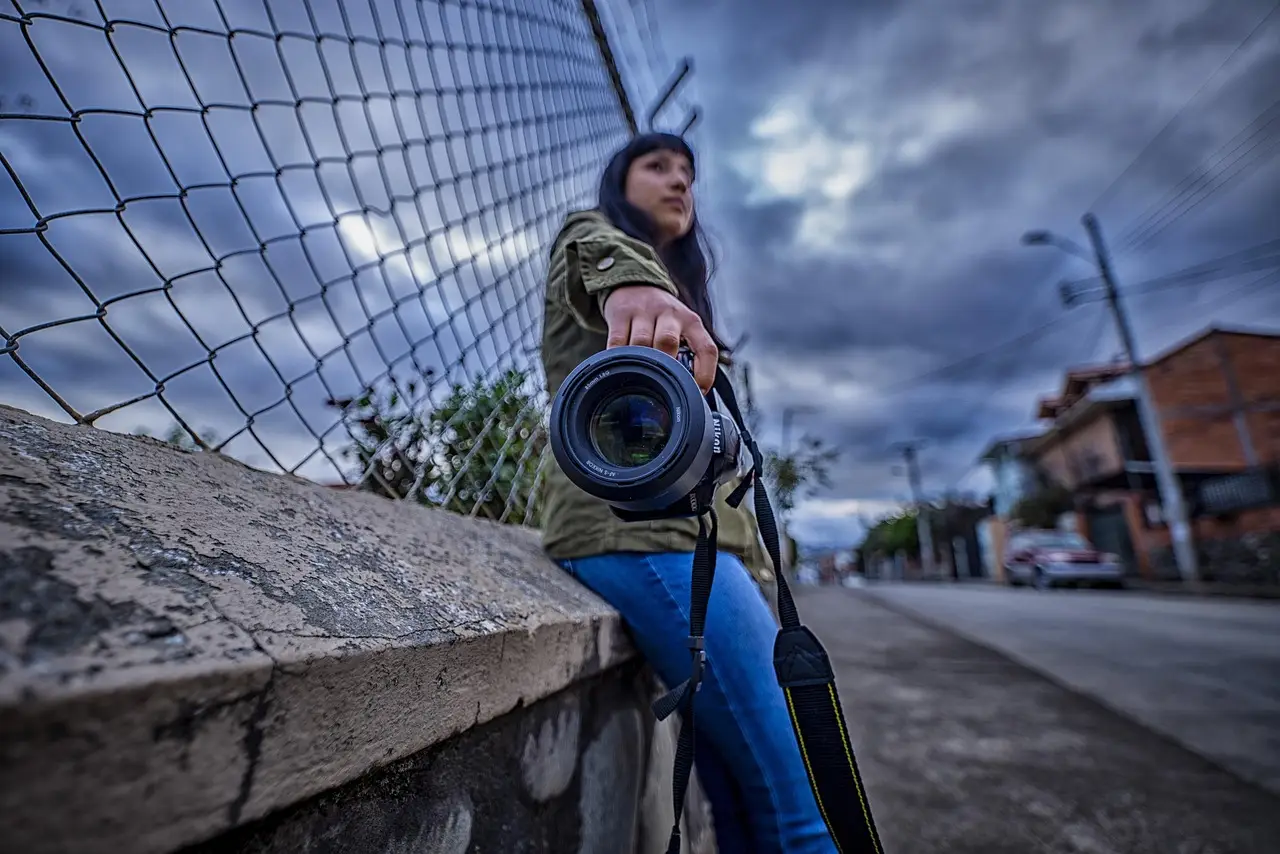
Background control is the fourth advantage, and it compounds the first three. One image frames subjects at distance over open ocean, the water's detail dissolving smoothly into sky. Another, shot beside a parking lot in Los Angeles with the Sigma 105mm f/1.4 Art, uses foliage and shallow focus to read as a lush field. A third conceals a moving truck one sidewalk away.
What are the trade-offs?
The article names two honest limitations:
- Tight spaces. In a small room the 85mm becomes difficult to use and its versatility shrinks; the author reaches for it there only when he wants that specific look.
- Focus speed wide open. Large apertures slow autofocus, varying by make and model, and low light compounds the lag. Fast-moving subjects become frustrating to nail.
The piece closes with the author's standing principle: knowing how to use the gear you own matters more than owning gear you cannot use. SLR Lounge points readers toward its Premium workshop library — courses covering posing, lighting, editing and business — as the next step for photographers who take up the focal length.
Key points
- Apertures from f/1.2 to f/1.8 produce the smooth depth-of-field effect regardless of lens price tier
- 85mm and 105mm primes avoid the facial distortion visible in close-ups shot on 50mm or wider lenses
- The 85mm–105mm range is described as the sweet spot for perspective compression at wide apertures
- Two cited drawbacks: poor performance in tight spaces and slower autofocus wide open, especially in dim light
- The tutorial appears alongside SLR Lounge's Premium workshop library on posing, lighting and editing
Source: slrlounge.com
James Calloway
Show full bio
Market editor covering people, launches and day-to-day practice in Photography exhibitions, photographers, photo books, festivals and awards at Lens Gazette.