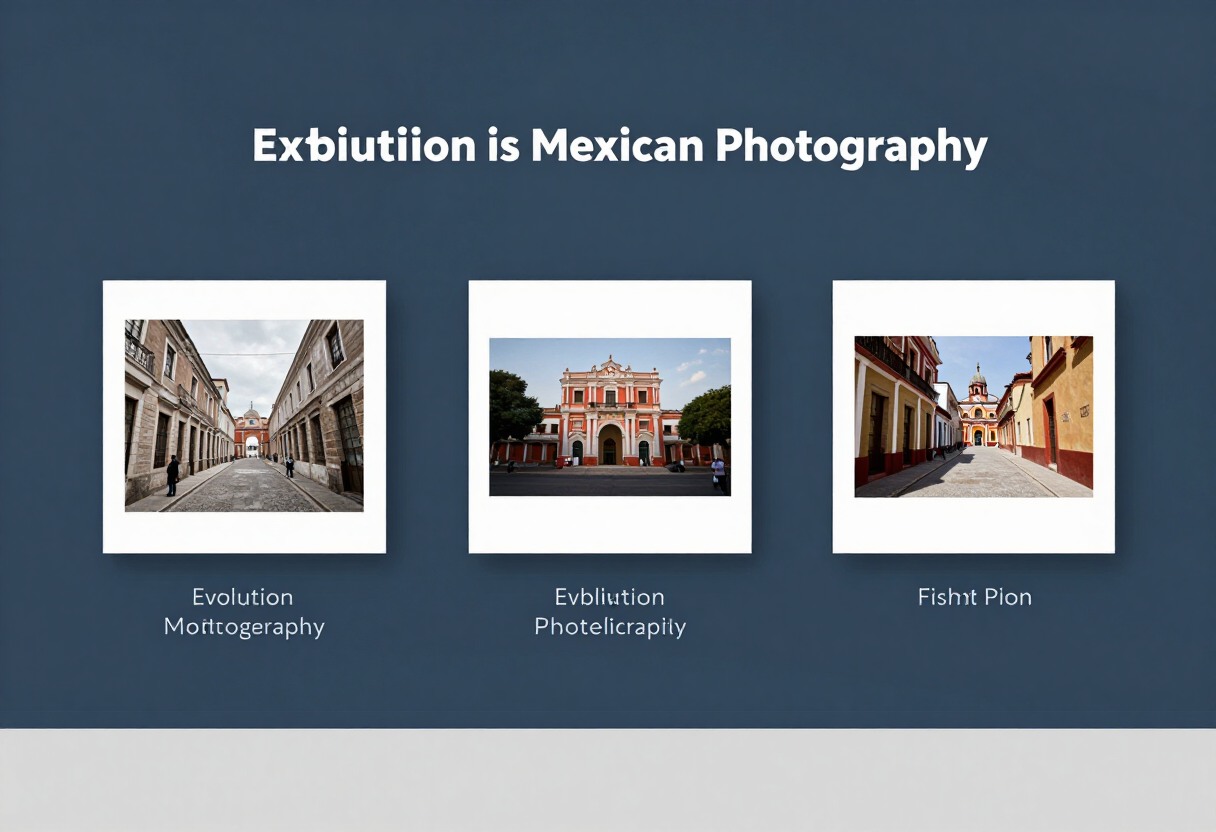
The Getty Assembles Decades of Mexican Photography
The Getty has assembled a survey spanning decades of Mexican photography, placing one of Latin America's most influential photographic traditions at the center of a major US museum.
Updated
The Getty has mounted an exhibition weaving together decades of Mexican photography, according to an announcement reported by Newcity Art — a survey that places Mexico's photographic tradition inside one of the United States' most heavily visited art institutions.
The headline fact is institutional rather than incidental. The J. Paul Getty Museum, based in Los Angeles, holds one of the deepest photography collections in North America, and its decision to organize material around Mexican photography signals how central that tradition has become to the way American museums now narrate the medium's history.
Why does the Getty's framing matter?
Los Angeles is home to the largest Mexican-origin population of any city outside Mexico itself. When the Getty turns its institutional weight toward Mexican photography, it does more than hang pictures on a wall. It inserts Mexican photographers — and the Mexican diaspora's visual culture — into a canon long dominated by European and Anglo-American names.
The word choice in the exhibition's framing matters too. To "weave" decades of photography together suggests the show is structured as an interlaced narrative rather than a strict chronology: different generations, regions and approaches overlapping, informing and complicating one another.
Mexican photography carries a weight of history that few national traditions match. The country produced figures whose influence runs through the entire medium — photographers who documented revolution, architecture, street life and identity with a formal rigor and political urgency that shaped documentary practice worldwide. Any survey touching this lineage inherits those expectations.
What can a decades-spanning survey do?
A show that spans decades gives curators a chance to do several things at once:
- Trace continuities between early twentieth-century practice and contemporary work
- Surface photographers who were influential in Mexico but under-recognized internationally
- Show how Mexican photographers absorbed and transformed international movements rather than merely receiving them
- Connect historical imagery to present-day questions about migration, border life and cultural identity
That last point carries particular force in Los Angeles, where Mexican photography is not a foreign import but part of the visual fabric of the city itself.
The Getty's photography department has a long record of exhibitions that reframe the medium's history, and its scholarship — published through the Getty Research Institute and exhibition catalogs — tends to outlast the shows themselves. A survey of this kind will likely be accompanied by research that feeds the field for years.
How does the show fit a broader institutional moment?
The timing reflects a wider institutional shift. American museums have spent the past decade reconsidering whose photographs hang on their walls, and Latin American photography has moved from the margins of collecting toward its center. Auction results, museum acquisitions and scholarly attention have all grown.
For the Getty specifically, an exhibition of Mexican photography also speaks to its relationship with its own city. Los Angeles institutions increasingly treat Mexican art not as regional interest but as core programming — a reflection of both demographic reality and a genuine art-historical correction.
There is a critical question any such survey must answer: does it treat Mexican photography as a living, evolving practice, or as heritage to be admired from a safe distance? The strongest exhibitions of national photographic traditions do the former, letting contemporary work sit in uncomfortable, productive tension with the historical material.
A woven structure — the metaphor the show's framing suggests — implies exactly that kind of tension. Threads cross; patterns repeat with variation; the contemporary thread cannot be pulled free of the historical one.
What comes next?
The exhibition's run at the Getty will be watched closely by curators and collectors tracking how Latin American photography is being canonized in the United States. If the show delivers on its weaving premise — connecting generations of Mexican image-makers into a single, argumentative narrative — it could shape how the tradition is taught, collected and exhibited well beyond Los Angeles.
Key points
- The Getty has mounted an exhibition spanning decades of Mexican photography
- The exhibition is held at the J. Paul Getty Museum in Los Angeles
- The show is structured as an interwoven narrative across generations rather than a strict chronology
- The report was published by Newcity Art
Source: Google News: photography museum
Marcus Bennett
Show full bio
Correspondent covering consumer brands and retail at Lens Gazette.