Pulitzer Winner Jerry Gay, Who Photographed Exhausted Firefighters, Dies at 79
Jerry Gay, whose Seattle Times photo of four exhausted firefighters won a Pulitzer, died October 14 at 79. He also shot the iconic low-angle image of a shackled Ted Bundy.
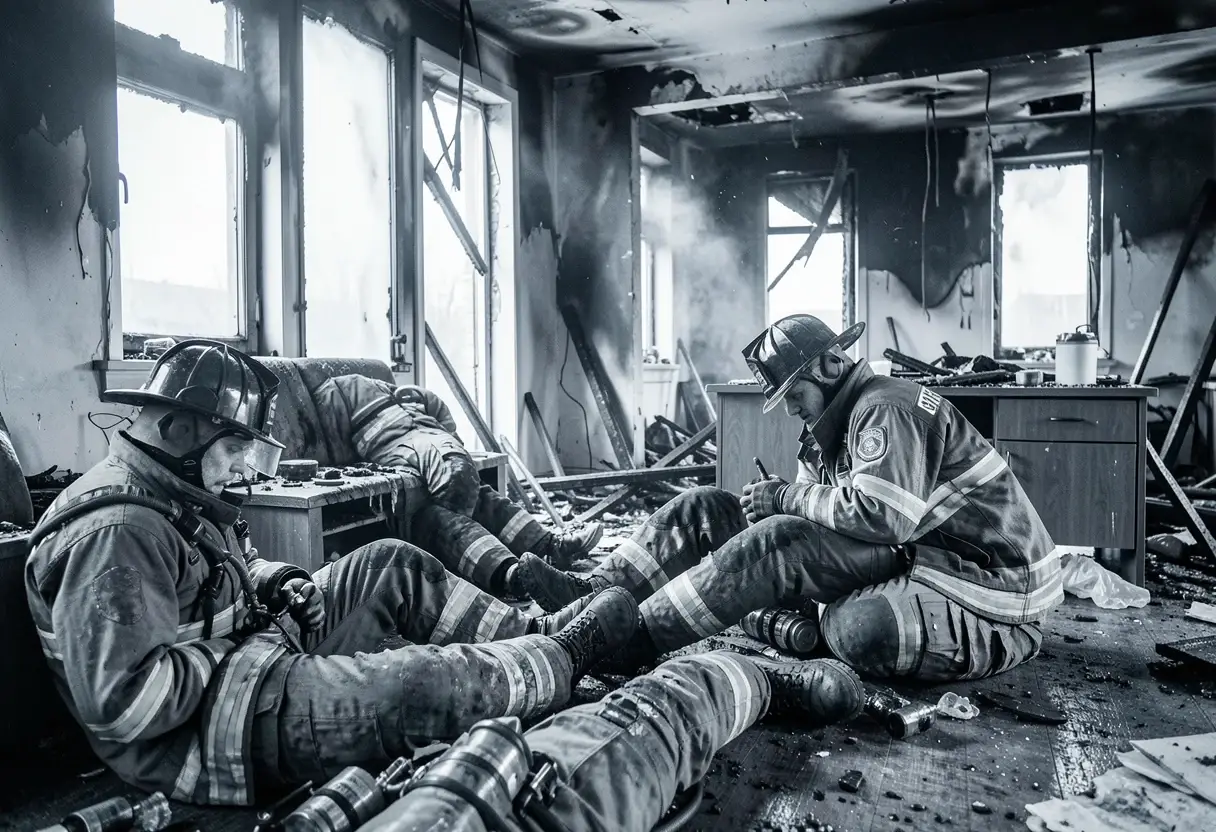
Jerry Gay, the photojournalist whose 1974 picture of four exhausted firefighters won a Pulitzer Prize, died on October 14 at 79 — weeks shy of his 80th birthday.
His daughter, Ellen Bohn, confirmed the death in an Instagram post. "With heavy hearts, we share the passing of our dad, Jerry Gay, 79, who peacefully passed away this morning, October 14th," she wrote. "Jerry was a Pulitzer Prize-winning photojournalist, an adored father, grandfather, and a dear friend to so many. We are grateful for the love, memories, and moments shared with him."
How did a routine fire call become a Pulitzer photograph?
Gay found black-and-white photography in his youth and studied at the Brooks Institute of Photography before building a career covering breaking news across the country. His eye for detail carried him through newsrooms at The Daily Herald, The Seattle Times, Newsday, and the Los Angeles Times.
The defining moment came in October 1974, when Gay was 27 and working for The Seattle Times. According to a 2002 account in the Seattle Pi, he was driving through early-morning darkness, instinctively chasing fire calls crackling over his radio scanner. By the time he reached a house fire in Burien, Washington, crews had largely brought the blaze under control. Gay pushed through mud, fog and acrid smoke until he spotted four spent firefighters sitting against a muddy bank.
"I took six or eight frames, all at once," Gay told the Seattle Pi. "They all had a deep, reflective look. I could tell they were rethinking what they'd just been through."
The Seattle Times published the picture that same day under the title A Lull in the Battle. It showed the men in a moment of exhaustion and reflection — an image the paper's readers, and later the Pulitzer board, recognized as reminiscent of photographs of American servicemen during the Vietnam War. A routine assignment, in other words, produced an unusual photograph: a portrait of the ordinary people who answer emergencies, caught in the pause after the fight.
That comparison to Vietnam-era imagery is doing real work. It is what separated the frame from routine spot news and pushed it toward the iconography of endurance rather than destruction. Though the Pulitzer capped the achievement, the picture's real subject was the aftermath — the part of the job most fire photography skips.
What did his Ted Bundy photographs show?
Gay also made some of the most famous images of serial killer Ted Bundy. In June 1977, while being transported from Garfield County Jail to Aspen for a preliminary hearing, Bundy leaped from a courthouse second-floor window and survived several days in the woods before his capture.
A few months later, according to the Edmonds Beacon, Gay got his chance to photograph Bundy back at the county jail, where the killer remained in custody. The result was an iconic black-and-white photograph shot from a low angle: Bundy's shackled feet beneath a desk in the Colorado jail, a book clutched in his hands, fixing the camera with a one-eyed stare.
"I let him create. He had shackles on his feet," Gay told the Edmonds Beacon. "I got on the floor; he got totally involved in his law book. I just let him give himself to me. I wasn't there to judge him. I was there to document him. His life was there now, and I had to show my appreciation for him giving to me, so he would keep giving and not, at some point, act like a journalist or judge him."
Note what that quote reveals. Gay's method was restraint — floor-level patience, no confrontation, no editorializing through the lens. Two landmark pictures, one of exhausted public servants and one of a shackled killer, came from the same instinct: wait, watch, and let the subject become himself. The gift was recognizing which six or eight frames mattered.
Key points
- Jerry Gay died October 14 at age 79, weeks before his 80th birthday.
- His 1974 photo of four exhausted firefighters in Burien, Washington, published as 'A Lull in the Battle', won a Pulitzer Prize.
- Gay worked at The Daily Herald, The Seattle Times, Newsday, and the Los Angeles Times.
- He took an iconic black-and-white photo of a shackled Ted Bundy in a Colorado jail in 1977, months after Bundy's courthouse escape.
- He studied at the Brooks Institute of Photography before his newspaper career.
Original: instagram.com
Daniel Okafor
Show full bio
News editor covering companies, deals and strategy in Photography exhibitions, photographers, photo books, festivals and awards at Lens Gazette.