Nicole Tung's Overfishing in Southeast Asia Opens at Bronx Documentary Center
Nicole Tung's nine-month Carmignac Award project on overfishing runs at the Bronx Documentary Center until April 26, 2026, spanning Thailand, the Philippines and Indonesia.
Updated
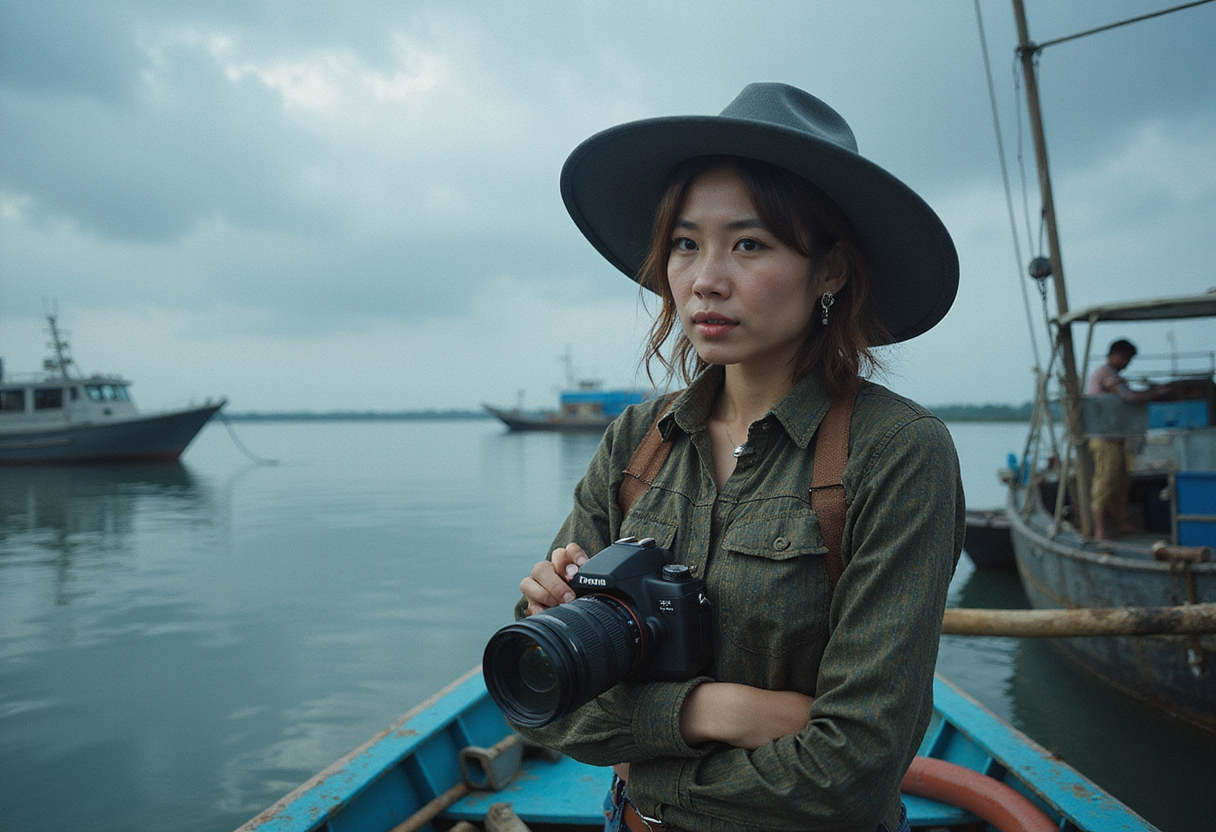
Nicole Tung's Overfishing in Southeast Asia remains on view at the Bronx Documentary Center until April 26, 2026, presenting the nine-month project that won her the 15th Carmignac Photojournalism Award. Supported by the Fondation Carmignac, the photojournalist worked across Thailand, the Philippines and Indonesia to trace what industrial fishing does to marine ecosystems, migrant laborers and coastal communities — an industry she describes as operating largely beyond public scrutiny.
The exhibition's images are unflinching in their specificity. At General Santos, the Philippines' tuna capital, fishermen unload Yellowfin tuna, Bigeye tuna and Blue Marlin after roughly a month at sea. In Tegal, Indonesia, sharks and wedgefish — among the most threatened species — come ashore. A drone photograph shows hundreds of commercial vessels docked at Maura Angke, Indonesia's largest commercial fish port, in Jakarta. In Prasae, Thailand, a veterinarian prepares to clean a hawksbill turtle with two amputated flippers, likely entangled in ghost nets, found by fishermen in a garbage patch.
What binds the three countries together?
One finding recurred everywhere Tung worked. "Every single fishing community I visited, they faced a multitude of concerns, the prime one being that there just weren't any fish of value to be caught near the shore anymore, and that they could not compete with industrial-scale fishing boats," she said. "This was across the board in all three countries I visited."
Her proposal for the award set out to explore overfishing's intersectional nature from the start: labor exploitation on commercial vessels, environmental damage, geopolitics, and fishing traditions threatened by plummeting stocks. What surprised her was how uniformly small-scale fishers had lost their near-shore grounds.
How do the three countries differ?
Tung identifies distinct failures in each:
- Thailand: Post-2015 regulations — including Port In Port Out (PIPO) checks on crews entering and leaving port — came under threat of rollback last year, with parliament pressured to relax laws designed to curb labor abuses and overfishing.
- Indonesia: Conditions on commercial vessels resemble Thailand before 2015, with abuses rife aboard mainly Chinese boats, and to some degree Korean and Taiwanese ones. Enforcement is weak and, according to fishermen she interviewed, corrupt.
- The Philippines: Overfishing intertwines with China's claim to its "Nine-Dash Line" territories, where Filipino fishermen have faced intimidation and been chased at sea by Chinese militias.
Thailand's decade of restrictions produced visible results, Tung found. Many vessels stayed docked because owners could no longer cover operating costs, and some fishing areas made a comeback — evidence environmentalists and small-scale fisherfolk cited for keeping them protected rather than reopening them to commercial interests. Indonesia has signed treaties complying with provisions such as the CITES II appendix, yet enforcing bans on which sharks are caught and sold remains far harder. The Philippines, Tung argues, cannot compete with China, Taiwan and Vietnam, all seeking to exploit its waters, making enforcement of anti-illegal-fishing laws nearly impossible.
What couldn't the camera reach?
One absence marks the project: Tung never got aboard a commercial or supply ship. "Access to get onto a commercial ship or onto a supply ship going out to sea was very difficult, and I did not manage to get access to that during the time I spent reporting," she said. Negotiating it would have taken many more months, as captains and boat owners remain wary of journalists. The interiors of the industrial fleet stay dark.
Her images of shore-side life carry the argument instead. At Tanjung Luar in East Lombok, one of the largest shark markets in Indonesia and Southeast Asia, endangered and vulnerable shark species are hauled ashore at dawn; fins are exported primarily to Hong Kong and China, bones feed cosmetic products, and meat and skins remain a local protein source. On Koh Lipe, Thailand, members of the Urak Lawoi indigenous group charge their boats toward shore during a bi-annual festival — a tribe whose livelihood has shifted from fishing to tourism because commercial fleets emptied their waters.
Tung hopes the work, which has drawn positive media response, makes an invisible supply chain legible to consumers: overfishing feeds into climate change and biodiversity loss that, as she puts it, ultimately hurts us all. The exhibition continues to anchor the Fondation Carmignac's investment in the subject, with the award's annual cycle pointing its lens at a new region next.
Key points
- Overfishing in Southeast Asia runs at the Bronx Documentary Center until April 26, 2026.
- Nicole Tung is the laureate of the 15th Carmignac Photojournalism Award.
- The project was produced over nine months in Thailand, the Philippines and Indonesia.
- Thailand introduced fishing and labor reforms after 2015, including Port In Port Out checks.
- Tung could not gain access to commercial ships during her reporting, as captains distrust journalists.
Original: bronxdoc.org
Olivia Hart
Show full bio
Staff writer covering industry trends and analytics at Lens Gazette.