Josh Aronson Waited Three Years to Develop 'Florida Boys'
Josh Aronson spent five years staging queer Black and Brown coming-of-age scenes in Florida swamps, then waited three years to develop the film. The gamble paid off.
Updated
Josh Aronson spent five years making the photographs in his series Florida Boys, then let the film sit undeveloped for three of them. That's the strangest fact in an otherwise warm interview the Miami-based, Toronto-born artist (b. 1994) gave about the project, and it's the one that tells you most about how he works.
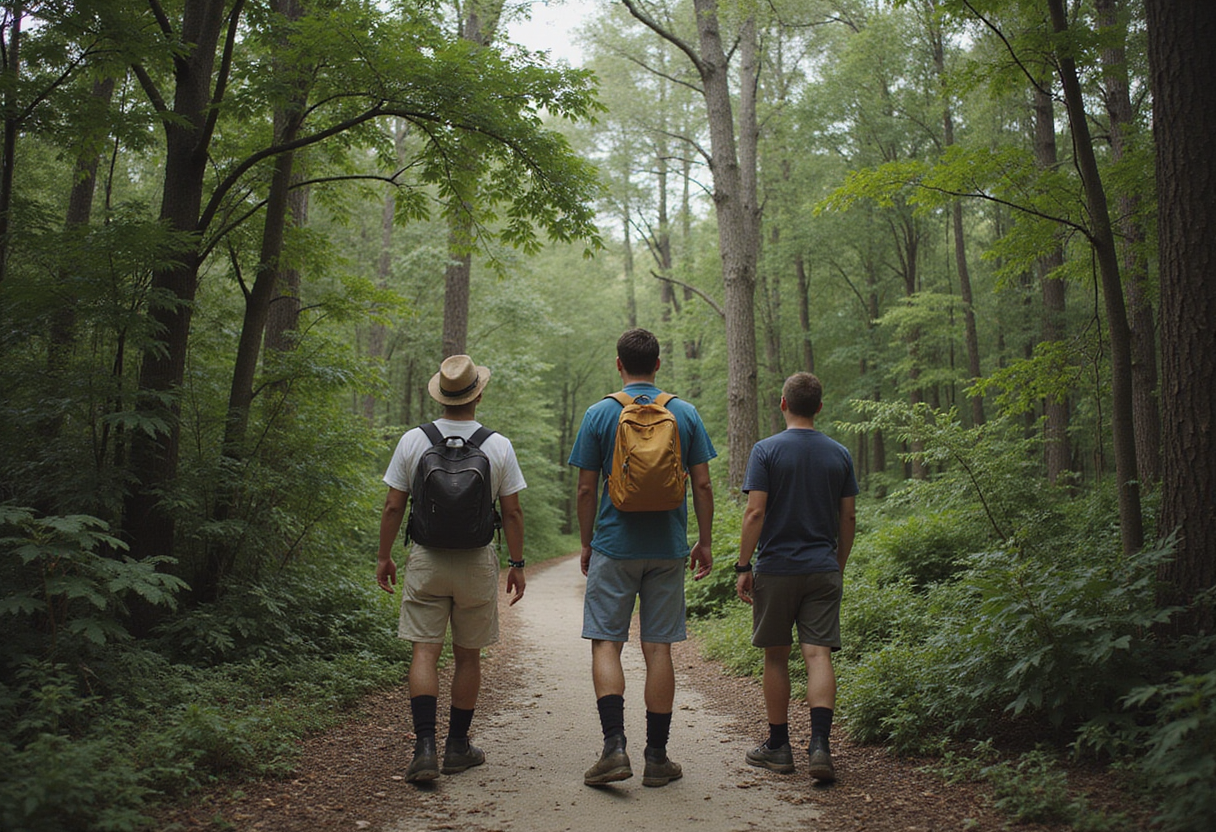
The pictures, made between roughly 2024 and 2025 judging by the titles and dates — Creek (2024), Ophelia (2025), Swamp (2025) — are staged scenes of young men in Florida's forests, swamps and creek beds. The subjects are, mostly, young queer Black and Brown men from greater Miami. Many are first-generation Americans. Aronson brings them from the city into rural landscapes and, in his words, they "play pretend as young men on the fringe, at ease in nature and in harmony with one another."
That framing is doing real work. This isn't documentary. He said so plainly: "I'm not photographing local youth I happen upon in rural towns; I'm staging scenes with people I bring from the city into these landscapes."
Why does he call them 'film stills'?
Aronson has a background in film, and he leans on it. In artist walkthroughs he's taken to calling the photographs "film stills," images that straddle the cinematic and the real. The comparison that comes to mind is a Gregory Crewdson production scaled down — directed, cast, lit — though Aronson names different ancestors: Justine Kurland's Girl Pictures, which pushed him toward group portraiture, and Ryan McGinley's collaborative freedom. Fair lineage. Whether the pictures earn it, you'd have to judge at the wall.
His stated motive is belonging. Writing in Vogue, he said: "Making photographs is, for me, a way to reclaim a sense of belonging. Photography allows me to imagine belonging somewhere and to make that fantasy a bit more real through the act of visualizing it." Born in Canada, raised in Florida, family with no roots there — an insider-outsider, by his own account. The photographs are the fantasy of belonging, staged until it feels true. "Fake it 'til you make it," as he puts it.
What about the land itself?
Here Aronson is more pointed than most photographers who shoot pretty boys in pretty woods. "America's idea of 'wilderness' was built on the displacement of Indigenous people, of Black and Brown communities," he said. "The conservation movement has roots in eugenics, and that legacy lingers. I hope this work helps expand who feels they belong in nature."
Strong claim. Historians would largely back him on the displacement and on the uglier corners of early conservation. Whether photographs of Miami creatives in cypress swamps can carry that political weight is a harder question, and one the interview doesn't answer. The response so far, he says, has been moving — including Floridians who grew up in the '60s, '70s and '80s telling him the work resonates.
The three-year gap
The undeveloped-film story holds up better than most process anecdotes. Aronson splits his practice into "the maker and the editor" and refuses to mix them. "By keeping the film undeveloped, I could stay curious. Stay hungry to keep staging images," he said. "It helped me sustain the project for five years without overthinking it." When he finally developed it: "It felt like rediscovering a diary I'd forgotten I was writing."
Risk, obviously. Three years of work could have been fog, scratches, a broken camera. His first reaction on seeing the negatives — "thank God my camera still worked" — suggests he knew it.
The research behind the locations is its own quiet project: hours in hashtags like #VisitFlorida and #FloridaWild, old travel guides, archives, multi-day scouting routes. Maps, postcards and brochures from those trips ended up in the Florida Boys exhibition at Baker–Hall, hung alongside the photographs. No alligators on the trips, he says, though owls, turtles, Confederate flags and gas stations all made appearances — Florida in full.
Aronson also runs Photo Book Speed Date, a public program pairing photography books with strangers in fast rounds. With Florida Boys exhibited, expanded into large outdoor works and grids, and now in wide circulation, he says each exhibition teaches him something new — which sounds like an artist who hasn't finished staging his belonging yet.
Key points
- Josh Aronson, born 1994 in Toronto and Miami-based, shot the series Florida Boys over five years on undeveloped film.
- He waited three years to develop the film, separating his 'maker' and 'editor' modes.
- The series was shown at Baker–Hall alongside found ephemera — maps, postcards, brochures.
- Aronson cites Justine Kurland's Girl Pictures and Ryan McGinley as key influences.
- His work has appeared in The New York Times, Vogue, Financial Times, Frieze and The Guardian.
Original: josharonson.us
Daniel Okafor
Show full bio
News editor covering companies, deals and strategy in Photography exhibitions, photographers, photo books, festivals and awards at Lens Gazette.