Adji Dieye Turns the Art-Sales Broadcast Against the Market
Adji Dieye stages CONTINENTE ARTE at Turin's Fondazione Sandretto Re Rebaudengo: a two-channel video selling her own work, probing how the art market constructs African identity. Until October 11.
Updated
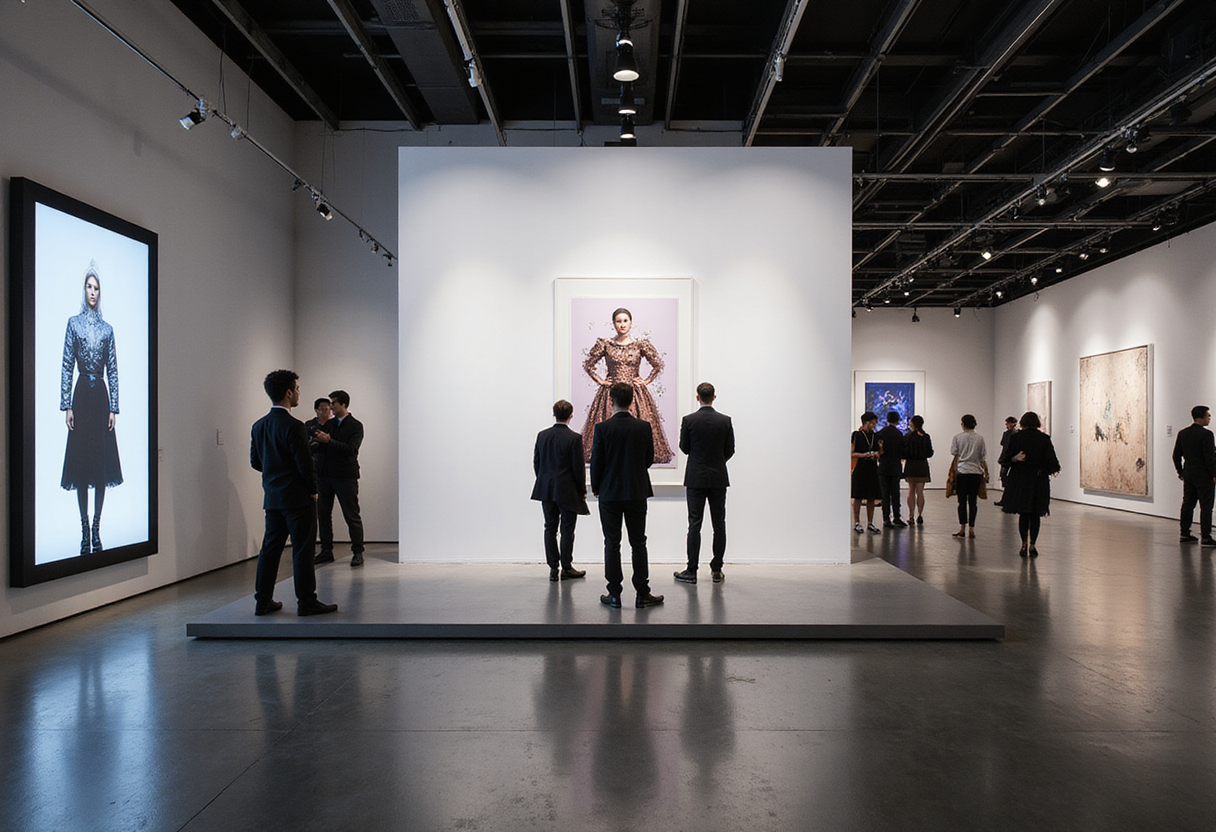
Adji Dieye's solo exhibition CONTINENTE ARTE runs at Fondazione Sandretto Re Rebaudengo in Turin until October 11, built around a two-channel video installation staged as a fictional art-sales television channel selling her own work.
For the Senegalese Italian filmmaker and photographer, the show is the latest step in a decade-long practice examining cultural representation, public space, and identity across West Africa, particularly Senegal. The foundation describes the exhibition as a "reflection on the form of the Western cultural unconscious and on the categories, often unquestioned, through which the art system interprets and attributes value to works."
What is on screen at CONTINENTE ARTE?
Two presenters, one of them the fictional Tiziana Bianchi, offer radically different interpretations of Dieye's work, each projecting onto it — and onto the artist herself — assumptions about who she is supposed to be and how her identity can be made legible to an imagined, predominantly Western audience. The 30-minute color video features a character played by Alessandro Orlando.
The title arrived late. For most of the process the project carried a different working title, Libera come un piccione di Cattelan — Free As One of Cattelan's Pigeons. Dieye developed the script with Rokhaya Thiam, Victoria Genzini and Gabriele Della Maddalena, and Bianchi's on-screen references to "the African continent" and to exhibitions such as Magiciens de la terre gave the channel its name. "The name carries some of the irony already present in the script," Dieye told BOMB Magazine: "the tendency to turn an entire continent into a vague and seemingly coherent category."
Behind the television format lies a long-standing fascination. "I find it fascinating and also quite funny how meanings and stories are constructed around an artwork in order to make it understandable, desirable, and, ultimately, sellable," she said. A joke she repeated for years — that one day she would make a TV sales show selling her own work — became the exhibition's starting point roughly a year and a half ago.
Where do the sculptures come from?
The sculptural installations draw on the Neo-Sudanese architectural style, developed under French colonial rule by borrowing selectively from Sahelian architecture and reorganizing those forms according to a European rationalist idea of order and symmetry. Dieye's research focused on Dakar's Sandaga Market, whose metal structure connects to a colonial pavilion built in Marseille in 1922, later dismantled and transported to Dakar. Her sculptures make these apparently rational forms unstable, as though the order itself were bending or fracturing.
A key textual reference was Reading the Contemporary: African Art from Theory to the Marketplace, edited by Olu Oguibe and Okwui Enwezor, and Oguibe's essay on an interview between critic Thomas McEvilley and artist Ouattara Watts, in which the questions searched for an African origin rather than engaging the work. This led Dieye to what she calls a catastrophe without an event — damage shaped not by a single rupture but by the repetition of words, categories and projections.
How did the practice begin?
Her first project, Maggic Cube (2014–19), observed the enduring presence of Western brands in Senegalese public space — specifically Maggi, whose advertising, largely targeted at women, suggested cooking was a woman's duty. The colorful series deliberately drew on West African studio masters Seydou Keïta and Malick Sidibe, partly as commentary on the art world's unsaid expectations of what images from West Africa should look like.
Working with the iconographic collection of the National Archives of Senegal, where she found photographs of buildings under construction, connected archives, architecture and advertising in her thinking. "They all produce images through which a society represents itself," she said.
On prizes, she is blunt: "Awards are always pleasant to receive, especially when they pay my bills. At the same time, the art world is extremely bulimic." One of CONTINENTE ARTE's inspirations, she notes, was the struggle many Italians have with their own fragmented identity, and the way cohesion is built through the construction of an "other."
With CONTINENTE ARTE running through October 11, Dieye's fictional broadcast continues to probe how language, desire and institutional categories produce the artists the market expects to find.
Key points
- Adji Dieye: CONTINENTE ARTE is on view at Fondazione Sandretto Re Rebaudengo, Turin, until October 11.
- The centerpiece is a two-channel video installation staged as a fictional art-sales TV channel, approximately 30 minutes long.
- Dieye's first project, Maggic Cube, ran from 2014 to 2019 and examined Maggi's advertising in Senegal.
- The sculptures reference Neo-Sudanese architecture and Dakar's Sandaga Market, linked to a colonial pavilion built in Marseille in 1922.
Original: s3.us-east-1.amazonaws.com
Olivia Hart
Show full bio
Staff writer covering industry trends and analytics at Lens Gazette.