A Vast Horizon Traces Picasso's Circle From Beach to Buchenwald
Anna Thomasson's A Vast Horizon follows Lee Miller, Picasso and their lovers from a 1937 Mougins holiday into war — with only four photographs reproduced, 304pp, Pegasus Books.
A single late-summer holiday in 1937 anchors A Vast Horizon: Artists and Lovers, Freedom and War, Anna Thomasson's new group biography from Pegasus Books — 304 pages, four black-and-white reproductions, $29.95 hardback, published 7 July — that follows ten artists and lovers from a French hill village into war, occupation and old age.
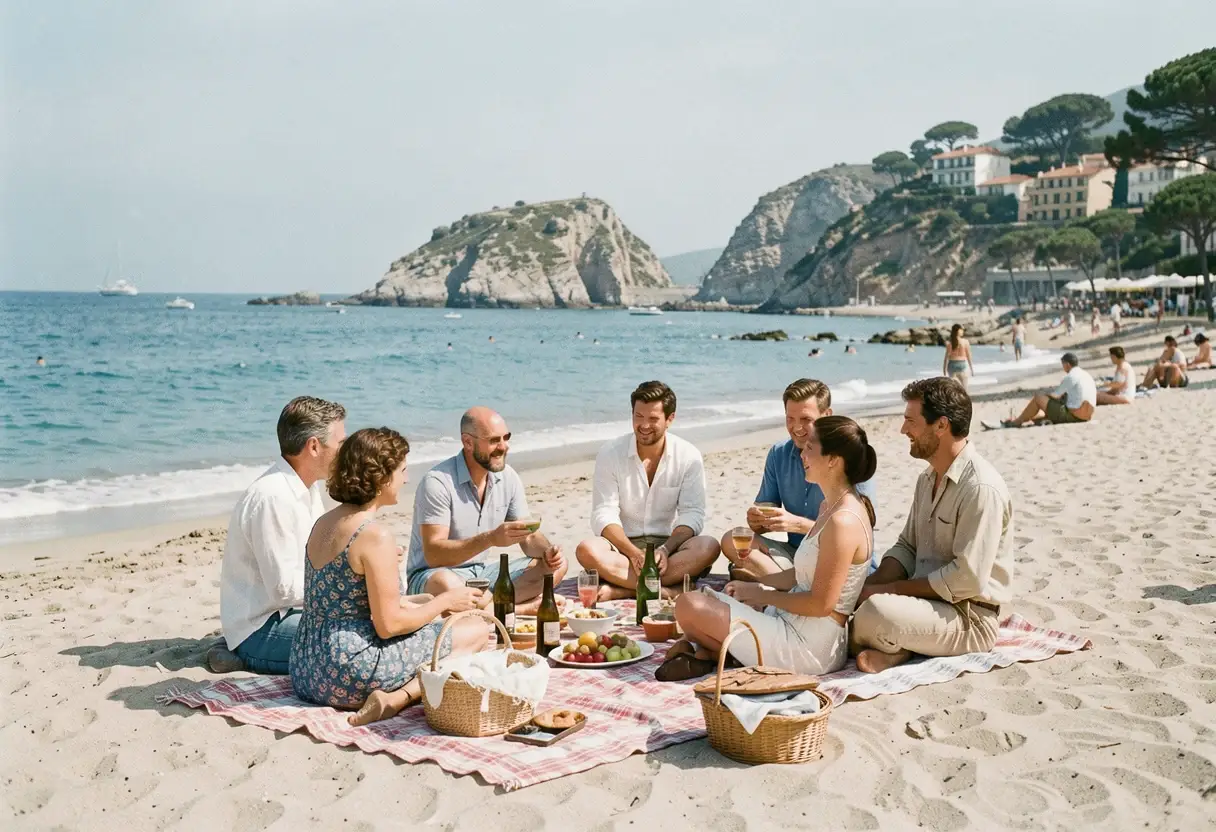
The holiday in question gathered at the Hotel Vaste Horizon in Mougins, in the South of France. The roll-call is the core of the book: Eileen Agar and Joseph Bard, Nusch and Paul Éluard, Ady Fidelin and Man Ray, Dora Maar and Pablo Picasso, Lee Miller and Roland Penrose. They came for friendship and for what Agar wittily called "le peintre soleil" — Picasso, the sun painter. Picasso urged everyone to work; half of them picked up cameras. Maar, Man Ray and Miller were the professionals at leisure; Agar and Penrose added snapshots.
Thomasson calls this a "fleeting community," and the phrase carries the book. What does she do with a chain of couples that risks becoming a cacophony of walk-on parts? She marshals it. The visual archive is rich but scattered, and she searched it thoroughly. As Roland Barthes recognised in Camera Lucida, photography "mechanically repeats what could never be repeated existentially" — and the hedonism these pictures froze, with the Spanish Civil War already a year old, defied the totalitarianism gathering around it.
What happened to them when war came?
The narrative plunges its participants into the conflict. For each, the war restructured their values — not as the Surrealists had hoped, but as Nazi destruction enforced. Paul Éluard turned a love poem for Nusch into a litany for "liberty" that captured the spirit of resistance; the RAF dropped copies over Occupied France. Miller reported the savagery of combat and, eventually, the concentration camps. The bodies posed willingly on southern beaches become, in Thomasson's telling, the distant optimistic opposite to the haunting corpses of Buchenwald — and Miller, the photographer in both cases, never fully recovered from witnessing such deliberate inhumanity.
There was no reciprocal gathering after the war. Thomasson instead traces the endgames, each participant aging in varying degrees of dignity, creativity and despair.
Whose voices have been missing?
Many of these lives are already familiar through autobiographies (Agar, Man Ray, Penrose) and biographies (Éluard, Miller, Picasso). Thomasson's synthesis draws on recent research and extensive reading, and a particular strength is rebalancing longstanding gender biases. The repositioning of Ady Fidelin — the double-marginalised Guadeloupean woman, rescued somewhat from being simply Man Ray's model on fresh scholarship — is especially timely. Nusch Éluard also comes into sharper focus.
Limits remain. Substantial traces of these women's own voices are still to be found, confining them to an unknowability ascribed to devotion to their partners. Thomasson may overstate the case in suggesting Nusch "died in the service of Paul's pursuit of freedom" in 1946.
Why only four photographs?
Late in the book Thomasson cites Emily Dickinson's belief that veracity is "more affecting, if told indirectly." That emerges as the volume's foundational conceit. A book inspired by photographs reproduces just four. Instead of showing, the author offers often highly evocative descriptions of images the reader never sees — a surprising choice for a narrative reportedly sparked by the author being drawn into "their distant world by their photographs."
The cover carries disproportionate weight as a result. The British edition favours Agar's photograph of Maar, Picasso and the Éluards at Juan-les-Pins. The US edition uses Miller's picnic photograph of "half-naked women sitting among fully clothed men," whose jarring nature introduces the whole narrative — but on the cover the torsos are rather ineptly airbrushed. That the publishers chose to manipulate a famous 90-year-old image undercuts an otherwise compelling account of artists embracing freedom before disaster struck. The book, at least, reproduces it unaltered inside.
Key points
- A Vast Horizon by Anna Thomasson, Pegasus Books, 304pp, $29.95 (hb), published 7 July
- The book reconstructs a late-summer 1937 holiday at the Hotel Vaste Horizon in Mougins, southern France
- Only four black-and-white photographs are reproduced in a book inspired by photographs
- The US edition airbrushed the half-naked torsos on Lee Miller's 90-year-old cover photograph
- Thomasson draws on fresh scholarship to reposition Ady Fidelin, Man Ray's Guadeloupean partner
Source: theartnewspaper.com
Marcus Bennett
Show full bio
Correspondent covering companies, deals and strategy in Photography exhibitions, photographers, photo books, festivals and awards at Lens Gazette.