A Cemetery, a Toddler, and 15 Hand-Sewn Books: Jennifer Lauren Smith's Grief Garden
A decade after Green-Wood Cemetery walks with her toddler, Jennifer Lauren Smith has bound them into a 15-copy handmade book of hidden flower collages and 4×5 views.
Jennifer Lauren Smith has released Weeping European Beech Baby Sleep Tonic, a handmade photobook in an edition of just 15 copies plus two artist's proofs, a decade after the project began in a cramped Sunset Park apartment across from Green-Wood Cemetery. In conversation with Amanda Sauer on Lenscratch, Smith traced the book's odd route from stroller walks to Coptic stitching.
The facts first. Smith is an analog photographer, video and performance artist trained in sculpture and the humanities, and she is deaf. Her practice, as she describes it, lives in a soundscape of fragments, residual hearing, guesswork and hypervigilance — a fractured perceptual field she channels into visual narratives about sound, silence and body memory. Her process starts with fieldwork: outdoors, at historical sites, collecting material in situ before processing it in the studio as writer, scanner, ceramicist and choreographer.
How does a baby book end up set in a cemetery?
The origin story is disarmingly literal. Raising a baby in a small apartment around 2016, Smith spent her days wandering the 478-acre-plus landmark — actually a 500-acre arboretum, as she insists — hunting greenery, fresh air and quiet nursing spots. Her toddling daughter began collecting dirty synthetic flower fragments from between graves. "They were talismans, little treasures," Smith said. "It took me a while to figure out what to do with them."
What she did, eventually, was collage them. She scanned and printed the flowers at body-scale — around 32 inches — thinking of an herbarium. But she worried the material history wouldn't read without context: would they look like cemetery flowers or generic fakes? So she dug out old cellphone and DSLR images and, after leaving Brooklyn for upstate New York in 2018, returned to Green-Wood with a 4×5 view camera. The cemetery had changed; her favorite broken mausoleum statuary had been repaired, and once dog-like weeping spruces had gone amorphous.
Why hide the collages?
The book's central device is concealment. Four detached color plates of collaged petals, one text piece and the acknowledgments are tucked into French-fold pockets, ghosting faintly through thin washi pages printed with black-and-white photographs. The first collage doesn't appear until roughly eleven photographs in. Smith structures projects around encounters: "I'm interested in the experience of stumbling upon something, as if fatalistically," she said. The obscured text page mimics headstones wearing away; the loose plates can be handled like ephemera found in an old tome.
The construction is almost foolishly laborious, by her own admission. Coptic link stitching in waxed linen thread, archival boards, hand-debossed covers, a laser-engraved back cover, drum-leaf attachment of the text block. Printing was outsourced to Jackson at the CPW Lab in Kingston, New York; everything else Smith did herself. She credits Paula McCartney's six-week course at Penumbra — part of Penumbra's Long Term Program — with making the handmade-book process feel manageable. Her advice to others: take a class with McCartney.
Is it a motherhood book?
Sauer reads the book's precarious, handle-with-care construction as an echo of parenting, and Smith doesn't argue — the viewer is "thrust into the responsibility of taking care of the loose, flyaway elements." But she resisted direct autobiography. She feared a sentimental baby book and approached motherhood sideways, through zoomorphic trees, wildlife and mausoleums. During editing she kept asking what was too personal versus too generic, landing on a test: "If you can't be honest, what are you even doing?" Hence the selfie of one child painting her face while she nursed another.
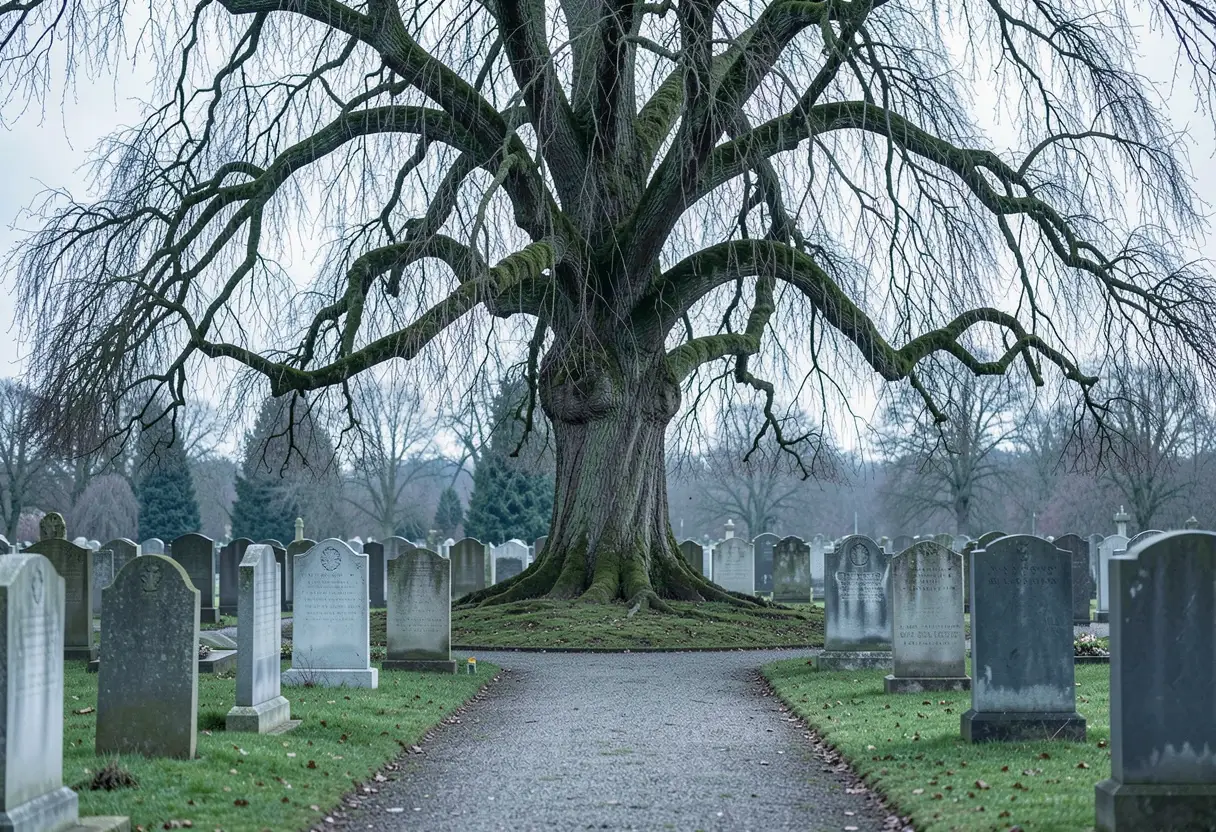
Her point, sharply made: the book is about "the condition of monotony and hypervigilance that motherhood imposed, and I happened to be frequenting a cemetery when it happened." She notes Green-Wood's own playfulness — 19th-century impresario William Niblo staged carnivalesque evenings at his own mausoleum, a tradition the cemetery has revived with fire-eaters and circus acts that sell out annually. The title comes from a giant Fagus sylvatica 'Pendula' on Oak Nut Path, with a tunnel cut through it, under which Smith rocked her daughter Pippa to sleep.
Weeping European Beech Baby Sleep Tonic is available through Smith's website. At 15 copies, it won't be easy to hold — but that, evidently, is the point.
Key points
- Jennifer Lauren Smith self-published Weeping European Beech Baby Sleep Tonic in an edition of 15 plus 2 APs.
- The project began roughly ten years ago, around 2016, while raising a baby near Green-Wood Cemetery in Sunset Park, Brooklyn.
- Smith returned to Green-Wood with a 4×5 view camera after moving upstate in 2018 to make new photographs.
- The book hides four color plates, one text piece and acknowledgments in French-fold pockets; the first collage appears about 11 photographs in.
- Printing was done at the CPW Lab in Kingston, NY; Smith bound the books herself with Coptic stitching after taking Paula McCartney's 6-week Penumbra course.
Original: jenniferlaurensmith.com
Olivia Hart
Show full bio
Staff writer covering people, launches and day-to-day practice in Photography exhibitions, photographers, photo books, festivals and awards at Lens Gazette.