Penn & Fashion Opens at Paris MEP, Spanning Six Decades
Paris's Maison Européenne de la Photographie traces six decades of Irving Penn's fashion photography, from 1950s haute couture to Issey Miyake, until 17 January 2027.
Updated
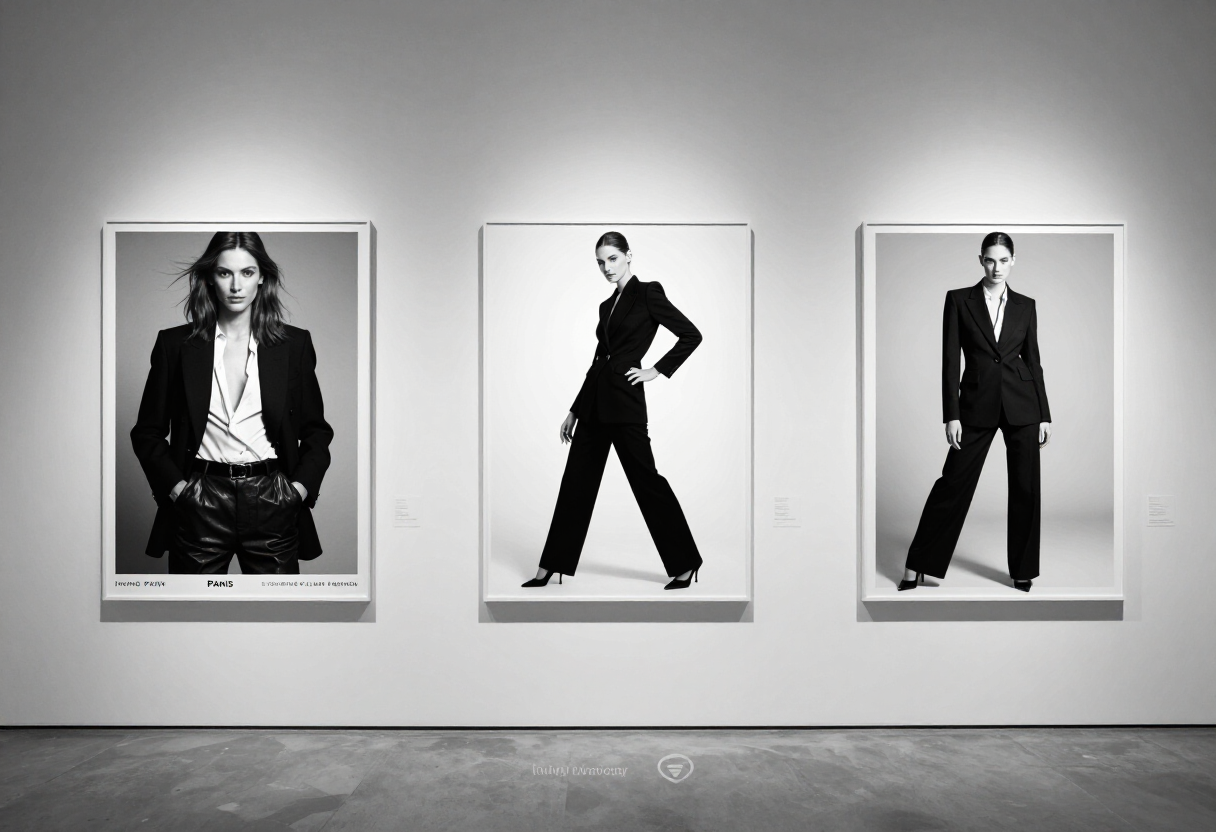
More than a century after Irving Penn's birth, the Maison Européenne de la Photographie in Paris has opened Penn & Fashion, a sweeping retrospective tracing over six decades of the American photographer's work with clothes. The exhibition, which opened on 30 September and runs until 17 January 2027, brings together some of his best-known images alongside facsimiles of the Vogue pages on which they first appeared.
The venue is not an incidental choice. Penn had a close relationship with the MEP from the early 1990s and was one of the founding artists of its collection, which today holds more than 100 of his prints. The archive grew further through a gift from his son, Tom Penn, including photographs that once belonged to Lisa Fonssagrives — the model, artist and collector Penn married.
Fonssagrives is inseparable from Penn's legacy. His 1950 photograph of her enveloped in a Balenciaga mantle coat remains among the most important images associated with the house: the fabric sweeping from one shoulder, her gloved hand near her face, the couture piece transformed into an unforgettable silhouette. That same year he shot Jean Patchett for an American Vogue cover, her face obscured by a veil beneath an enormous black hat.
Penn's path to these pictures was indirect. When he arrived at Vogue in 1943, he joined as a designer, working with art director Alexander Liberman on layouts and cover ideas, drawing on his graphic design training under Alexey Brodovitch. Liberman recognised his eye and encouraged him to take the photographs himself. What began with still lifes grew into a career shooting fashion for the magazine through successive eras, including its beauty section, where his full-page images became known as "stoppers" for their ability to halt readers mid-page-turn. Bee on Lips from 1995 brought a surreal edge to the conventional beauty close-up.
Penn was celebrated for an approach that stripped fashion photography to its essentials. At a time when elaborate settings were commonplace, he photographed his subjects against plain backdrops, removing anything that might compete with the clothes. Composition became paramount — the placement of the body, the way fabric occupied the frame — and the result brought both a garment's construction and the model's presence sharply into focus.
The exhibition unfolds chronologically, from the late 1940s to 2008. The 1950s rooms capture Parisian haute couture during its great post-war revival. In the summer of 1950, Penn travelled to Paris to photograph the latest collections, setting up a daylight studio on Rue de Vaugirard. Balenciaga and Rochas delivered their clothes to the space, where an old theatre curtain served as his backdrop and Fonssagrives worked as his principal model. A standout from this period shows her in the graphic harlequin dress designed by Jerry Parnis, published in a 1950 Vogue article titled The Black and White Idea.
By the 1960s, ready-to-wear was gaining ground, and Diana Vreeland's appointment as American Vogue's editor-in-chief in 1963 ushered in a more exuberant era. Penn stayed faithful to his studio's simplicity, photographing André Courrèges's and Emanuel Ungaro's increasingly modern clothes against plain backgrounds and letting the garments command the image.
In the following decade, fashion reached him in an entirely different setting. Vreeland, then a special consultant to The Metropolitan Museum of Art's Costume Institute, organised an exhibition devoted to early 20th-century French fashion, and Penn shot historic garments by Paul Poiret, Madeleine Vionnet and Coco Chanel on resin mannequins in the museum's galleries. The experience changed him, he recalled, in a way his years photographing contemporary collections had not — he felt a thrill he had never experienced before.
His designer roster only grew. In the 1980s he photographed Karl Lagerfeld's designs for Chanel and Yves Saint Laurent's celebrated Hommage aux peintres collection, which translated the work of artists including Pablo Picasso and Henri Matisse into fashion. His most fascinating later collaboration was with Issey Miyake: between 1986 and 1999, Penn shot the designer's creations without ever attending his shows. The clothes were sent to his New York studio, where he was free to interpret them. "Penn's photographs allow me to see my own creations," Miyake once said.
Towards the end of his career, Penn grew increasingly selective about assignments. Among the later works on display is his striking portrait of Nicole Kidman in Jean Paul Gaultier for Vogue in 2004. What emerges across the MEP's galleries is the remarkable consistency of his eye, even as fashion transformed around him — a sustained argument for looking closer, at the clothes and at the people who brought them to life.
Key points
- Penn & Fashion opened at Paris's Maison Européenne de la Photographie on 30 September and runs until 17 January 2027, covering more than six decades of his career from the late 1940s to 2008.
- The MEP holds more than 100 Penn prints and counts him among the founding artists of its collection; the archive was enriched by a gift from his son, Tom Penn, including photographs once owned by Lisa Fonssagrives.
- Penn photographed Issey Miyake's creations between 1986 and 1999 without ever attending a show, with garments sent to his New York studio; Miyake said, "Penn's photographs allow me to see my own creations."
Original: media.voguearabia.com
Daniel Okafor
Show full bio
News editor covering consumer brands and retail at Lens Gazette.