Kraków tributes, Cop31, tents, Brand sentencing and smog
Four Guardian-selected photographs chart Cop31 in Antalya, rain-damaged tents, Russell Brand’s court arrival and a smog-covered capital after Diwali celebrations.
By Olivia Hart
The Guardian’s Monday picture round-up sets four captioned scenes side by side: Indonesian delegates at the opening of Cop31 in Antalya, displaced Palestinians examining rain-damaged tents, Russell Brand arriving at Southwark Crown Court for sentencing, and thick smog over a capital after Diwali.
The round-up’s introduction states: “The Guardian’s picture editors select photographs from around the world.” In four captioned images, the sequence spans climate diplomacy, displacement, criminal justice and urban air pollution; geography and scale shift as sharply as the subjects do.
The four captions read:
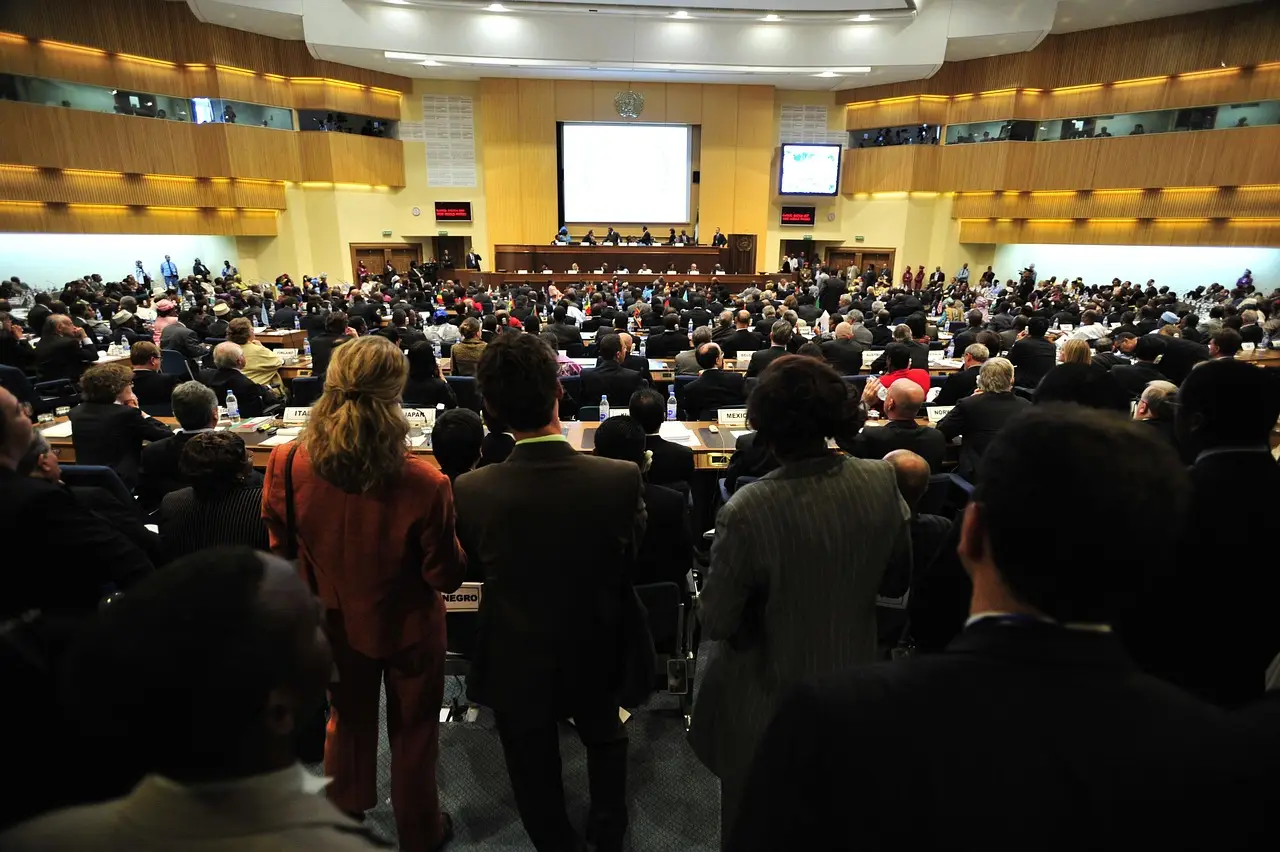
- Tolga Akmen/EPA: Indonesian delegates chat beside their pavilion on the opening day of Cop31 in Antalya, Turkey.
- Ahmed Ibrahim/APA Images/Shutterstock: displaced Palestinians inspect tents damaged after heavy rain collapsed an embankment.
- James Veysey/Shutterstock: Russell Brand arrives in a security van ahead of sentencing at Southwark Crown Court.
- Yanni Rawat/JNA/Zuma Press Wire/Shutterstock: thick smog blankets parts of a capital one day after Diwali.
The headline also names Kraków tributes, but the accompanying captions do not identify that subject’s photographer, participants or precise setting. For a round-up built around selection, that omission matters: it is the difference between a photograph of tributes and an unsupported claim that they occurred.
What does the Cop31 photograph establish?\n
Cop31’s frame is the most formally legible of the four because the pavilion gives the delegates a specific place within the annual UN climate conference. The caption describes conversation rather than a set of individual portraits; talk, not spectacle, supplies its action.
The image fixes three concrete coordinates: Indonesian nationality, Cop31’s opening day and Antalya, Turkey. It also names Tolga Akmen/EPA as the maker. What the picture does not do is claim a policy breakthrough. An opening-day photograph can establish attendance without borrowing the authority of an outcome.
What does the rain damage reveal?\n
Ahmed Ibrahim’s picture shifts from institutional architecture to damaged shelter. Its caption gives a three-part cause-and-effect sequence—heavy rain, collapse of an embankment, inspection of tents—placing the displaced Palestinians inside the aftermath rather than in the middle of the storm.
The embankment does more than describe the setting: it explains the damage. The people are witnesses examining consequences, not distant figures in a generic disaster scene. That is a consequential distinction in photojournalism, where a precise caption can keep an image with people from becoming an anonymous claim about suffering.
The accompanying caption does not identify the camp, the number of tents affected or the displaced people’s nationality beyond the description Palestinians. Those omissions limit the claims available to editors and readers. A photograph can make damage visible; a caption still has to say where the damage occurred.
What does Brand’s sentencing image add?\n
James Veysey/Shutterstock contributes the third frame and the round-up’s most explicit legal detail. The caption says Russell Brand was found guilty of one count of rape and three counts of sexual assault—four convictions in all. It then states: “Russell Brand arrives in a security van ahead of sentencing at Southwark crown court.”
The vehicle turns an abstract verdict into a physical passage toward the court. It does so without a courtroom view, a display of a sentence or an invented emotional cue. The caption’s timing, ahead of sentencing, matters because it tells readers exactly what the picture withholds as well as what it records.
How does smog define the fourth image?\n
Yanni Rawat/JNA/Zuma Press Wire/Shutterstock photographs thick smog blanketing parts of the capital one day after Diwali celebrations, as the city confronts severe air pollution. The caption supplies two anchors—a one-day interval and a named civic occasion—but withholds the city’s name and any pollution measurement.
The visible subject is a condition rather than a person. Smog dominates the frame by blanketing parts of the capital, according to the caption; the timing after Diwali places that condition within a civic calendar. Severe pollution is therefore not an anonymous backdrop but the fourth captioned photograph’s central subject.
That produces a useful tension. The picture communicates an environmental crisis, yet the caption provides neither a place name nor a measured figure, so it cannot support a statistic about the capital’s air. One frame shows the smog; another would show what officials recorded. Both matter, and this round-up has only the former.
What should the picture desk clarify?\n
Read together, the four captioned photographs perform distinct evidentiary jobs: Akmen records institutional arrival, Ibrahim inspection after damage, Veysey a defendant’s movement toward court, and Rawat an environmental condition over a city. Their adjacency creates breadth, but not a single visual argument.
Within documentary photography, the sequence uses the daily picture round-up as its form: discrete witnesses accumulate through editorial selection rather than forming a sustained series. That format rewards breadth, but it also makes caption precision part of the image’s meaning.
That breadth explains both the value and the friction. The conference image has exact names; the tent image lacks a location; the court image supplies four convictions; the smog image supplies timing but no city or measured figure. No caption carries all four kinds of information, and a responsible picture desk should leave those blanks visible rather than fill them with assumptions.
The Kraków tributes named in the headline require the same discipline. Without an accompanying caption, editors cannot responsibly attach a date, crowd size, ceremony or emotional description. A tributes photograph may invite a question; it does not answer one by itself.
Still, the selection does something more useful than recycling a generic frame: it puts four kinds of witness near one another. Delegates talk, displaced people inspect, a defendant arrives and smog blankets part of a capital. The editorial task is to keep that sequence legible without making the images say more than their makers and captions support.
With Cop31 already under way in Antalya after its opening day, the visual story has a clear next test: subsequent coverage should show what happens beyond the pavilion conversation, just as these four frames anchor their subjects in place, cause, legal status and atmosphere.
Key points
- Four captions accompany the Monday round-up; its title additionally names Kraków tributes.
- Tolga Akmen/EPA photographed Indonesian delegates at their pavilion on Cop31’s opening day in Antalya, Turkey.
- Ahmed Ibrahim/APA Images/Shutterstock photographed displaced Palestinians inspecting tents after heavy rain caused an embankment to collapse.
- The caption says Russell Brand faced sentencing after one count of rape and three counts of sexual assault.
- Yanni Rawat/JNA/Zuma Press Wire/Shutterstock photographed thick smog over parts of a capital one day after Diwali.
Source: theguardian.com
Olivia Hart
Show full bio
Staff writer covering people, launches and day-to-day practice in Photography exhibitions, photographers, photo books, festivals and awards at Lens Gazette.