Elmgreen & Dragset turn the Oval Office into weathered steel
Elmgreen & Dragset turn the Oval Office into a 36-tonne Cor-Ten sculpture at Pace Gallery, pairing it with six mirrored portraits of absent leaders until 16 January 2027.
By James Calloway
At Pace Gallery in New York, Elmgreen & Dragset have installed a 36-tonne Cor-Ten steel recreation of the Oval Office for “TRANSITION,” on view through 16 January 2027. The Danish-Norwegian duo’s monumental, two-part work reduces presidential authority to a traversable volume, then surrounds it with six mirrored images of absent leaders.
What does the Oval Office become without presidential symbols?
“TRANSITION” extends Elmgreen & Dragset’s “Powerless Structures” reconfigurations, begun in 1997, into a direct examination of institutional authority. Elmgreen said the real room is smaller than its screen-driven reputation. He asked: “Why don’t we try to take away its power symbols, all its decorations, all its authoritarian structure, and see what it becomes if it’s pure volume?”
The sculpture measures just shy of the actual room. Its lattices imitate the Oval Office windowpanes, while its door matches the original, making recognition depend on proportion rather than ornament.
At the entrance, Dragset identifies the threshold as the Resolute desk; Elmgreen indicates two imaginary couches and the space reserved for a press scrum. He adds that the enclosure fills readily, with journalists aligned along one wall.
The resulting room is monumental and enveloping, austere yet oddly habitable. By retaining the desk, couches and press position, the artists preserve the room’s choreography while stripping away the visual codes that give those positions authority.
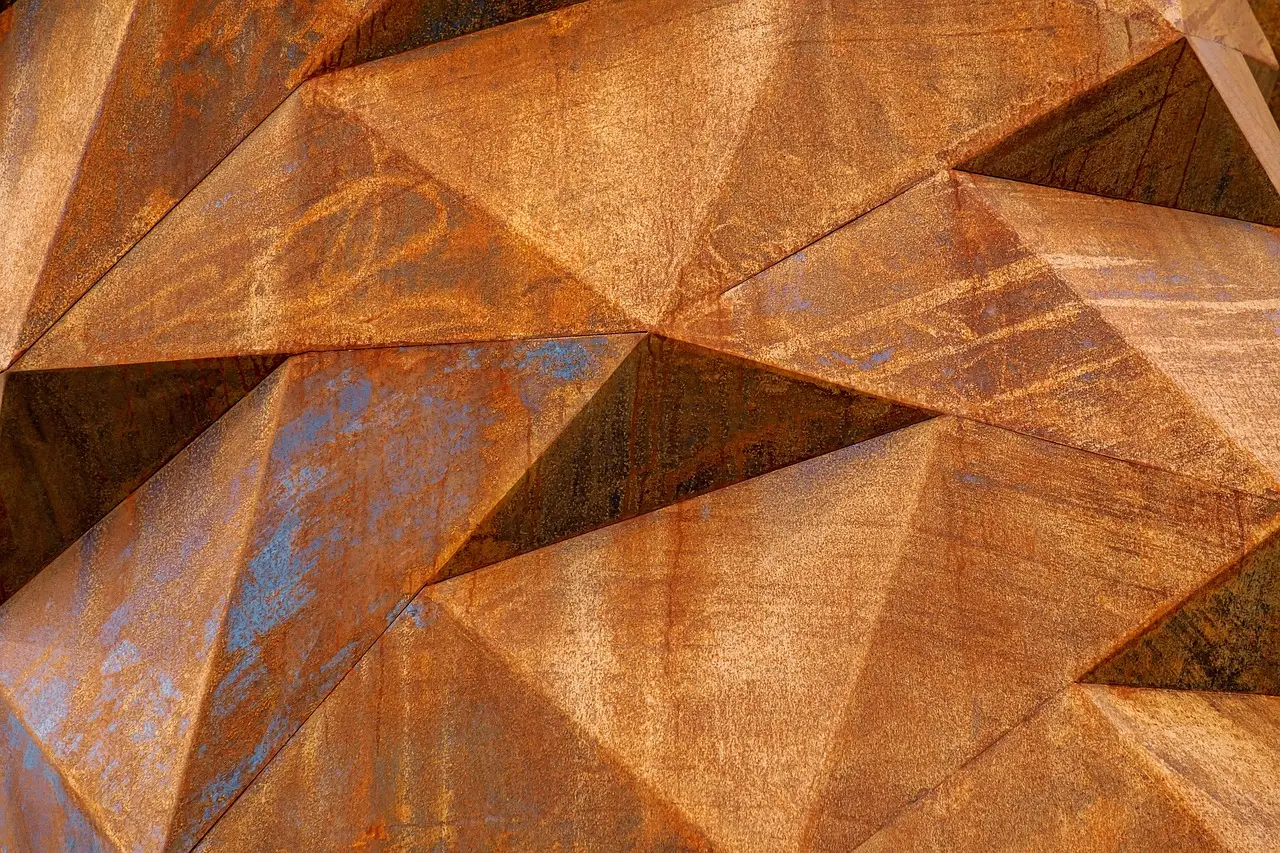
Cor-Ten supplies the material argument. Fabricated in north Germany by Richard Serra’s metal-formers of choice, the weathered steel replaces ceremonial gold with russet planes whose tones shift across the curve.
Dragset said: “It was transported by sea in an open crate, and exposure to the elements created this painterly quality. It’s a surface of constant transformation.” The transport did not merely age the material; it supplied pictorial variation that the steel could not have produced predictably in a factory.
The choice also places the work within Minimalism, particularly Serra’s monumentality and Gordon Matta-Clark’s decisive cuts and apertures. That lineage gives the installation a rigorous counter-language to the Oval Office’s claims of grandeur.
The contrast follows a specific political exchange. Days after former President Barack Obama compared the Trump-era White House with a Cheesecake Factory opened by Saddam Hussein, the artists removed the room’s ersatz ormolu and ornamental hierarchy.
Obama had described the décor as supergluing gold medallions to the mantel, precisely the ceremonial excess this steel version withdraws. The sculpture thus answers decoration with mass, and official permanence with a surface that continues to change.
Before arriving in Manhattan, the duo completed their cyan-bottomed pool in the revitalised sculpture garden at Washington, DC’s Hirshhorn Museum. That intervention and this Oval Office treat presidential design as an object artists can correct, using institutional settings to expose assumptions embedded in official furnishing.
How does the Balcony Series remove the ruler?
An adjoining room contains six large, wall-mounted circular works, the Balcony Series. Elmgreen and Dragset altered photographs of heads of state waving from elevated positions, cutting out the rulers while retaining the architecture.
For Elmgreen, the balcony constitutes a guilty architecture: it supports and elevates the leader, then directs the gesture downward toward assembled people. The missing figure becomes a shaped absence rather than an image of office.
Each work carries a black-and-white silkscreen on highly polished stainless steel. The cut-out ruler reads as a mirrored silhouette, reflected onto the floor like a human shadow; at eye level, the visitor’s own face occupies the leader’s place.
The black-and-white process preserves the documentary source, but cutting and polishing change its function. The photographs stop functioning as fixed portraits and become optical instruments, dependent on framing, placement and the bodies in front of them.
The artists do not disclose the identities or locations, although the Buckingham Palace scene is unmistakable and other balconies preserve deliberate clues.
- Danish Rococo flourishes point toward Margrethe II, whom Elmgreen recalls waving a small flag in 1972, when she became queen on a different Copenhagen palace balcony.
- The Casa Rosada appears in greyscale with Javier Milei, Argentina’s present-day president, whose distinctive coiffure carries the legacy of Evita.
- A dedicated work places former US First Lady Nancy Reagan on the White House balcony beside a figure in an Easter bunny costume. Elmgreen and Dragset read that figure as an emblem of her silence during the AIDS epidemic of the 1980s.
- One unidentified balcony remains open to a reading as a Sciences Po alumnus, although neither that identity nor its location is disclosed.
The uncertainty is part of the method, not a missing caption. Buckingham Palace anchors one work, while the other clues sustain argument among viewers without producing a complete key.
What changes when the mirrored works meet a viewer?
Polished surfaces make placement part of each work. Elmgreen says the compositions change according to where they hang, absorb their surroundings and produce different accounts; a blue-sky reflection could make one work resemble a Magritte.
The difference from conventional official portraiture is precise. A photograph fixes a ruler’s likeness and authority in place; these works replace likeness with architecture, reflection and the viewer’s body.
That makes the Balcony Series less a record of particular leaders than an instrument for examining how public space grants visibility and hierarchy. Yet withholding names makes some associations interpretive rather than demonstrable, giving the Buckingham Palace reference firmer purchase than the more allusive clues.
As TRANSITION remains on view through 16 January 2027, the steel chamber will weather in place while the six mirrored works change with each visitor and reflection. The exhibition’s forward proposition stays active in that exchange: remove fixed symbols, and presidential power becomes something viewers continually reassemble.
Key points
- TRANSITION runs at Pace Gallery in New York through 16 January 2027.
- The two-part Oval Office sculpture weighs 36 tonnes.
- Elmgreen & Dragset began the Powerless Structures series in 1997.
- The adjoining Balcony Series contains six wall-mounted circular works.
- A 1972 image of Queen Margrethe II waving a flag informs one balcony portrait.
Source: wallpaper.com
James Calloway
Show full bio
Market editor covering people, launches and day-to-day practice in Photography exhibitions, photographers, photo books, festivals and awards at Lens Gazette.