AI Helps Peel Back a Century of Overpaint on Chase's 'A Comfortable Corner'
AI composite imaging helped conservators recover lost details in Chase's 1888 'A Comfortable Corner', cut down during a 1960s restoration, ahead of a Parrish Art Museum show.
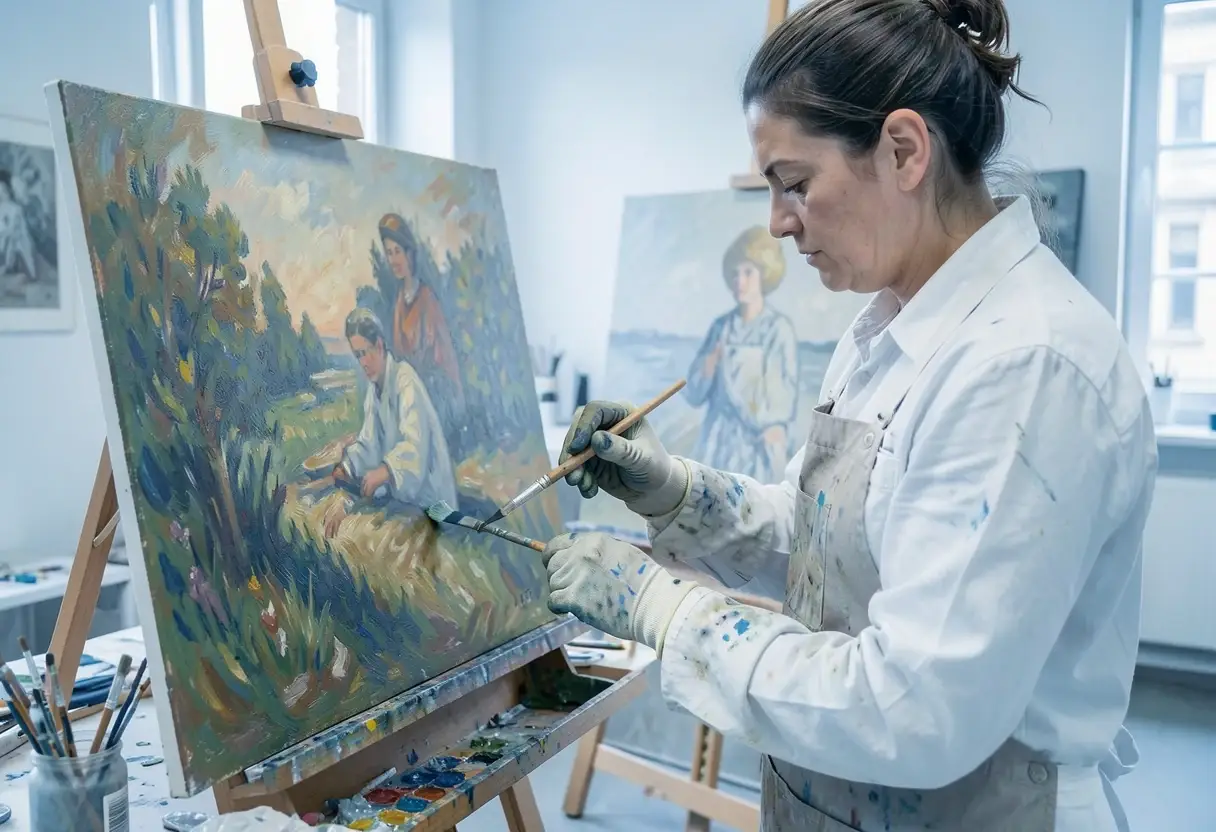
A painting by William Merritt Chase, cut down and clumsily repainted during a 1960s restoration, has returned to view after a conservation project in which artificial intelligence helped recover details lost for more than half a century.
A Comfortable Corner (around 1888), part of the collection of the Parrish Art Museum in Water Mill, New York, goes on display in the museum's exhibition William Merritt Chase and Walter Granville-Smith: American Impressionists of the East End, running 14 November to 21 March 2027. The show fits the institution neatly: Chase spent time on Long Island's East End, and the Parrish today holds a substantial body of his work alongside archival material donated by the artist's family.
The canvas shows a woman reclining in an elaborately furnished interior, dressed in a deep blue kimono and holding an uchiwa fan. "A Comfortable Corner is an important work within William Merritt Chase's oeuvre as it depicts a specific moment in 19th-century art and Chase's own period with influences of art and design from Japan," says Kaitlin Halloran, the museum's associate curator.
What had gone wrong with the painting?
At least two restorations had substantially altered the picture, the most significant in the 1960s. That campaign added a heavyweight, almost burlap-like lining, retouching and blotchy inpainting, and uneven varnishes that discoloured or distorted the surface texture. Worse, the work appears to have been physically reduced in size — perhaps to fit a new stretcher, or because damaged edges were folded over and effectively removed.
The decisive evidence arrived as a black-and-white photograph, taken before the 1960s restoration. It showed more of the composition than now survives: a curl of hair beneath the sitter's ear had vanished; parts of a decorative screen had grown faint; delicate passages had been overpainted with heavier marks. The team also found pentimenti — changes Chase himself made — that the early photograph didn't record, which complicated matters further.
"It is difficult to establish whether all of these changes resulted from earlier conservation," says Suzanne Siano, the conservator whose Modern Art Conservation studio carried out the work with the Parrish. "Some of it may have stemmed from a misreading of what the conservator was seeing. They may have been cleaning toward what they believed to be the original surface when, in fact, some of what they removed may have been changes or additions made by the artist."
Where does the AI come in?
The software's job was modest and, frankly, sensible: it combined the historical photograph with a modern colour image of the painting to produce a composite flagging where the two diverged. "Although we are reasonably adept with Photoshop, we felt it was worth seeing what AI could offer," Siano says. "It proved very helpful, largely because of its speed. It was not instantaneous, but it was considerably faster than assembling the comparison manually."
That composite pointed the team toward areas worth closer scrutiny. One finding concerned Chase's signature, now extremely faint, with some letters apparently buried under overpaint. Because the signature is relatively abstract, Siano believes an earlier conservator may simply have mistaken it for part of the carpet pattern. An honest error. A permanent-looking one.
The team did not reinstate every discrepancy the software flagged. The old photograph was neither high-resolution nor necessarily a record of the painting's earliest state. Its evidence was weighed against magnified examination, ultraviolet imaging, knowledge of Chase's materials and comparison with his other works. The project, supported by a Bank of America grant, was also the first time Siano's studio had used AI on a painting conservation.
A tool, not a verdict
Siano's assessment is brisk. "Tasks that once took considerable time can be completed more quickly, and AI can provide additional information for us to weigh," she says. "Ultimately, however, conservation is carried out by a highly skilled individual or team, and we do not expect that to change."
"Conservation is a combination of science, art history, craft, manual skill and artistry," she adds. "AI is none of those things."
Her studio expects AI's role in deciding how to conserve a painting to remain case-specific, though she sees it growing as a research tool — locating historical images or relevant source material. "The judgments conservators make are nuanced and subtle, and we doubt those qualities can be replicated by a machine."
The restored A Comfortable Corner now hangs with its recovered curl of hair and its signature back in the conversation, and the museum's East End survey suggests this pairing of Chase scholarship and careful, machine-assisted conservation has room to run through spring 2027.
Key points
- Chase's 'A Comfortable Corner' (c. 1888) was restored after a 1960s campaign that reduced its size and overpainted details including his signature.
- The restored painting appears in a Parrish Art Museum exhibition running 14 November to 21 March 2027.
- AI combined a pre-1960s black-and-white photograph with a colour image to reveal where the painting had diverged from its earlier state.
- Conservator Suzanne Siano says it was Modern Art Conservation's first use of AI in painting conservation, funded by a Bank of America grant.
Source: theartnewspaper.com
Olivia Hart
Show full bio
Staff writer covering people, launches and day-to-day practice in Photography exhibitions, photographers, photo books, festivals and awards at Lens Gazette.